Tokenized Collateral: How Financial Institutions Are Moving From Pilots to Production
Five takeaways from a Nasdaq webinar on institutional adoption of tokenized collateral in capital markets

Collateral management is at an inflection point. Rising complexity, fragmentation and costs are pushing firms to rethink how they optimize and mobilize collateral. Tokenization is increasingly being evaluated as a way to offer more certainty and efficiency, and adoption is increasingly shifting from experimentation to operating reality.
These themes were explored during “From Pilots to Ecosystem: How the Industry Is Moving Forward,” a Nasdaq webinar on tokenized collateral moderated by Nasdaq’s Head of Digital Asset Solutions Sophie Marnhier‑Foy and featuring panelists:
Together, industry experts discussed the current challenges in collateral management, the benefits of tokenization, and what use cases and next steps are emerging to support institutional adoption.
Click here to watch a recording of the Nasdaq tokenized collateral webinar "From Pilots to Ecosystems"
Interest—and intent—in tokenization is soaring. More than half of respondents to a recent survey from Nasdaq and the ValueExchange said they planned to manage live tokenized collateral by the end of 2026. That activity was reflected in webinar audience polling: 55% of attendees said they are exploring tokenized collateral in the near term and 21% said they are already actively involved (just under a quarter said they are not currently considering).
Across the discussion, panelists agreed the industry has moved past asking whether tokenized collateral will matter. The more pressing question is how institutions can deploy it in ways that integrate with existing operating models while unlocking real efficiency and liquidity benefits.
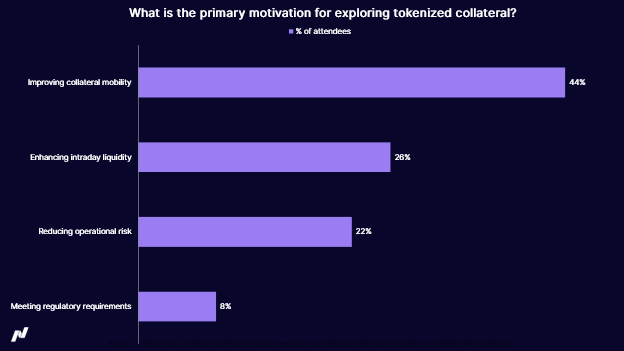
However, roadblocks exist to institutional adoption with standards, risk controls and legal certainty. With that framing, the central question for 2026 is “What will it take to progress from pilots to ecosystem-ready production?” Here are the top five takeaways from the conversation on how the industry can work together to implement, scale and benefit.
Tokenized collateral is gaining urgency because it addresses a core weakness in today’s collateral ecosystem: diminished certainty around data, location, settlement and control, particularly across jurisdictions.
Kelly Mathieson framed the issue through a practitioner’s lens. When certainty breaks down, firms compensate by adding buffers and operational workarounds that inject cost and risk into activities collateral is meant to support. Indeed, the Nasdaq survey found 35% of collateral is posted overnight and firms posted 7% more collateral than needed, on average, just to be safe.

“[Collateral management relies] on the certainty of data, location, settlement and control. And to the extent that data and that certainty are in any way diminished, it’s actually injecting risk into something that you’re trying to reduce the risk of.”
Tokenization is not about digitizing assets for the sake of digitalization. It is about restoring confidence so collateral can support trading, hedging and investing more efficiently through increased certainty of movement and delivery, addressing key gaps in the collateral landscape today.
The discussion then turned to what tokenization changes in practice. The panel emphasized that tokenized collateral does not change what the asset is. It changes how effectively the asset can move.
Excess margin postings and fragmented liquidity are symptoms of siloed and stationary collateral. Collateral is still anchored in static accounts, in slow settlement cycles and fragmented infrastructures.

“Tokenization decouples the asset from its location, enabling substitution, reallocation and reuse across obligations without altering eligibility rules or governance frameworks.”
Sam Edwards emphasized that institutionalization will be supported by an evolution of collateral market infrastructure, not a replacement. Governed, permissioned mobility across OTC margin, repo and clearing—using the same eligibility rules, optimization engines and legal constructs—allows institutions to enhance existing platforms rather than create parallel systems.
Tokenized collateral cannot scale in isolation. Panelists highlighted the need for ecosystems that bring together three essential components:
Without all three, firms risk simply shifting trapped liquidity from securities to cash—or from one venue to another. Cash‑like instruments such as stablecoins, tokenized deposits and tokenized money market funds (TMMFs) were cited as critical to completing the loop.
The message was clear: collateral tokenization is enabled not only when both legs of the transaction are supported, but the ecosystem at-large is ready: buy and sell side to CCPs and CSDs.
Two risks to institutional adoption were surfaced throughout the conversation: over‑engineering and building in isolation.
Arjun Jayaram cautioned that many initiatives begin by tokenizing the asset and then building a platform around it. Instead, he urged firms to start with a workflow problem—such as margining—and apply tokenization within that context.

"If you start by tokenizing the asset instead of solving a real workflow problem, you’re almost guaranteed to stop at a pilot. Production happens when you unify rails and interoperate with the systems you already have.'"
While the industry broadly agrees on the destination—real‑time collateral mobility—fragmentation remains in legal structure, interoperability and operating models. Panelists emphasized that unified risk visibility across traditional, tokenized and digital assets is foundational to moving beyond experimentation.

“Firms need to have one pane of glass where they can understand their risk in real time 24/7.”
Ethan Feldman framed unified risk management as a central requirement to practical tokenization. Institutions need a single, real‑time view across traditional, tokenized and crypto exposures, supported by workflows that allow risk systems to update based on on‑chain movements.
As the webinar closed, panelists returned to what distinguishes initiatives that reach production. Rather than technology‑first experimentation, early movers are taking a disciplined, outcome‑driven approach that aligns infrastructure decisions with operating reality. Early winners from the Nasdaq survey include high‑frequency trading (HFT) firms, repo transactions, North America and cash.
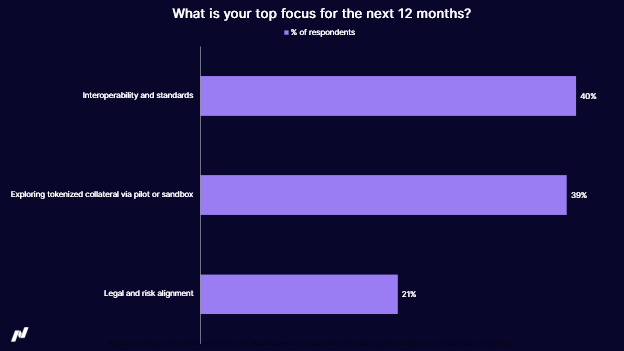
The conversation produced a tangible roadmap to progressing tokenization:
For most institutions, the next phase will be incremental. The focus is on practical deployment—starting with defined use cases, engaging within established ecosystems and modernizing operating assumptions where they constrain mobility and liquidity. Those choices, made deliberately, will determine how tokenized collateral moves from pilot to institutional capability.
We are committed to helping market operators and participants overcome infrastructure, operational and regulatory challenges. Our solutions empower you to focus on your core competencies, driving market growth and progress.

This data feed is not available at this time.
