
These 6%+ Dividends Surged 20%+ This Year. It's Just the Start
One of the best things about high-yielding closed-end funds (CEFs) is that they can post big gains and be strong bargains at the same time.
That's a tougher circle to square with stocks: It's hard to argue, for example, that NVIDIA (NVDA) and Apple (AAPL) are "cheap" now, given the strong runs they've been on.
But a single CEF can (and regularly does) offer both growth and value. In fact, it's something we love to see, because it shows a fund is already rising, thanks to the momentum of its underlying portfolio (referred to as its "net asset value," or NAV, in CEF-speak).
When CEF investors (who are notoriously slow to respond to changes in the market) notice that growth, we can expect the difference between the fund's market price and its per-share NAV to narrow, cutting its discount to NAV--a key valuation figure for CEFs--as it does.
And that's before we talk about the dividends: The average CEF yields 8.6%, according to data from my CEF Insider service.
I brought up Apple and NVIDIA a second ago for a reason, because it's in tech where we're getting our best shot at these "triple play" CEFs--with high dividends, attractive discounts and momentum behind them. Let's analyze two funds from the sector to see this phenomenon at work.
2 "Triple Play" Tech CEFs (With Yields Up to 6.8%)
Those would be the BlackRock Technology and Private Equity Term Trust (BTX), with a 6.8% yield; and the BlackRock Science and Technology Trust (BST), which yields 6.1%.
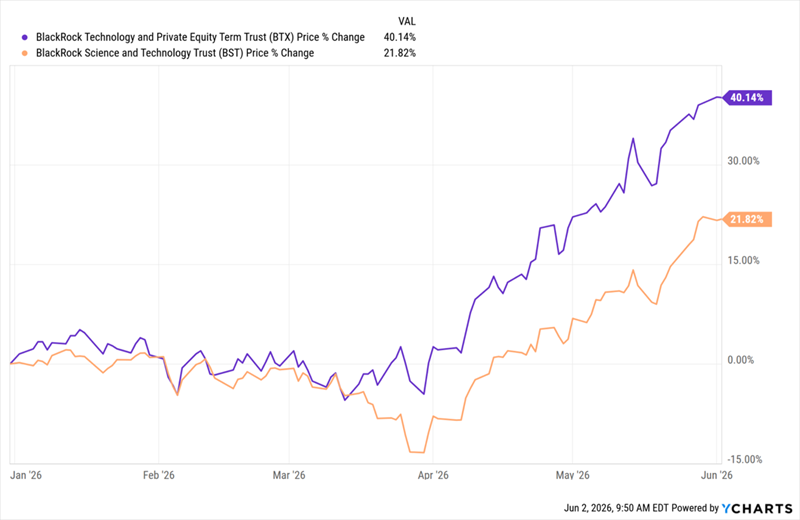
The first thing to note is that both funds yield less than the 8.6% the average CEF pays. But we're okay with that because it's for the best of reasons: They've both posted strong price gains this year, and dividend yields move down as prices rise:
Big Gains Make These 2 Look Like "Low" Yielders
So we've got prices up, yields down. Let's throw in the other element we want to discuss: those discounts to NAV.
Growing Tech CEFs Still Trade at Discounts
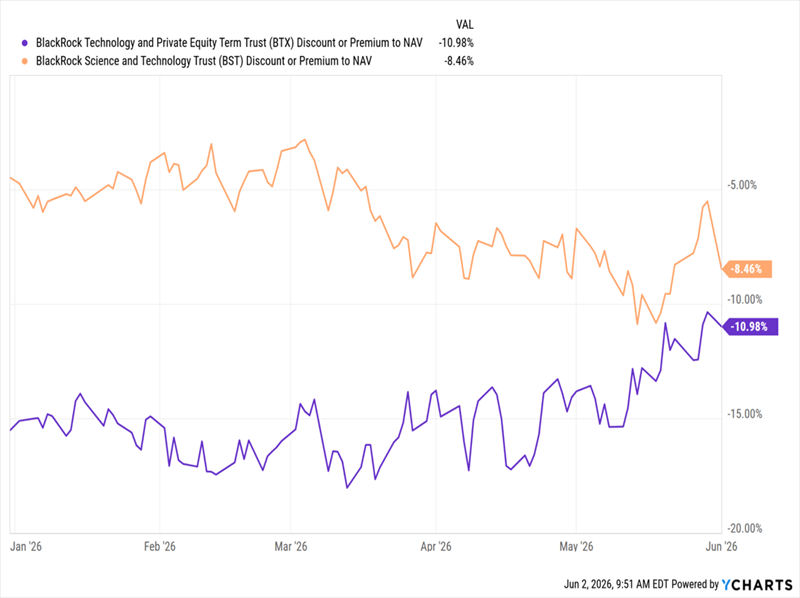
As you can see above, despite their price gains this year, these two funds sport wide discounts. BST's 8.5% markdown (shown in orange above), for example, is well below the 2.8% discount at which it's averaged over the last five years.
BTX's 11% discount (in purple) is slightly narrower than the 12.4% it's averaged in that time, but bear in mind that this fund traded around a 1% discount a year ago, before concerns over the Iran conflict and higher interest rates flared.
This tells us there's plenty of unrealized upside with BTX as rates eventually moderate. That makes both of these CEFs bargains with more upside ahead.
Now let's look at their portfolios, because these are two different tech CEFs that complement each other nicely.
The Portfolios
We'll start with BTX, which, as the name says, holds leading tech firms--NVIDIA is a top holding, along with Fabrinet (FN), a maker of much of the tech behind the AI buildout. But BTX also gives us exposure to pre-IPO companies, including Anthropic, maker of the Claude chatbot.
That is, of course, an aggressive approach, and it's reflected in the fund's roughly 40% price gain so far this year.
BST, meantime, takes a more conservative approach. NVIDIA is still a top holding, but it's accompanied by well-established firms with deep "moats" surrounding their businesses: Broadcom (AVGO) and Apple round out the top three holdings, while Microsoft (MSFT) and Alphabet (GOOGL) are among BST's top-10 positions, as well.
In addition, BST funds its 6.1% dividend using a covered-call strategy. This involves selling call options, or the right to buy its holdings at a fixed price and date in the future. BST then collects fees for those rights, which it uses to fund its dividend.
The downside? This strategy can cap its best stocks' gains as they're sold, which is part of the reason why BST's price gain has lagged that of BTX this year (along with its conservative, large cap-based approach).
That's a nice setup for us to talk a bit more about these funds' payouts--and why I expect them to grow.
The Dividends
One advantage of these funds' reduction in yields (again, due mainly to their prices rising) is that their lower yields are easier for management to cover with portfolio gains. Indeed, both funds' yields are well below the total returns they've delivered on a NAV basis this year:
NAV Gains Far Outstrip Payouts
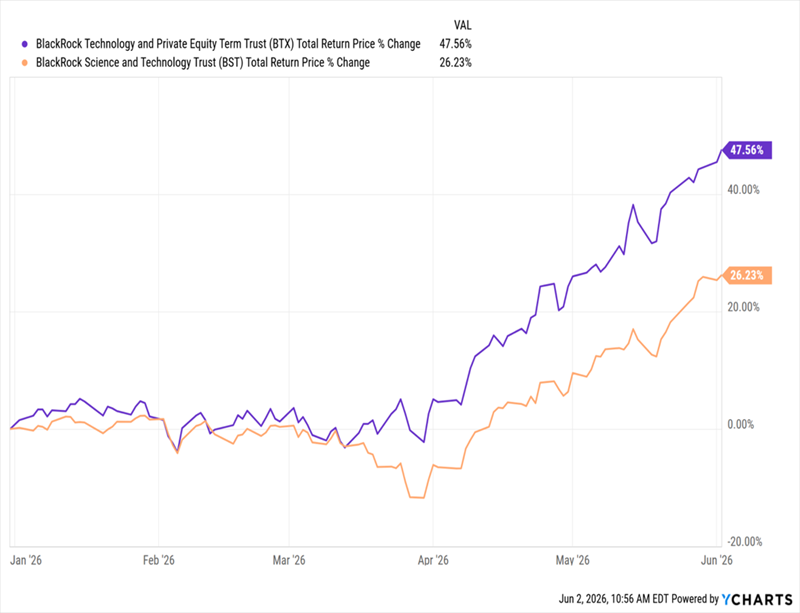
When this happens--falling yields and strong NAV gains--CEFs are likely to raise payouts, which I expect both of these funds to do. BST, for its part, has a history of keeping its payouts steady (partly due to its covered-call strategy).
And BTX did cut its payout last year, but as members of my CEF Insider service know, this was a result of the fund changing its management team and approach, after the previous group had raised the payout too much, too soon. Now that this correction is complete, I expect a return to payout increases, in light of the fund's strong performance.
Taken together, these funds show how CEFs can give us both value and growth in one buy--and high (potentially growing) dividends, to boot.
These 10% Payers Are Primed for AI's NEXT Wave--and They're Cheap (for Now)
These two "value with momentum" plays are great ways to profit from the growth of AI without overpaying. And there are plenty of other ways to do so in our CEF Insider portfolio.
I want to share 4 of them with you now.
These 4 funds yield 10% on average. Best part is, they "micro-target" emerging trends within the AI buildout that regular investors have sleepwalked right past.
These are the kind of shifts that go beyond the tech sector and supercharge businesses across the economy.
When the mainstream crowd finally clues in (and they will), I expect these 4 funds' discounts to snap shut, catapulting their prices higher as they do.
Here's what I mean by "micro-target": One of the 4 CEFs I'm pounding the table on holds the most innovative pharmaceutical companies out there.
As AI spreads through the drug business, it'll slash development times, giving these firms years more of sales on their most profitable drugs before their patents expire.
We're talking billions of dollars in extra revenue here--but this 13% (!) paying pharma fund is still off the radar, trading at a ridiculous 9.7% discount as I write this.
It's the same story at the other 3 funds I'm going to show you now. All of them stand to gain from the coming "pivot points" in the economy as AI unleashes growth in surprising ways.
Click here and I'll tell you more about these 4 "stealth" 10%-paying funds, including how each stands to gain from AI's ongoing growth. You'll also get a free Special Report revealing their names and tickers.
Further BTX Research:
