
Key Points
Every major cryptocurrency is struggling at the moment.
The struggles are highly likely to continue for at least a while longer.
Many of the most popular investment theses for buying cryptoassets are no longer valid.
- 10 stocks we like better than Bitcoin ›
The S&P 500 is up about 24% during the past 12 months. Bitcoin (CRYPTO: BTC) is down 40% in the same period. Meanwhile, the rest of the crypto sector has been a graveyard for capital. Investors who bought a plain index fund in June 2025 made money; holders of "digital gold" did not, and holders of altcoins were quite likely to have lost almost everything.
In the longer view, some original investment theses for buying crypto still hold, while many (most?) others have been bludgeoned into irrelevance by hard evidence, courtesy of the market. So, is there any reason left to buy cryptocurrency in 2026, or is this show over for good?
Will AI create the world's first trillionaire? Our team just released a report on the one little-known company, called an "Indispensable Monopoly" providing the critical technology Nvidia and Intel both need. Continue »

Image source: Getty Images.
When the wheels fell off the car
Crypto's hard times started with the flash crash on Oct. 10, and practically none of the major currencies have recovered since then. Leading coins like XRP (CRYPTO: XRP), Ethereum (CRYPTO: ETH), and Solana (CRYPTO: SOL) have taken an absolute shellacking. Take a look at this chart:
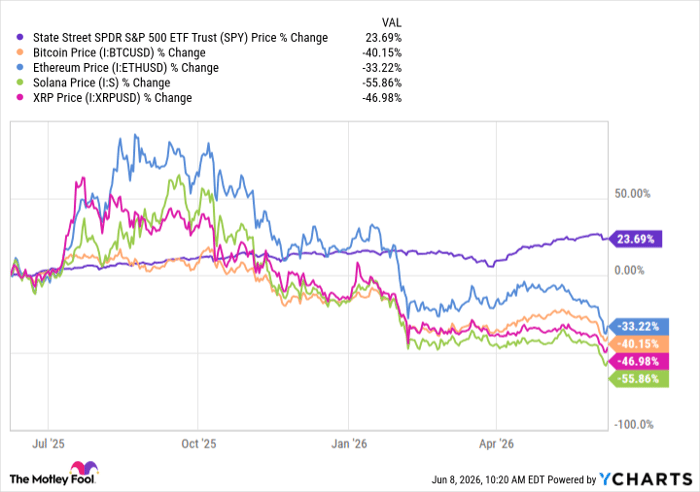
But the outlook for the coming period could be even more pessimistic.
After more than a decade of existing as an industry, the most commercially successful crypto applications by revenue generated are still largely venues for investors to speculate or outright gamble, which is a significant problem when the decision to invest in either crypto or equities increasingly comes down to crypto's promises of higher returns versus equity earnings. As for most of the biggest coins by market cap, there simply hasn't been a strong relationship between their financial metrics and returns for holders due to tokenomics that lack a mechanism for holders to capture any of the value being generated.
On that note, Strategy just made its first stand-alone net Bitcoin sale, thereby retiring the reassuring certainty of the "never sell your Bitcoin" thesis behind its digital asset treasury model. That's one fewer major holder that can be counted on not to dump a coin whose price action ends up influencing everything else in the sector.
The macro picture is also unlikely to be supportive of higher crypto prices. The Federal Reserve, under its new Chair Kevin Warsh, may opt to hold interest rates higher for longer due to April's Consumer Price Index (CPI), which came in with a hot readout of 3.8%. If that happens, it will drain the liquidity that historically fed crypto rallies.
Geopolitics are another headwind. The U.S.-Israel war with Iran, now running past 90 days, has periodically disrupted oil transit through the Strait of Hormuz and kept Middle East risk premiums elevated, conditions that historically pull capital out of risk-on assets like crypto.
The surviving theses are few and far between
Two assets still have a mechanical reason to own them.
Bitcoin's scarcity, the basis for its value, is still intact. Its supply cap is still in force, its halvings will continue, and adoption by many types of actors, including countries and corporations, seems to be continuing apace. The main new vulnerability is the concentration of marginal demand; Strategy alone accounted for 97.5% of net new corporate Bitcoin purchases in January 2026, meaning that almost anything it does will move the market.
Separately, the decentralized financial derivatives exchange Hyperliquid is one of the very few tokens whose circulating supply is mechanically tied to its platform revenue, via a process that routes nearly all trading fees into open-market buybacks. Other than Hyperliquid, Ethereum and Solana have substantial ecosystems that are probably valuable, but neither has a clean, mechanism-driven case to hold over Bitcoin or Hyperliquid.
So for the moment, the takeaway here is that if you participate at all, evaluating cryptocurrency as a long-term holding means maintaining a small allocation of your overall portfolio, likely focusing on one or two defensible assets, and investing using disciplined dollar-cost averaging instead of a lump-sum entry.
There are still a few reasons to buy cryptocurrency in 2026. The list is just a lot shorter than it used to be.
Should you buy stock in Bitcoin right now?
Before you buy stock in Bitcoin, consider this:
The Motley Fool Stock Advisor analyst team just identified what they believe are the 10 best stocks for investors to buy now… and Bitcoin wasn’t one of them. The 10 stocks that made the cut could produce monster returns in the coming years.
Consider when Netflix made this list on December 17, 2004... if you invested $1,000 at the time of our recommendation, you’d have $443,191!* Or when Nvidia made this list on April 15, 2005... if you invested $1,000 at the time of our recommendation, you’d have $1,258,838!*
Now, it’s worth noting Stock Advisor’s total average return is 941% — a market-crushing outperformance compared to 206% for the S&P 500. Don't miss the latest top 10 list, available with Stock Advisor, and join an investing community built by individual investors for individual investors.
*Stock Advisor returns as of June 9, 2026.
Alex Carchidi has positions in Bitcoin, Ethereum, and Solana. The Motley Fool has positions in and recommends Bitcoin, Ethereum, Hyperliquid, Solana, and XRP. The Motley Fool has a disclosure policy.
The views and opinions expressed herein are the views and opinions of the author and do not necessarily reflect those of Nasdaq, Inc.

