What Is TCFD? Understanding the Framework for Climate-Related Financial Disclosures
Climate change is no longer a distant concern. It’s a present-day business risk. As companies face growing pressure from investors, regulators, and customers to disclose how they’re managing climate-related challenges, the need for transparent and consistent reporting has never been greater. That’s where the Task Force on Climate-related Financial Disclosures (TCFD) comes in.
What Is TCFD?
The Task Force on Climate-related Financial Disclosures (TCFD) was established by the Financial Stability Board to improve and increase the reporting of climate-related financial information. As climate change continues to pose significant risks to businesses and economies, the TCFD framework provides a structured approach for organizations to disclose their climate-related risks and opportunities. This transparency helps investors, stakeholders, and regulators make informed decisions.
Key Takeaways
- TCFD reporting is a globally recognized framework for climate-related financial disclosures.
- It consists of four pillars: Governance, Strategy, Risk Management, and Metrics & Targets.
- TCFD helps companies align with ESG reporting requirements and regulatory expectations.
- It supports climate risk assessment and management using tools like climate risk management software.
- TCFD is complementary to other frameworks like CSRD, CDP, and ISSB.
Understanding the TCFD Framework
To effectively manage and disclose climate-related risks, the TCFD framework offers a clear structure built around four foundational pillars. These pillars guide organizations in integrating climate considerations into governance, strategy, risk management, and performance tracking. Understanding each component is essential for building a robust and transparent climate reporting process.
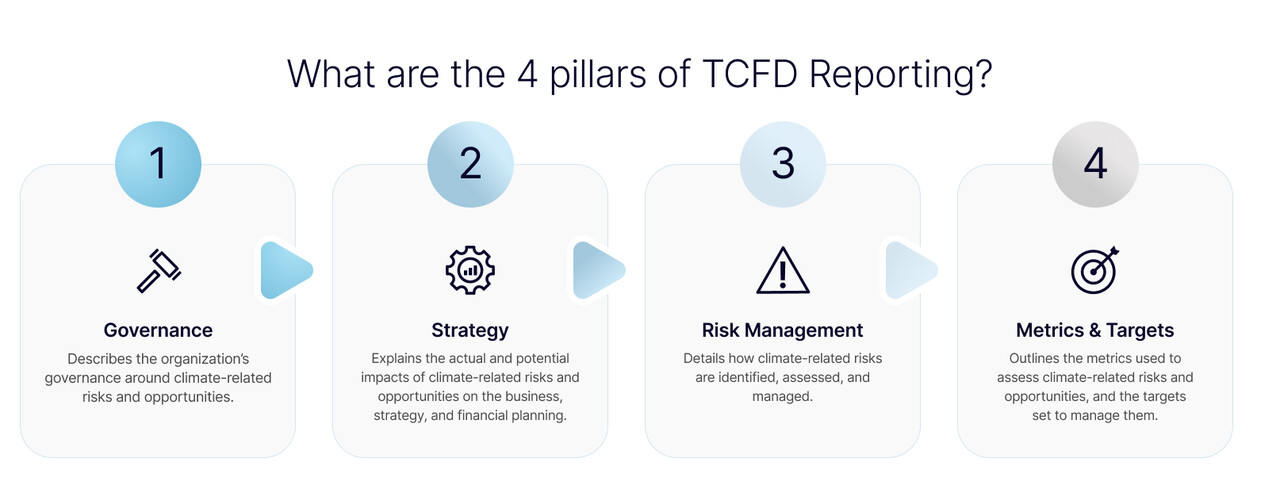
The TCFD framework is built around four key pillars:
- Governance: This pillar focuses on the organization’s governance around climate-related risks and opportunities. It includes the role of the board and management in assessing and managing these risks.
- Strategy: Here, companies disclose the actual and potential impacts of climate-related risks and opportunities on their businesses, strategy, and financial planning. This includes scenario analysis and long-term planning.
- Risk Management: This section outlines how organizations identify, assess, and manage climate-related risks. It integrates climate risk assessment into the overall risk management process.
- Metrics & Targets: Companies report on the metrics used to assess climate-related risks and opportunities, along with targets for managing these risks. This includes greenhouse gas emissions and other sustainability indicators.
Why TCFD Reporting Matters for Climate Risk Management
TCFD reporting is more than a compliance exercise. It’s a strategic tool for managing climate risk. Stakeholders, including investors and customers, increasingly expect transparency in how companies address climate change. Regulatory bodies are also aligning with TCFD principles, making it a cornerstone of ESG reporting requirements.
From a business perspective, TCFD reporting adds value by identifying risks and opportunities that could impact financial performance. It enables companies to proactively manage climate risks using ESG metrics and climate risk management software, integrating sustainability into their core strategy. As regulators increasingly align with global standards, the IFRS-aligned ISSB sustainability disclosure standards are helping unify ESG reporting frameworks and extend the foundational principles of TCFD.
How to Get Started with TCFD Reporting
Getting started with TCFD reporting may seem complex but breaking it down into manageable steps can make the process more approachable. Whether you're building your climate disclosure strategy from scratch or enhancing existing ESG efforts, a structured approach helps ensure alignment with regulatory expectations and stakeholder needs. Below are key steps to guide your implementation, along with common challenges and tools that can support your journey.
- Assess Readiness: Conduct a climate risk assessment to understand current capabilities and gaps.
- Engage Stakeholders: Involve key departments such as finance, sustainability, and risk management.
- Develop Governance Structures: Define roles and responsibilities for climate-related disclosures.
- Integrate with Existing Reporting: Align TCFD with other ESG reporting requirements and frameworks.
- Leverage Tools: Use ESG and sustainability software and other digital tools to streamline data collection and reporting.
Common challenges include data availability, scenario analysis complexity, and aligning internal processes. Fortunately, tools and support are available to help companies overcome these hurdles.

TCFD vs. CSRD and Other ESG Reporting Requirements
While TCFD is widely adopted, it’s not the only framework in the ESG landscape. The Corporate Sustainability Reporting Directive (CSRD) in the EU mandates detailed sustainability disclosures, including climate-related information. Carbon Disclosure Project (CDP) sustainability reporting focuses on environmental data, while the ISSB aims to harmonize global sustainability standards.
Choosing the right framework depends on regulatory requirements, stakeholder expectations, and organizational goals. TCFD is often used in conjunction with Corporate Sustainability Reporting Directive (CSRD) and CDP to provide a comprehensive view of climate-related risks.
Framework | Focus Area | Key Features | Best For |
|---|---|---|---|
| TCFD (Task Force on Climate-related Financial Disclosures) | Climate-related financial risk | Four pillars: Governance, Strategy, Risk Management, Metrics & Targets | Companies seeking to disclose climate risks and align with investor expectations |
| CSRD (Corporate Sustainability Reporting Directive) | Broad ESG reporting (EU-focused) | Mandatory for large EU companies; aligns with EU taxonomy and double materiality | Organizations operating in or doing business with the EU |
| CDP (Carbon Disclosure Project) | Environmental impact and emissions | Questionnaire-based; focuses on carbon, water, and forests | Companies aiming to benchmark environmental performance |
| ISSB (International Sustainability Standards Board) | Global sustainability standards | Seeks to unify ESG reporting frameworks; builds on TCFD | Multinational companies needing global alignment |
To enhance ESG transparency, many organizations also incorporate Global Reporting Initiative (GRI) standards for ESG transparency, which provide detailed guidance on social and governance disclosures that go beyond climate risk.
Real-World Examples of TCFD in Action
Organizations across industries use TCFD reporting to improve climate risk transparency and decision-making. Whether a company is focused on manufacturing, energy, consumer goods, or real estate, the framework offers flexible guidance that can be tailored to different business models and sustainability goals. Below are a few examples of how various types of companies might apply TCFD in practice.
- A manufacturing company might use TCFD to assess climate risks across its supply chain, identifying vulnerabilities in sourcing and logistics due to extreme weather or regulatory shifts.
- A renewable energy provider could integrate TCFD into its strategic planning to evaluate long-term climate scenarios and investment risks.
- A consumer goods company may align TCFD reporting with broader sustainability goals, using it to track emissions and set reduction targets across product lines.
- A real estate firm might apply TCFD to evaluate how climate change could impact property values, insurance costs, and tenant demand.
These examples show how TCFD can be tailored to different business models, helping organizations enhance transparency, meet stakeholder expectations, and build resilience.
ESG Gap Assessment: Identify Your Climate Risk Reporting Gaps
Understanding where your company stands in terms of climate risk reporting is a critical first step toward building a resilient and transparent sustainability strategy. That’s why a free ESG Gap Assessment can be a powerful tool, especially for organizations navigating frameworks like TCFD, CSRD, SEC, and ISSB.
This assessment helps you pinpoint areas where your disclosures may be strong, where they may fall short of regulatory or stakeholder expectations, and where there’s room for improvement. By comparing your current reporting against thousands of global companies, you gain a clearer picture of how your climate strategy stacks up and where it can be strengthened.
With Nasdaq’s ESG Gap Assessment, you’ll receive data-driven insights and peer benchmarking that highlight gaps in governance, strategy, risk management, and metrics. You’ll also get actionable guidance tailored to your industry and reporting maturity, helping you align with evolving ESG requirements and make your climate story a competitive advantage.
Whether you're preparing for boardroom discussions, responding to investor inquiries, or simply trying to stay ahead of regulatory changes, this free assessment offers a fast, effective way to evaluate your readiness and chart a path forward.

TCFD reporting is a vital component of modern corporate sustainability. It empowers organizations to understand and disclose climate-related risks, align with ESG reporting requirements, and build resilience in a changing world. By adopting the TCFD framework, companies can enhance transparency, meet stakeholder expectations, and contribute to a sustainable future.
TCFD Reporting FAQs
What is TCFD reporting?
TCFD reporting refers to the disclosure of climate-related financial information using the framework developed by the Task Force on Climate-related Financial Disclosures (TCFD). It helps organizations communicate how climate risks and opportunities may impact their financial performance, strategy, and operations—enabling investors and stakeholders to make better-informed decisions.
What are the 4 pillars of TCFD?
The TCFD framework is structured around four key pillars: 1. Governance – Describes the organization’s governance around climate-related risks and opportunities. 2. Strategy – Explains the actual and potential impacts of climate-related risks and opportunities on the business, strategy, and financial planning. 3. Risk Management – Details how climate-related risks are identified, assessed, and managed. 4. Metrics & Targets – Outlines the metrics used to assess climate-related risks and opportunities, and the targets set to manage them.
Where is TCFD reporting required?
TCFD reporting is required or strongly encouraged in several jurisdictions, including the United Kingdom, European Union (via CSRD), Canada, Japan, and by various financial regulators globally. Many stock exchanges and institutional investors also expect companies to align with TCFD principles, making it a de facto standard in climate-related disclosure.
Is TCFD still required?
Yes, TCFD remains highly relevant and is increasingly embedded into regulatory frameworks. While not universally mandatory, its principles are being adopted into laws and standards such as the EU’s CSRD and the ISSB’s global sustainability disclosure standards. As climate risk becomes a central concern for financial markets, TCFD continues to serve as a foundational framework for transparent and consistent reporting.