
Stocks Tumble on New U.S.-China Tariffs, Weak Manufacturing Data
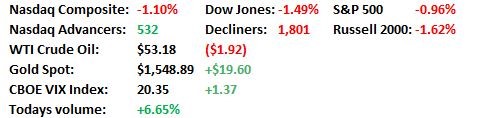
Market Movers
- U.S. China Trade continues to affect stocks as US and Chinese tariffs took effect Sept. 1.
- ISM manufacturing reported at 49.1 for August, the first sub-50 reading in three years.
- Chinese economic growth now forecast below 6% growth in 2020.
Mike’s Commentary
Back to school. September always feels like back to school even though I've been out of school for longer than I care to share. On Wall Street, the last two weeks of August are generally for taking a vacation if you’re lucky, or if not, dressing down at work while catching up on emails. Once the calendar turns to September it is time to sharpen your pencils, kickstart new projects and think about the push to year-end. September is also the worst month historically for the Dow, S&P and NASDAQ indexes.
It sure feels that way today as September also marks the implementation of about $110 billion of tariffs on Chinese imports and retaliatory tariffs on $75 billion of U.S. goods. And since the U.S. and China can't even agree on a time to meet, this could go on a while. One reason for August's volatility has been fear of what the trade war means for the global economy. Economists are now expecting growth to drop below 6% in China in 2020. The question of where global growth will come from is legitimate given Europe's problems.
Europe is weak enough that bond yields there are basically negative, pulling U.S. yields lower and sending warning signals to stocks. S&P 500 earnings expectations for Q3 (now -3.1%) and Q4 (only +3.9% from double that rate a few months ago) are not going to bail us out. And the widely watched U.S. ISM Manufacturing Index fell to 49.1, below all forecasts and the 51.3 consensus. A reading below 50 indicates contraction in the manufacturing economy. This is the first contraction in three years, continuing a trend of lower readings since May 2016. And not to pile on, the new orders reading hit a seven-year low.
So with that happy backdrop stocks are lower by over 300 points as we write. Recall that last week stocks gained about 775 points, which sounds great until you remember it was the first week in five that stocks saw gains and the cumulative losses for the prior four weeks totaled over 1,500 Dow points. Only Real Estate, Utilities and Staples are higher today in the classic flight to safety/yield. One sure sign of how wacky things are is that investors are buying negative yielding bonds for capital gains and buying stocks for income. Back to school indeed.
Economic Calendar
| DATE | EVENT |
|---|---|
| Tuesday | Manufacturing PMI |
| Tuesday | ISM Manufacturing Index |
| Tuesday | Construction Spending |
| Wednesday | MBA Mortgage Purchase Applications |
| Wednesday | Redbook Chain Store |
| Wednesday | API Crude Inventories |
| Thursday | ADP Employment Report |
| Thursday | Initial Jobless Claims |
| Thursday | Continuing Claims |
| Thursday | Factory Orders |
| Thursday | ISM Non-Manufacturing Index |
| Thursday | EIA Natural Gas Inventories |
| Thursday | DOE Crude Inventories |
| Friday | Average Hourly Earnings |
| Friday | Average Weekly Hours |
| Friday | Nonfarm Payrolls |
| Friday | Unemployment Rate |
Sector Recap

Brian’s Technical Take
There was certainly no shortage of geopolitical, economic, and market concerns throughout August, however in somewhat impressive fashion the SPX closed out the month just 3% from its all-time highs. The U.S. Dollar Index (DXY) finished on a strong note gaining 1.3% in the final week of August and to the dismay of President Trump is surging to new multi-year highs to start September.
The strong dollar is not only a headwind to the exports of large U.S. corporations, but also to issuers of dollar denominated debt, the Federal Reserve which is fighting declining inflation pressures, and commodity prices.
The Bloomberg Commodity index (BCOM) has been down in five of the last six months and is flat YTD following last year’s 13% decline. The BCOM Index remains 68% below its 2008 highs, and today is within 3% of its secular lows made in February 1999, which it more recently tested at the lows of Q1’16. Meanwhile UST 10YR break-evens reached a three year low today at 1.5%.
Falling commodity prices and market measures of inflation should weigh heavily on the committees of the Federal Reserve and the European Central banks. The next FOMC is in two weeks on 9/18 while the ECB meets next Thursday on 9/12. ECB officials are leaning towards a stimulus package not just including cutting rates deeper into negative territory, but also a potential restarting of asset purchases. Some within Europe’s northern block, namely the heads of the German and Dutch central banks, argue there is no reason to resume QE. The Fed disappointed markets at the prior FOMC at the end of July when they characterized the 25bps rate cut as a “mid-cycle adjustment.” Markets are currently pricing in a 100% probability for a 25bps cut in two weeks. As we saw last FOMC, words speak louder than actions.

Nasdaq's Market Intelligence Desk (MID) Team includes:
Charles Brown is Associate Vice President on The Market Intelligence Desk with over 20 years of equity capital markets experience. Charlie has extensive knowledge of equity trading on both floor and screen-based marketplaces. Charlie assists with the management of The Market Intelligence Desk and works with Nasdaq listed companies providing them with insightful objective trading analysis.
Steven Brown is a Managing Director on the Market Intelligence Desk (MID) at Nasdaq with over twenty years of experience in equities. With a focus on client retention he currently covers the Financial, Energy and Media sectors.
Christopher Dearborn is a Managing Director on the Market Intelligence Desk (MID) at Nasdaq. Chris has over two decades of equity market experience including floor and screen-based trading, corporate access, IPOs and asset allocation. Chris is responsible for providing timely, accurate and objective market and trading-related information to Nasdaq-listed companies.
Brian Joyce, CMT is a Managing Director on the Market Intelligence Desk (MID) at Nasdaq. Before joining Nasdaq, Brian spent 16 years as an institutional trader executing equity and options orders for both the buy side and sell side. He also provided trading ideas and wrote technical analysis commentary for an institutional research offering. Brian focuses on helping Nasdaq’s Financial, Healthcare and Transportation companies, among others, understand the trading in their stock. Brian is a Chartered Market Technician (CMT).
Michael Sokoll, CFA is Associate Vice President on the Market Intelligence Desk (MID) at Nasdaq with over 25 years of equity market experience. In this role, he manages a team of professionals responsible for providing NASDAQ-listed companies with real-time trading analysis and objective market information.
The views and opinions expressed herein are the views and opinions of the author and do not necessarily reflect those of Nasdaq, Inc.

MarketInsite
Nasdaq
Nasdaq’s Marketinsite offers actionable insights on a variety of market-moving topics. Learn from our thought leaders who are driving the capital markets of tomorrow.
Read MarketInsite's Bio
The Market Intelligence Desk Team
Nasdaq
Nasdaq’s Market Intelligence Desk (MID) is designed to provide critical touch-points for timely trading analysis and market information.