
Key Points
Eli Lilly now controls roughly 60% of the GLP-1 market.
International growth could become Lilly's next major catalyst.
The GLP-1 franchise could reach $70 billion annually.
- 10 stocks we like better than Eli Lilly ›
Eli Lilly (NYSE: LLY) doesn't need a perfect year to reach $1,200 in 2026. It does, however, need to maintain its continued dominance in the rapidly growing market for obesity and diabetes drugs -- and that's exactly how things are playing out. Let's see why investors should remain upbeat on Eli Lilly.
Extraordinary growth continues
Lilly's GLP-1 franchise, led by Mounjaro and Zepbound, continues to generate extraordinary growth. During the first quarter of 2026, Lilly reported nearly $13 billion in combined quarterly revenue from the two drugs. That's not trivial, especially when you consider that the bull case for Lilly increasingly revolves around the future size of the obesity market.
Will AI create the world's first trillionaire? Our team just released a report on the one little-known company, called an "Indispensable Monopoly" providing the critical technology Nvidia and Intel both need. Continue »
Recent prescription data suggest that Lilly now controls roughly 60% of the U.S. GLP-1 market,a remarkable achievement considering Novo Nordisk's early lead with Ozempic and Wegovy.
The next phase of growth may come from outside the U.S.
While the market has long been focused primarily on domestic prescription trends, international markets could ultimately become just as important. Obesity rates continue rising globally, and many countries are only beginning to expand access to GLP-1 therapies.
Mounjaro has already launched across much of Europe, the Middle East, Asia, and Latin America. International sales of Lilly's incretin medicines (drugs that help patients lose weight and control blood sugar) have been growing significantly faster than the broader pharmaceutical market, too. In Q1 2026, revenue outside the U.S. increased 81% year over year to $7.7 billion.
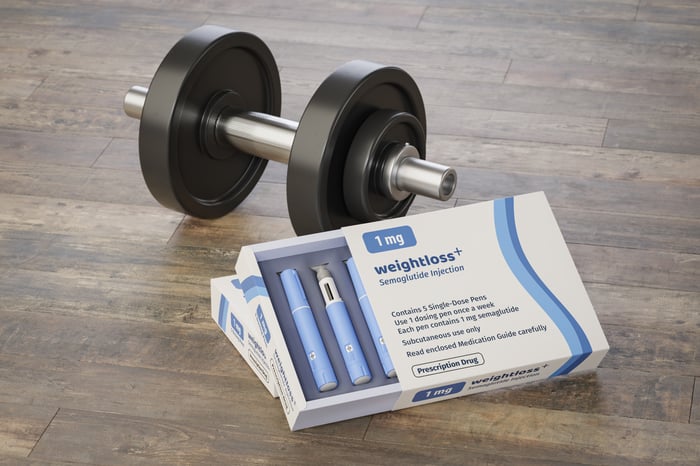
Image source: Getty Images.
Europe, for instance, remains one of the biggest opportunities. Germany could soon become one of Lilly's fastest-growing obesity markets, and France recently became the first major E.U. country to approve reimbursement for obesity treatments. Meanwhile, demand continues growing in China, Japan, and several Middle Eastern countries, where obesity and diabetes rates remain elevated.
Still, to justify a $1,200 share price, Lilly likely needs Mounjaro and Zepbound to deliver massive revenue outside the U.S. We're talking roughly $60 billion to $70 billion a year.
Consider the math
If Lilly can continue taking market share, expand internationally, and maintain strong pricing power, reaching $60 billion to $70 billion in annual revenue over the next year isn't an unrealistic target.
Consider the math. Mounjaro and Zepbound produced nearly $13 billion in first-quarter revenue, which already implies an annualized run rate exceeding $50 billion. Lilly doesn't need revenue to double from here. It just needs continued prescription growth, additional manufacturing capacity, and broader international adoption.
If combined quarterly revenue rises to roughly $16 billion to $17.5 billion by late 2026, the franchise would be operating at an annualized revenue run rate of approximately $64 billion to $70 billion. Given Lilly's current market share gains and expanding global footprint, that scenario is far from unrealistic. That could help justify a higher valuation.
Of course, risks remain. Competition from Novo Nordisk isn't disappearing, and new oral obesity therapies from competitors such as Viking Therapeutics and Pfizer are under development.
Still, Lilly remains one of the dominant players in the fastest-growing segment of the pharmaceutical industry. Between rising GLP-1 market share, expanding international access, and a revenue franchise that could eventually exceed $60 billion annually, the path to a $1,200 share price in 2026 is not hard to see.
Should you buy stock in Eli Lilly right now?
Before you buy stock in Eli Lilly, consider this:
The Motley Fool Stock Advisor analyst team just identified what they believe are the 10 best stocks for investors to buy now… and Eli Lilly wasn’t one of them. The 10 stocks that made the cut could produce monster returns in the coming years.
Consider when Netflix made this list on December 17, 2004... if you invested $1,000 at the time of our recommendation, you’d have $443,191!* Or when Nvidia made this list on April 15, 2005... if you invested $1,000 at the time of our recommendation, you’d have $1,258,838!*
Now, it’s worth noting Stock Advisor’s total average return is 941% — a market-crushing outperformance compared to 211% for the S&P 500. Don't miss the latest top 10 list, available with Stock Advisor, and join an investing community built by individual investors for individual investors.
*Stock Advisor returns as of June 6, 2026.
Jeff Siegel has no position in any of the stocks mentioned. The Motley Fool has positions in and recommends Eli Lilly and Pfizer. The Motley Fool recommends Novo Nordisk and Viking Therapeutics. The Motley Fool has a disclosure policy.
The views and opinions expressed herein are the views and opinions of the author and do not necessarily reflect those of Nasdaq, Inc.

