
NASA Has Big Plans for the Moon. Here Are Some of Them.
Key Points
NASA plans to build a Moon Base in three phases stretching through 2032 and beyond.
Phase 1 alone begins with multiple large contracts and was supposed to begin this year.
The disaster that struck Blue Origin late last month throws this timeline into question.
- These 10 stocks could mint the next wave of millionaires ›
Leave it to the U.S. government to take a concept like "as easy as one, two, three" -- and make it confusing.
Last week, NASA held a press conference to lay out to the public its plans for establishing a Moon Base that will one day see astronauts residing more or less permanently on Earth's biggest satellite. Running just over an hour, the conference kicked off with NASA Administrator Jared Isaacman outlining three stages, starting now and continuing through 2032 and "beyond," during which NASA will build a Moon Base encompassing hundreds of square miles of lunar surface.
Will AI create the world's first trillionaire? Our team just released a report on the one little-known company, called an "Indispensable Monopoly" providing the critical technology Nvidia and Intel both need. Continue »
That same day, NASA announced precisely three new Moon Base contracts, dubbed Moon Base I, II, and III, hiring private space companies to send lunar landers to the moon. But Isaacman's Moon Base Phases 01, 02, and 03 are not the same thing as the Moon Base I, Moon Base II, and Moon Base III contracts.
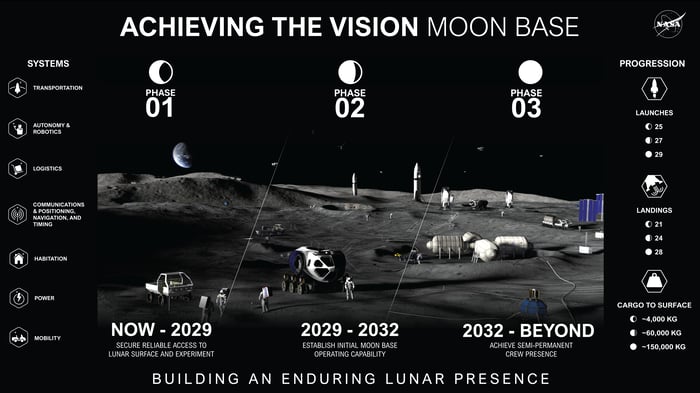
Image source: NASA / Edmy S. Cruz Reyes.
Three phases of the Moon Base
Let's cover the big picture first -- the phases for building the Moon Base:
Phase 01, running from now through 2029, lays the foundation for subsequent phases and focuses on ensuring "reliable access" to the lunar surface through developing and testing lunar landers and the rockets that will take them to the moon. Autonomous vehicles (space drones and lunar rovers) will be tested on the surface, and communications and observation satellites will be put into orbit. Landings will focus on the lunar South Pole region, specifically on the Shackleton Connecting Ridge, and will be conducted under Commercial Lunar Payload Services (CLPS) contracts.
Phase 01 accomplished, NASA will shift into Phase 02, which will see the Moon Base reach "initial operating capability" to host astronauts on the lunar surface for short periods by 2032. Semi-permanent habitations will be built, nuclear and solar power established, and pressurized rovers deployed. NASA intends to set up a surface communications system as well, similar to cellphone tower networks on Earth.
This accomplished, from 2032 and beyond, NASA will establish a "semi-permanent" presence on the moon during Phase 03. Astronauts will arrive and work on the surface, probably for months at a time -- similar to how the International Space Station is crewed currently.
Unlike on the space station, which floats alone in a vacuum, the Moon Base in Phase 03 will have access to in situ resources on the moon. Phase 03 will see these resources exploited to build infrastructure (housing, solar panels, factories, and so on) as NASA begins mining the moon. Depending on what NASA finds to extract, the space agency plans to set up a system for sending products back to Earth, establishing the solar system's first interplanetary trade.
Three (or four) missions to get it all started
But let's not get ahead of ourselves. Flipping back to Phase 01, NASA has outlined three specific missions it wants to get the ball rolling:
Moon Base 1 will be the first such mission, blasting off no earlier than fall of 2026*. Blue Origin will send its robotic Mk 1 Endurance lander to deliver multiple payloads to Shackleton Connecting Ridge, paving the way for a later crewed landing of Blue's Mk 2 lander in 2028. Blue Origin will later launch a second Mk 1 lander carrying a Volatiles Investigating Polar Exploration Rover (VIPER) in late 2027* to search for water ice on the moon.
The second mission, Moon Base 2, aims for an end-of-2026 launch atop a SpaceX Falcon Heavy rocket. The largest commercial payload ever sent to the moon, Moon Base 2 will deliver an Astrobotic Griffin-1 Endeavor lander with more than 500 kilograms of cargo -- including a Flip Lunar Terrain Vehicle from Astrolab.
Moon Base 3, also scheduled for an end-of-2026 launch, will use a smaller SpaceX Falcon 9 rocket to send Intuitive Machines' (NASDAQ: LUNR) IM-3 lander to the moon. IM-3 will carry payloads from the European Space Agency and Korea Astronomy and Space Science Institute (KASI), as well as a Lunar Vertex payload under the Payloads and Research Investigations on the Surface of the Moon (PRISM) project. This latter payload will investigate "magnetic anomalies" on the moon.
Finally, NASA includes a MoonFall mission from Firefly Aerospace (NASDAQ: FLY) in Phase 01, scheduled to take place in 2027. Here, a Firefly Elytra spacecraft will deploy four Jet Propulsion Laboratory MoonFall hopping drones above the lunar surface. These drones will land on and then hop around the moon, mapping the surface and scouting out "locations that are difficult or impossible for traditional rovers to access."
Tallying it all up
In total, NASA plans to conduct 25 launches and 21 landings (it's unclear, for example, whether Elytra will actually land or simply orbit) on the moon. By the time 2029 wraps up, we should have two separate Lunar Terrain Vehicles on the moon, one ground drone, four hoppers, and a VIPER rover -- 4 tons of cargo in all, spread across a Moon Base hundreds of square miles in area.
*The best laid plans of mice and NASA
Two days after NASA held its Moon Base press conference, its plans were shaken to the core by a massive explosion that destroyed a Blue Origin New Glenn rocket -- the very rocket Blue Origin intends to use for two of its launches in Phase 01 -- and heavily damaged the company's only launch pad. Blue Origin insists it will be able to repair the damage and resume flying New Glenn rockets before the end of 2026, but even if that's possible, it will delay NASA's Moon Base 1 mission by at least three months -- and probably more.
What this does to the rest of the schedule for the various launches, as well as the long-term planned phases, remains to be seen. NASA plans to award $20 billion worth of Moon Base contracts across the three phases. Investors, however, must now anticipate that the revenue flowing from these contracts could be delayed by months, if not years.
Caveat investor: Space is hard.
Where to invest $1,000 right now
When our analyst team has a stock tip, it can pay to listen. After all, Stock Advisor’s total average return is 941%* — a market-crushing outperformance compared to 206% for the S&P 500.
They just revealed what they believe are the 10 best stocks for investors to buy right now, available when you join Stock Advisor.
*Stock Advisor returns as of June 8, 2026.
Rich Smith has positions in Intuitive Machines. The Motley Fool has positions in and recommends Intuitive Machines. The Motley Fool has a disclosure policy.
