
Key Points
Micron's profits are soaring because of a bottleneck in memory chip supply.
The company may generate record profits next year, but it has a history of significant cyclicality.
Multiple factors keep it away from the echelon of the "Magnificent Seven" stocks.
- 10 stocks we like better than Micron Technology ›
When Apple reached a $1 trillion market cap, it was a momentous occasion. Almost 10 years later, it seems a new stock is reaching a $1 trillion valuation every week amid the artificial intelligence (AI) bull market. The latest is Micron Technology (NASDAQ: MU), a memory chip maker benefiting from increased on-device and cloud storage needs for AI software.
The question remains whether Micron has permanently elevated itself into the ranks of the "Magnificent Seven" stocks like Nvidia, or whether Micron is enjoying a temporary boost to the memory chip market before it falls back to Earth.
Will AI create the world's first trillionaire? Our team just released a report on the one little-known company, called an "Indispensable Monopoly" providing the critical technology Nvidia and Intel both need. Continue »
Soaring profits due to insatiable demand
Nvidia has soared to become the largest company by market cap thanks to its innovation in AI chips. Training and running AI models like your ChatGPT chatbot require robust processing capabilities compared to legacy software programs, which is why Nvidia now generates $82 billion in quarterly revenue.
Now, it is increasingly the job of memory chips to help operate these AI software programs. Whether on your computing device (like an iPhone) or in the cloud, demand for storage is growing like an invasive species, creating a bottleneck for AI use worldwide. More memory chips will be needed to match supply and demand.
This may be a problem for the AI software providers, but it is a gold mine for Micron at the moment. A shortage of memory chip production has led to soaring prices, which in turn have boosted Micron's revenue and earnings. Revenue last quarter grew to $24 billion, up from $8 billion a year ago, and operating income was $16 billion. This quarter, management is guiding for $33.5 billion in revenue.
With analysts believing the shortage of memory chips won't end for years -- especially if both Anthropic and OpenAI raise tens of billions in capital for their initial public offerings (IPOs) -- estimates call for Micron to post $100 billion in net income in both 2027 and 2028.
Compared to these levels of net income, a market capitalization of $1 trillion does not look unreasonable for Micron.
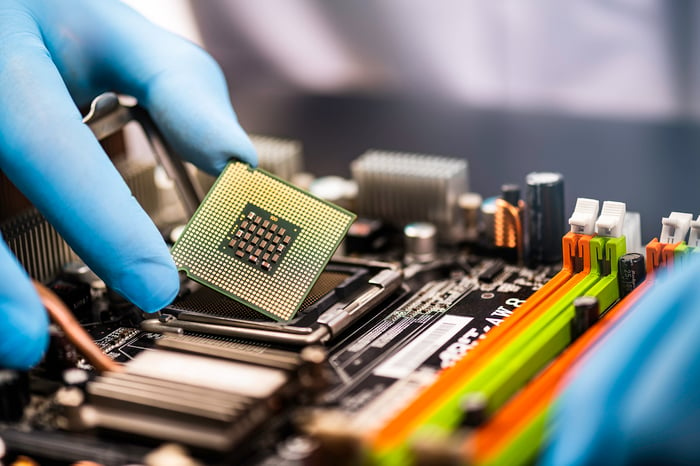
Image source: Getty Images.
Revenue and earnings volatility
The big question is whether these earnings are durable. Some AI bulls claim that because of this new paradigm, memory chip demand will grow in perpetuity. You can understand the logic of this argument if AI is going to take over digital consumption worldwide, as it will need a gargantuan number of memory chips to operate smoothly.
Where the argument does not hold up is the historical cyclicality of the memory chip and semiconductor sector in general. Micron and the rest of the industry have experienced historical volatility in revenue due to undersupply or oversupply of memory chips. The bears would argue that, while AI is driving demand, this is just an overpriced memory chip cycle that will eventually turn the other way on investors.
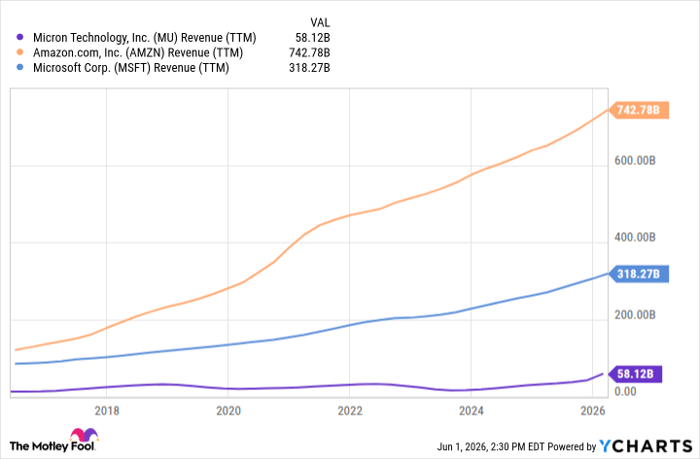
MU Revenue (TTM) data by YCharts
Why Micron is not a Magnificent Seven stock
Micron may generate the same level of net income as a Magnificent Seven stock like Amazon in 2027 and 2028 (Amazon's net income was $91 billion over the last 12 months). This does not put the business on the same competitive plane as the technology giants.
Outside of typical cycle worries, Micron could be seen as a commodity provider of computing storage alongside the rest of the memory chip industry. Large technology players like Amazon have diverse business models and competitive advantages that keep upstarts from accessing their profit pools. This is part of the reason why these stocks are valued so highly. Even fellow chipmaker Nvidia has a software development edge and product ecosystem that keeps customers from switching.
Micron does not have any of these competitive advantages, which is why I would not classify it as a Magnificent Seven stock even if it temporarily has a market value of $1 trillion and $100 billion in net income.
Should you buy stock in Micron Technology right now?
Before you buy stock in Micron Technology, consider this:
The Motley Fool Stock Advisor analyst team just identified what they believe are the 10 best stocks for investors to buy now… and Micron Technology wasn’t one of them. The 10 stocks that made the cut could produce monster returns in the coming years.
Consider when Netflix made this list on December 17, 2004... if you invested $1,000 at the time of our recommendation, you’d have $439,632!* Or when Nvidia made this list on April 15, 2005... if you invested $1,000 at the time of our recommendation, you’d have $1,316,532!*
Now, it’s worth noting Stock Advisor’s total average return is 960% — a market-crushing outperformance compared to 211% for the S&P 500. Don't miss the latest top 10 list, available with Stock Advisor, and join an investing community built by individual investors for individual investors.
*Stock Advisor returns as of June 4, 2026.
Brett Schafer has no position in any of the stocks mentioned. The Motley Fool has positions in and recommends Amazon, Apple, Micron Technology, Microsoft, and Nvidia. The Motley Fool has a disclosure policy.
The views and opinions expressed herein are the views and opinions of the author and do not necessarily reflect those of Nasdaq, Inc.

