
Warren Buffett famously said, 'Volatility is far from synonymous with risk.' It's only natural to consider a company's balance sheet when you examine how risky it is, since debt is often involved when a business collapses. We note that TELA Bio, Inc. (NASDAQ:TELA) does have debt on its balance sheet. But should shareholders be worried about its use of debt?
When Is Debt A Problem?
Debt and other liabilities become risky for a business when it cannot easily fulfill those obligations, either with free cash flow or by raising capital at an attractive price. If things get really bad, the lenders can take control of the business. However, a more common (but still painful) scenario is that it has to raise new equity capital at a low price, thus permanently diluting shareholders. Of course, plenty of companies use debt to fund growth, without any negative consequences. The first thing to do when considering how much debt a business uses is to look at its cash and debt together.
What Is TELA Bio's Net Debt?
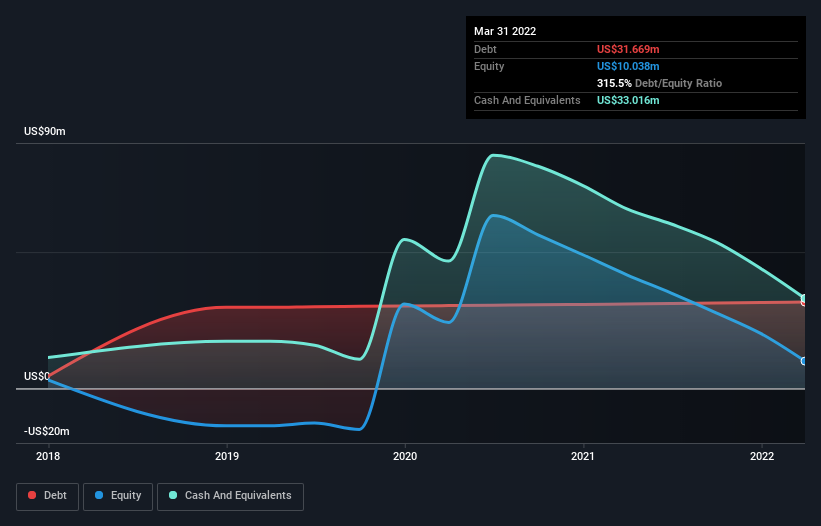
As you can see below, TELA Bio had US$31.7m of debt, at March 2022, which is about the same as the year before. You can click the chart for greater detail. However, its balance sheet shows it holds US$33.0m in cash, so it actually has US$1.35m net cash.
How Strong Is TELA Bio's Balance Sheet?
We can see from the most recent balance sheet that TELA Bio had liabilities of US$12.3m falling due within a year, and liabilities of US$33.0m due beyond that. Offsetting these obligations, it had cash of US$33.0m as well as receivables valued at US$4.31m due within 12 months. So its liabilities outweigh the sum of its cash and (near-term) receivables by US$7.99m.
Given TELA Bio has a market capitalization of US$131.2m, it's hard to believe these liabilities pose much threat. Having said that, it's clear that we should continue to monitor its balance sheet, lest it change for the worse. While it does have liabilities worth noting, TELA Bio also has more cash than debt, so we're pretty confident it can manage its debt safely. The balance sheet is clearly the area to focus on when you are analysing debt. But it is future earnings, more than anything, that will determine TELA Bio's ability to maintain a healthy balance sheet going forward. So if you're focused on the future you can check out this free report showing analyst profit forecasts.
Over 12 months, TELA Bio reported revenue of US$32m, which is a gain of 56%, although it did not report any earnings before interest and tax. With any luck the company will be able to grow its way to profitability.
So How Risky Is TELA Bio?
We have no doubt that loss making companies are, in general, riskier than profitable ones. And the fact is that over the last twelve months TELA Bio lost money at the earnings before interest and tax (EBIT) line. And over the same period it saw negative free cash outflow of US$33m and booked a US$36m accounting loss. But at least it has US$1.35m on the balance sheet to spend on growth, near-term. With very solid revenue growth in the last year, TELA Bio may be on a path to profitability. Pre-profit companies are often risky, but they can also offer great rewards. There's no doubt that we learn most about debt from the balance sheet. However, not all investment risk resides within the balance sheet - far from it. We've identified 2 warning signs with TELA Bio (at least 1 which is potentially serious) , and understanding them should be part of your investment process.
Of course, if you're the type of investor who prefers buying stocks without the burden of debt, then don't hesitate to discover our exclusive list of net cash growth stocks, today.
Have feedback on this article? Concerned about the content? Get in touch with us directly. Alternatively, email editorial-team (at) simplywallst.com.
This article by Simply Wall St is general in nature. We provide commentary based on historical data and analyst forecasts only using an unbiased methodology and our articles are not intended to be financial advice. It does not constitute a recommendation to buy or sell any stock, and does not take account of your objectives, or your financial situation. We aim to bring you long-term focused analysis driven by fundamental data. Note that our analysis may not factor in the latest price-sensitive company announcements or qualitative material. Simply Wall St has no position in any stocks mentioned.
The views and opinions expressed herein are the views and opinions of the author and do not necessarily reflect those of Nasdaq, Inc.

