Stock surveillance is the ongoing monitoring of share ownership and trading activity to understand how a company’s shareholder base is evolving. Core components typically include ownership tracking, trading pattern analysis, real-time monitoring, and multi-venue data aggregation.

Understanding Stock Surveillance: Purpose, Benefits, and Best Practices
Key Takeaways
- Stock surveillance may track share ownership and position changes, potentially enabling IR teams to identify activist accumulation before public campaigns emerge
- Surveillance platforms are designed to monitor trading activity across exchanges and alternative venues to flag unusual volume and ownership shifts
- According to Lazard's Shareholder Advisory Annual Review 2024, activist campaigns in the Russell 3000 have gained sizable impact since 2018, making early detection a strategic priority
- Machine learning models may improve predictive accuracy, with some research suggesting performance improvements of up to 91% in certain applications
- Investor relations technology is increasingly delivering real-time shareholder intelligence via AI-powered platforms, rather than static, quarterly reports
Investor relations (IR) teams cannot build effective shareholder strategies without understanding who owns their stock and how positions are changing. Stock surveillance is the ongoing process of monitoring share ownership and trading activity to help identify potential activist accumulation before campaigns become public.
According to Lazard’s Shareholder Advisory Annual Review 2024, there were 243 activist campaigns globally in 2024, the highest level since 2018. Over the past two years,20% of activist targets experienced CEO turnover within a year, underscoring the potential impact of activism when companies miss early warning signs. Stock surveillance systems aim to surface those signals earlier, giving IR teams more time to engage proactively.
What Is Stock Surveillance?
Stock surveillance is the continuous monitoring of who owns a company’s shares and how ownership changes over time. IR teams typically rely on specialized investor relations technology platforms that analyze trading data across public exchanges and alternative venues to provide an ongoing view of shareholder behavior.
Unlike regulatory market surveillance which focuses on fraud detection and rule enforcement stock surveillance for IR is centered on shareholder intelligence: understanding who is building or reducing positions and interpreting what those patterns may signal.
Purpose and Functionality of Stock Surveillance
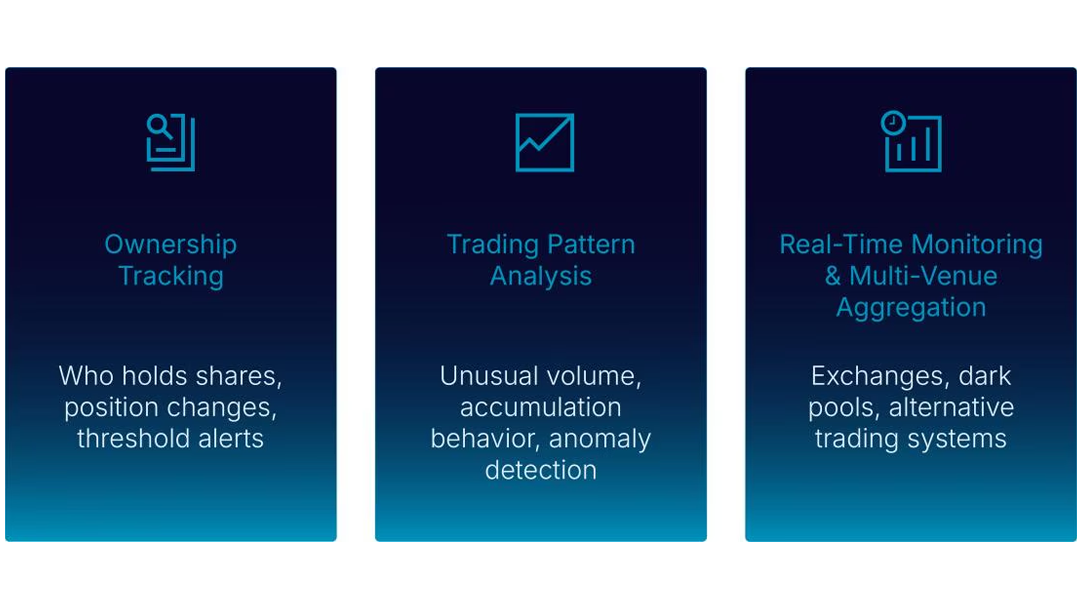
Rather than learning about ownership changes through quarterly filings or after a Schedule 13D is filed, stock surveillance may help IR teams detect patterns as they develop. Most platforms are designed to support three core functions:
Image
Ownership Tracking
Ownership tracking identifies who holds shares, monitors position changes, and flags when investors approach key thresholds. This data may help IR teams prioritize outreach and understand shifts in shareholder composition for example, whether long-term funds are exiting or new institutions are accumulating.
Trading Pattern Analysis
Trading pattern analysis monitors unusual volume, price movements, or accumulation behavior that may indicate information leakage, market stress, or activist interest. While anomalies require careful contextual review, early detection may help teams prepare responses before issues escalate.
Real-Time Monitoring and Multi-Venue Aggregation
Modern markets are highly fragmented. According to FINRA’s Equity Market Structure Report (2024), dark pools and off-exchange venues can account for up to 50% of U.S. equity trading volume. Effective surveillance platforms aggregate data across exchanges, dark pools, and alternative trading systems to build a more complete picture of trading activity.
Regulatory Context and Overlap
Many organizations already collect trade surveillance data for compliance purposes. In some cases, IR teams may be able to extract shareholder insights from the same systems used by legal and compliance teams, reducing duplication. Key regulatory areas where surveillance data may overlap include:
- SEC Rule 10b5-1 and insider trading policies require companies to monitor suspicious trading behavior.
- Regulation Fair Disclosure (Reg FD) aims to prevent selective disclosure. Surveillance systems may help identify unusual trading or price movement ahead of public announcements.
- International frameworks, including MiFID II in the EU and the Dodd-Frank Act in the U.S., impose broader monitoring and audit trail requirements across venues and asset classes.
While surveillance data alone does not establish wrongdoing, early internal visibility may help organizations address risks proactively with appropriate legal oversight.
Challenges in Implementing Effective Trade Surveillance
Despite its potential value, implementing effective stock surveillance presents several challenges.
Data volume and fragmentation: Large volumes of trading data flow across multiple venues, many of which are off-exchange. Consolidating accurate, timely information typically requires advanced technology and data partnerships.
Alert fatigue: Surveillance systems can generate significant numbers of alerts. Without effective filtering, IR teams may struggle to distinguish meaningful signals from noise.
Technology integration: When surveillance data is disconnected from investor databases and engagement tools, linking trading patterns to specific shareholders becomes more difficult. Integrated IR platforms generally offer greater practical value.
The Future of Stock Surveillance: AI and Predictive Analytics
Investor relations technology has evolved from static ownership reports to AI-powered surveillance platforms capable of identifying complex patterns. Research published in the Journal of Financial Markets suggests machine learning models may significantly outperform traditional statistical methods, with some studies reporting predictive
Predictive analytics may help IR teams anticipate ownership changes based on historical behavior and market conditions. Cloud-based platforms are also lowering infrastructure barriers. Gartner’s Public Cloud Services Forecast (2024) reported global public cloud spending of $678.8 billion in 2024, reflecting widespread adoption of cloud-based data systems that support real-time analytics.
Integrating Stock Surveillance Into IR Strategy
To be effective, surveillance insights must connect to daily IR workflows:
- Align surveillance with engagement priorities: Ownership data may help identify investors who warrant closer attention.
- Coordinate with legal and compliance teams: Shared visibility can help ensure consistent responses to potential risks.
- Brief executives and boards regularly: Surveillance summaries ahead of earnings and roadshows provide valuable context.
- Respond proactively: The period between early accumulation and a Schedule 13D filing may offer an opportunity for constructive engagement.
FAQs
Stock surveillance for IR helps surface unusual trading activity or ownership shifts that may warrant closer review. While it does not establish wrongdoing, it can provide early signals that support further investigation by legal or compliance teams.
U.S. regulations such as SEC Rule 10b5-1 and Regulation Fair Disclosure require companies to monitor suspicious activity and ensure equal access to information. International frameworks, including MiFID II and the Dodd-Frank Act, extend monitoring obligations across venues and asset classes.
Machine learning models may improve the ability to detect complex trading patterns that are difficult to identify manually. Predictive analytics can also help IR teams anticipate ownership changes based on historical behavior and market conditions.
Stock surveillance for investor relations focuses on shareholder intelligence, including ownership changes and potential activist accumulation. Market surveillance is typically a regulatory function designed to detect fraud, enforce trading rules, and prevent market manipulation.
A Schedule 13D must be filed when an investor acquires more than 5% of a company’s shares with the intent to influence management. By the time it becomes public, accumulation may already be well underway, making earlier surveillance signals valuable for IR teams.
Dark pools are private trading venues where orders are not publicly displayed before execution. Because a significant portion of equity trading occurs off‑exchange, surveillance systems that aggregate both on‑ and off‑exchange data provide more complete visibility.
Activist investing involves acquiring a significant stake in a company to influence strategy, governance, or operations. Stock surveillance helps IR teams monitor for early signs of activist accumulation before campaigns are publicly announced.