
HPE Gains From Server Refresh Cycle: Sign of More Growth?
Hewlett Packard Enterprise HPE is seeing strong momentum in its Server segment, signaling a promising growth trajectory ahead. In its latest quarter, HPE reported record Server revenues of $4.9 billion, up 16% year over year and 21% sequentially, driven by robust AI order conversions and rising demand for traditional servers.
A major driver behind this surge is the global server refresh cycle. Many enterprises are replacing outdated infrastructure with HPE’s more efficient and powerful servers. The company highlighted that its new Gen12 servers can replace up to seven Gen11 or 14 Gen10 units, while cutting power consumption by 65% and enhancing security through quantum-proof encryption (iLO 7).
These improvements allow customers to optimize data center space, reduce cooling requirements, and strengthen system protection. HPE has also broadened its Gen12 compute portfolio by integrating AMD’s fifth-generation EPYC processors, offering stronger performance and energy efficiency.
The new servers are supported by HPE Compute Ops Management, which leverages AI-driven lifecycle management to streamline operations. The company expects Gen12 adoption to accelerate through 2026, further fueling growth. Adding to this momentum, AI systems orders nearly doubled quarter over quarter, with significant traction in both sovereign and enterprise markets.
How Competitors Fare Against HPE
Dell Technologies DELL is capitalizing on the strong demand for its servers across industries, driven primarily by ongoing digital transformation and the adoption of generative AI applications. DELL has experienced sequential growth in server adoption.
Super Micro Computer SMCI is another server provider that is massively growing on the back of artificial intelligence workloads. As data centers are expanding their capacity and new data centers are being created, the demand for Super Micro Computer’s high-performance, energy-efficient servers is ramping up.
Given the proliferation of AI and its massive workload demand, the growth in server-supported data center business is likely to rise in the future, driving all three giants, including HPE, DELL and SMCI, with ample opportunities to grow.
HPE’s Price Performance, Valuation and Estimates
Shares of Hewlett Packard Enterprise have gained 17.1% year to date compared with the Zacks Computer - Integrated Systems industry’s growth of 64.1%.
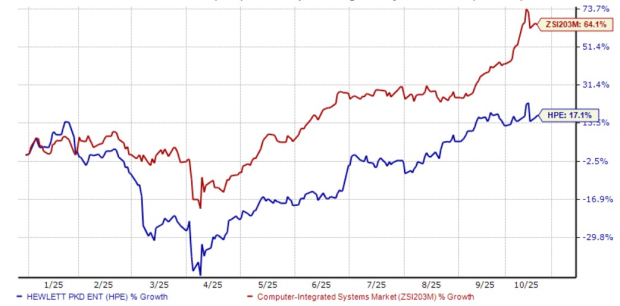
Image Source: Zacks Investment Research
From a valuation standpoint, HPE trades at a forward price-to-sales ratio of 0.83, below the industry’s 4.38.
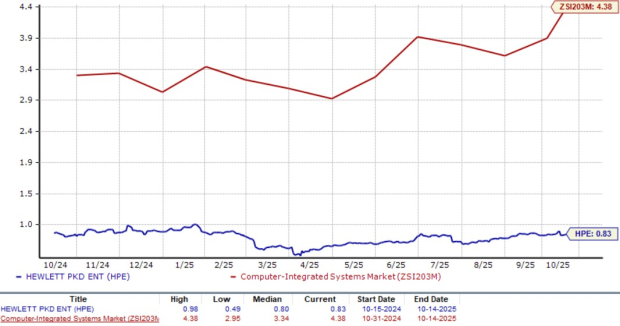
Image Source: Zacks Investment Research
The Zacks Consensus Estimate for HPE’s fiscal 2025 earnings is pegged at $1.89 per share, which implies a decrease of 4.5% year over year. The consensus mark for fiscal 2026 is pegged at $2.40 per share, indicating a year-over-year increase of 26.5%. HPE's fiscal 2025 and 2026 earnings remained unchanged in the past 30 days.

Image Source: Zacks Investment Research
HPE stock currently carries a Zacks Rank #3 (Hold). You can see the complete list of today’s Zacks #1 Rank (Strong Buy) stocks here.
Zacks' Research Chief Names "Stock Most Likely to Double"
Our team of experts has just released the 5 stocks with the greatest probability of gaining +100% or more in the coming months. Of those 5, Director of Research Sheraz Mian highlights the one stock set to climb highest.
This top pick is a little-known satellite-based communications firm. Space is projected to become a trillion dollar industry, and this company's customer base is growing fast. Analysts have forecasted a major revenue breakout in 2025. Of course, all our elite picks aren't winners but this one could far surpass earlier Zacks' Stocks Set to Double like Hims & Hers Health, which shot up +209%.
Free: See Our Top Stock And 4 Runners UpDell Technologies Inc. (DELL) : Free Stock Analysis Report
Super Micro Computer, Inc. (SMCI) : Free Stock Analysis Report
Hewlett Packard Enterprise Company (HPE) : Free Stock Analysis Report
This article originally published on Zacks Investment Research (zacks.com).
