The Triple Wave: How Cancer Became an Employer Problem
By Othman Laraki, CEO and Co-Founder, Color Health and Dr. Karen Knudsen, CEO, Parker Institute for Cancer Immunotherapy
For decades, cancer was overwhelmingly a disease of the elderly. The median age at diagnosis was 66. The vast majority of cases hit after retirement. For employers, cancer was tragic but largely peripheral - something that happened to retirees on Medicare's watch, not theirs.
That era is over.
Cancer has been the number one condition driving employer healthcare costs for four consecutive years. Nearly 90% of large employers now rank it among their top three cost drivers. And the forces reshaping cancer's economics aren't cyclical - they're structural, compounding, and accelerating. We think of it as a triple wave.
Wave 1: Cancer is getting younger
Early-onset cancers - those diagnosed before age 50 - are surging. An NIH study published in 2025 found that 14 cancer types have risen in incidence among people under 50 over the past decade. Globally, early-onset cancer incidence has increased roughly 79% over the last three decades. GI cancers in younger adults are rising faster than any other type. Colorectal cancer is now the leading cause of cancer death in men under 50. Young adults born in 1990 are twice as likely to develop colon cancer as those born in 1950.
This isn't a blip. Multiple factors are converging: shifting screening guidelines and tools that catch cancers earlier are part of it, but there is an undeniable rise in incidence - which is suspected to be tied to lifestyle and various exposures. But regardless of cause, the result is the same - cancer is increasingly affecting working-age adults, and therefore increasingly covered by employer-sponsored plans.

Source: Madison Hoff/Business Insider; National Cancer Institute
Wave 2: Treatments are better, last longer and cost more
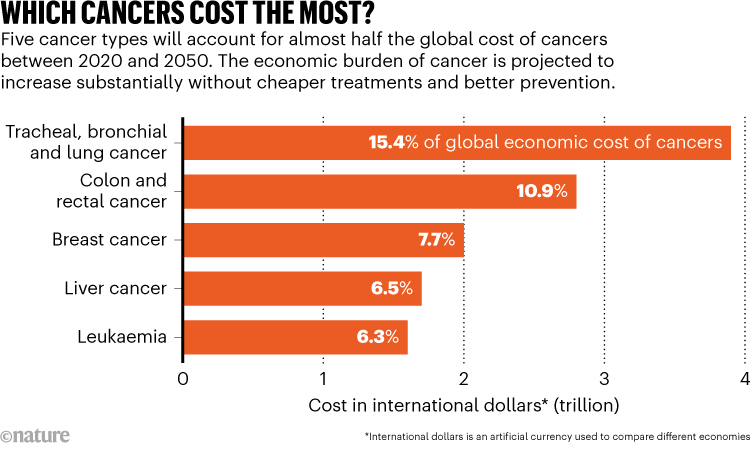
The good news is that cancer medicine is in a golden age. Immunotherapy, CAR-T cell therapy, genomically targeted drugs, and tumor profiling are extending lives in ways that were unimaginable a decade ago. The bad news is that these treatments are extraordinarily expensive. A single course of CAR-T therapy can exceed $400,000. Immunotherapy regimens can run $150,000+ per year. And these aren't one-and-done interventions - many advanced cancers are increasingly managed as chronic conditions, with treatment extending for years or even indefinitely.
For employers, this fundamentally changes the math. A late-stage cancer diagnosis is no longer a catastrophic but bounded cost event. It's an ongoing, compounding expense. About 80% of FDA approvals in 2025 fell into the specialty drug category, and roughly half of all drug spending is now specialty. Employer healthcare costs are projected to be 62% higher in 2026 than they were in 2017, and cancer is a primary reason.
Source: Nature.com
Wave 3: The growing survivor workforce
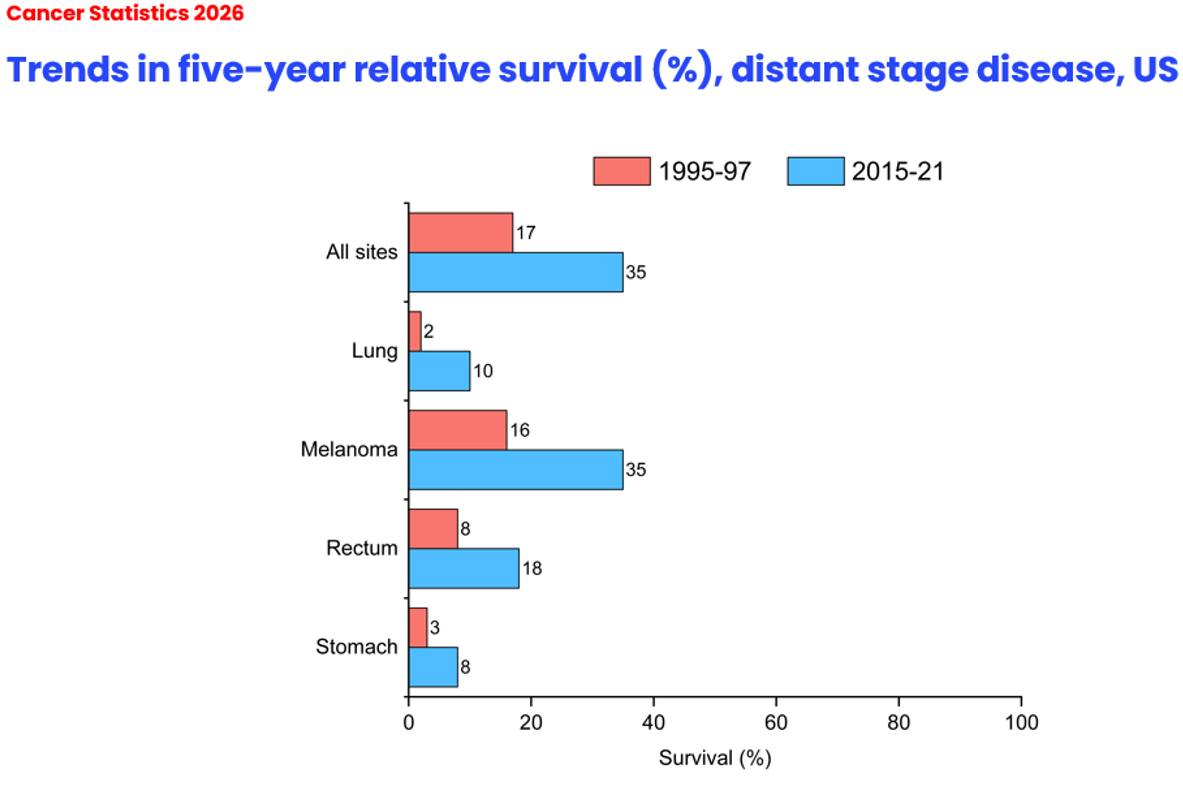
Here's the part most people miss. As of January 2025, 18.6 million people in the United States are living with a history of cancer. That number is projected to hit 22 million by 2035 and 26 million by 2040. Thanks to earlier detection and better treatment, more people are surviving cancer - and more of those survivors are of working age.
This growing survivability of cancer is truly wonderful. It's also an enormous, largely unmanaged cost. Cancer survivors require ongoing monitoring, follow-up care, management of treatment side effects, and support for the secondary health conditions that cancer and its treatments create - from cardiovascular complications to mental health challenges to fertility issues. The oncology workforce is already strained: the ratio of oncologists relative to the aging population has dropped from 15.9 per 100,000 in 2014 to 14.9 in 2024. Yet the growing number of survivors needing care from medical oncologists are already heavily under-served - and that gap is only growing.
For employers, survivorship isn't a one-time celebration. It's a long-duration responsibility that current health service offerings are not designed to handle.
Source: American Cancer Society
The compounding effect
What makes the triple wave so challenging is that these forces multiply each other. More working-age diagnoses mean more employees entering treatment. More effective but expensive treatments mean higher per-patient costs. More survivors returning to work mean a growing population of employees with ongoing, complex care needs and a higher chance of future cancer incidence. The "area under the curve" - the total cost burden - is expanding along every dimension simultaneously: more people, higher cost per person, and longer duration of that cost.
One benefits leader I spoke with summarized what cancer leaves her employees: "Sick, Confused, Broke, and Pissed Off." That's not an anecdote. That's the summary of the American cancer experience for working-age adults in 2026.
What this means
Cancer is no longer a problem that employers can manage with a narrow center-of-excellence referral or a utilization management policy. It’s also not a navigation problem (yes, the system is confusing, but pointing you to a dead end doesn’t solve the fundamental problem). It's a direct care delivery and access problem, and one that spans prevention, early detection, active treatment, survivorship, and everything in between.
There are concrete steps employers can take, now, to blunt the impact of this rapidly approaching reality:
Deliberate stage shift strategy: Every shift from late to early stage saves 30% of cancer cost and years of productive life. Most employers have heard from their plan administrators that they are “at national benchmarks” for cancer cases in their workforce. This positioning obfuscates the opportunity of impact and agency employers have to decrease the proportion of late-stage cancers in their population. In the new reality, every employer can move the needle by ensuring that their employees are receiving full guideline-based screening that has been proven to be cost-effective and life-saving.
Fully-defined high-risk and survivorship programs: In most working-age adult populations, employers will be responsible for high-risk groups and a growing pool of survivors. These are populations for whom active management has disproportionately positive impact, but who universally struggle to find the care they need - until they face a cancer diagnosis. Each one of these individuals represents a missed opportunity for a high return in guideline-based prevention and care.
Demystifying cancer in the workplace: Employers have the opportunity to publicly promote a culture of health and prevention. When corporate and benefits leaders publicly and openly communicate the importance of care and publicly de-stigmatize cancer as part of the modern adult life reality, it helps ensure that employees are diligent about their health, and that of their coworkers and dependents. Prominent CEOs who have publicly shared their personal stories battling cancer make it easier for colleagues to be proactive and for other survivors to return to the workforce.
Direct clinical care offerings: A key opportunity that AI and digital technology bring is that they can make world-class clinical expertise directly accessible to each individual. Every American adult has experienced weeks or months of delay in accessing important clinical services. Every case can have a clinical team that you trust - whether it is for screening or receiving clinical support to ensure the most effective treatment pathways are being followed. Improving cancer care is less about adding more middlemen or steering people, and more about making high quality care immediately available when it is most impactful.
The organizations that get ahead of this won't be the ones that try to contain cancer costs at the point of treatment. They'll be the ones that recognize the triple wave for what it is and build a strategy across the full cancer continuum, from screening through survivorship. Every stage shift from late to early saves 30% of treatment costs and years of productive life.
We're entering an era where the majority of cancer costs will be for people who are alive and working. That's a profound shift - and for employers, it's both a massive challenge and an extraordinary opportunity to make a difference in people's lives.