2025 Nasdaq-100® Reconstitution and Performance Highlights
What is the Nasdaq-100?
| Tracks the performance of 100 of the largest non-financial companies (according to ICB Industry classification) listed on the Nasdaq Stock Market®. |
| A fully systematic, rule-based index — unlike the S&P 500, index additions are not subject to committee approval. |
| Employs a modified market-cap weighting scheme, with quarterly rebalances and an annual reconstitution in December. |
| Tracked by ETPs with over US$640 billion of AUM across 18 exchanges in major international markets, within a broader global ecosystem of mutual funds, futures, options, annuities and structured products. |
Source: Nasdaq Global Indexes. As of December 31, 2025.
How does the annual reconstitution work?
To remain an accurate reflection of the markets they track, indexes undergo periodic reconstitution to align with evolving market dynamics. The Nasdaq-100 is reconstituted each December, strategically scheduled to coincide with the quadruple witching[1] day of the quarter.

- Select the top 75 non-financial Nasdaq-listed companies by market capitalization.
- Retain current constituents ranked within the top 100.
- Fill remaining slots, in rank order, with existing constituents ranked 101–125 if they were (i) in the top 100 at the prior reconstitution or (ii) added after the last reconstitution.
- If vacancies persist, include non-constituents ranked in the top 100, in rank order.
Note: Steps 3 and 4 apply only if fewer than 100 names are selected after the previous steps.
For the complete index methodology, please visit our website.

Source: Nasdaq Global Indexes.
From 2021 to 2025, an average of 91.6% of companies were selected at Steps 1 and 2, 5.8% at Step 3, and 2.6% at Step 4.
Which companies were added and removed during the 2025 reconstitution?
Additions in 2025 Reconstitution
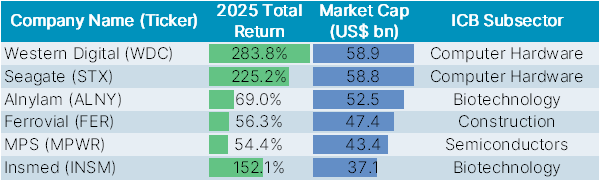
Source: Nasdaq Global Indexes, Bloomberg. As of December 31, 2025.
The Nasdaq‑100 added six new constituents in the 2025 reconstitution, representing nearly US$300 billion in combined market cap. Each newcomer posted gains of at least 50% last year, with Western Digital and Seagate both climbing more than 200%.
Removals in 2025 Reconstitution
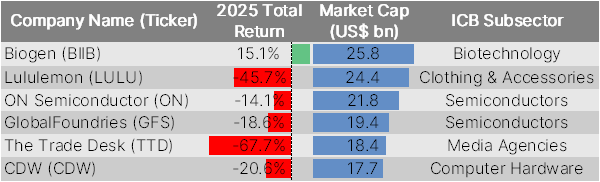
Source: Nasdaq Global Indexes, Bloomberg. As of December 31, 2025.
To maintain the index at 100 companies, six existing members have been removed. Notably, the largest deletion, Biogen, with a market cap of US$26 billion, grew over the past year but not enough to retain its spot. Shares of The Trade Desk and Lululemon, with 2025 declines of 68% and 46%, respectively, rank as the two weakest performers in the Nasdaq‑100 by percentage loss.
Over the past decade, December has typically seen about six additions and deletions. By that measure, 2025 appears broadly in line with historical norms.
Why do off-cycle constituent changes occur?
Certain indexes, especially those with fixed company counts in their names, such as the Nasdaq‑100 and S&P 500, can also add or remove constituents at ad hoc times during the year. Off-cycle additions to the Nasdaq-100 generally occur as a result of off-cycle deletions. The primary exception is when securities enter the index due to corporate actions, such as spin-offs. Removal criteria include:
- Delisting, liquidating or cessation of operations.
- Transfer to another exchange (other than the Nasdaq Global Select Market or the Nasdaq Global Market).
- Reclassification as an ineligible security type or as a Financial company (according to ICB classifications).
- Failure to maintain a minimum weight of 0.10% for two consecutive month-ends.
When a security is removed (excluding spin-offs), it is replaced by the Nasdaq-listed company with the largest market capitalization that meets all eligibility requirements.
Off-cycle additions and deletions in 2025
Effective Date | Deletion | Addition | Reason |
| May 19, 2025 | Mongo DB (MDB) | Shopify (SHOP) | Failing to maintain a 0.10% weight for two consecutive months. |
| July 28, 2025 | ANSYS (ANSS) | Thompson Reuters (TRI) | ANSYS was acquired by Synopsys. |
Added: October 20, 2025 Removed: November 10, 2025 | Solstice (SOLS) | Solstice (SOLS) | Solstice was added as a result of a spin-off but was later removed for failing to maintain the minimum weight of 0.10%. |
Source: Nasdaq Global Indexes.
Thomson Reuters (TRI) and Shopify (SHOP) transferred their U.S. listings from the New York Stock Exchange to Nasdaq in February and March of last year, respectively. Both later joined the Nasdaq‑100 in 2025 as off‑cycle additions. Over the past 10 years, the index has averaged roughly three off‑cycle inclusions and deletions annually.
How did the Nasdaq-100 perform in 2025?

Source: Nasdaq Global Indexes, Bloomberg. As of December 31, 2025.
The Nasdaq‑100 delivered a 21% total return in 2025, topping the S&P 500 by 3 percentage points. Over the past 18 years, its cumulative return was 2.4 times that of the S&P 500 (1,342% vs. 560%), or 45% higher on an annualized basis (16.0% vs. 11.1% CAGR). The Nasdaq‑100 has beaten the S&P 500 in 14 of the past 18 calendar years, delivering a nearly 30‑percentage‑point advantage in standout years such as 2009, 2020 and 2023. This translates to a robust 78% win rate versus the S&P 500 during that period.

Source: Nasdaq Global Indexes, FactSet. As of December 31, 2025.
The weights of Class A and C shares of Alphabet are combined.
Eight of the world’s ten largest public companies are represented in the Nasdaq‑100. By year‑end 2025, the top ten securities comprised 52% of index weight and delivered an average total return of 35% over the past year. All posted positive returns, with Palantir Technologies, Alphabet and Broadcom exceeding 50%. Across the broader index, Micron (240%), Warner Bros. Discovery (173%) and Lam Research (139%) were the strongest performers last year. With an average weight of 61%, the Technology sector drove 88% of the index’s total return in 2025, led by Alphabet, Nvidia and Broadcom as the top contributors.
U.S. growth is expected to remain resilient despite lingering geopolitical and trade risks. Continued fiscal and monetary support, coupled with record capital investment in AI adoption, underpins the cycle’s extension. 2026 may offer further proof of AI’s transformative impact, though benefits will be unevenly distributed. The broadening productivity boost from AI adoption is also a constructive tailwind.
Conclusion
Indexes require periodic reconstitutions to stay aligned with their stated objectives. The Nasdaq‑100 added six new constituents in the 2025 reconstitution, each posting gains of at least 50% last year. The index delivered a 21% total return in 2025, outperforming the S&P 500 by 3 percentage points and sustaining a 78% win rate versus the S&P 500 over the past 18 calendar years. Looking ahead, 2026 could reinforce AI’s transformative role in productivity, while U.S. growth is expected to remain resilient, supported by policy measures and record AI investment.
[1] Quadruple witching occurs on the third Friday of March, June, September and December, when single-stock futures, stock index futures, stock index options and single-stock options expire simultaneously. December options expirations are typically the biggest of the year.
Disclaimer:
Nasdaq®, Nasdaq-100®, Nasdaq-100 Index® and NDX® are registered trademarks of Nasdaq, Inc. The information contained above is provided for informational and educational purposes only, and nothing contained herein should be construed as investment advice, either on behalf of a particular security or an overall investment strategy. Neither Nasdaq, Inc. nor any of its affiliates makes any recommendation to buy or sell any security or any representation about the financial condition of any company. Statements regarding Nasdaq-listed companies or Nasdaq proprietary indexes are not guarantees of future performance. Actual results may differ materially from those expressed or implied. Past performance is not indicative of future results. Investors should undertake their own due diligence and carefully evaluate companies before investing. ADVICE FROM A SECURITIES PROFESSIONAL IS STRONGLY ADVISED.
© 2026. Nasdaq, Inc. All Rights Reserved.