
With the rising prevalence of diabetes worldwide, the demand for more efficient and real-time glucose monitoring solutions has intensified. Abbott ABT and DexCom DXCM are among the leading players in the continuous glucose monitoring (CGM) device market, valued at $13.4 billion in 2025 by Grand View Research.
Healthcare giant Abbott’s businesses span cardiovascular care, diagnostic testing, nutrition, pain and movement disorders, with Diabetes Care being a consistent top-line driver for the past several quarters. On the other hand, DexCom is a pure-play CGM company whose target market consists mainly of people with Type 1 and Type 2 diabetes using insulin therapy, as well as certain non-insulin users who struggle with hypoglycemia.
Here’s a closer look at both companies to determine which stock offers the more compelling investment opportunity today.
The Case for Abbott
Abbott’s flagship, sensor-based CGM system, FreeStyle Libre, has quickly established global leadership across both Type 1 and Type 2 diabetes. CGM sales reached $2 billion in the first quarter of 2026, up 7.5% year over year, though growth was affected by a delay in an international tender renewal and a difficult prior-year comparison tied to shelf restocking dynamics. CGM growth is forecasted to return to double-digits in the second quarter.
Abbott’s CEO also remains bullish on the long-term CGM opportunity, estimating that 70-80 million people globally should be using CGMs compared with the current market of roughly 10-12 million users. Recently, the company secured CE Mark for the first-ever dual glucose-ketone sensing technology for people with diabetes, branded as Libre Duo and Libre Duo 10 Day. The systems continuously measure glucose and ketone levels every minute and will integrate with the Libre digital health ecosystem.
Beyond Diabetes Care, Abbott’s Core Lab Diagnostics business is seeing robust demand across the United States, Europe and Latin America. However, Core Lab trends were flat in China, with the company continuing to expect a weaker market for the full year despite lapping prior pricing actions.
The March 2026 acquisition of Exact Sciences added a Cancer Diagnostics business, expanding presence in one of the fastest-growing areas of healthcare. Even so, the deal introduces a $0.20 dilution to the 2026 adjusted EPS guidance of $5.38 to $5.58.
Abbott’s Rapid and Molecular Diagnostics business suffered from lower demand for respiratory virus testing due to a much weaker respiratory season compared to last year. Management is taking a cautious view and is not assuming the shortfall will recover later in the year. The Established Pharmaceuticals Division benefits from branded generics positions in faster-growing geographies. Abbott is focused on restoring a healthier balance between price and volume over time in Nutrition, while its Medical Devices segment is gaining from scale advantages and new product cycles across the franchises.
Take a look at how analysts are projecting Abbott’s bottom line.

Image Source: Zacks Investment Research
The Case for DexCom
DexCom is benefitting from broader access to its CGM product portfolio, continued active base growth and new product launches. The company has partnered with several insulin delivery systems manufacturers to integrate its CGM products, with more than one million CGM users now connected to an automated insulin delivery (AID) system worldwide.
Internationally, DexCom’s 2026 first-quarter growth was widespread across core markets, with notable strong performance in countries such as France and Canada, where access has recently expanded. Management outlined a targeted international strategy aimed at gaining share through reimbursement progress and a portfolio tailored to local channels, including DexCom One+ in Europe.
In the quarter, DexCom made an expanded rollout of the G7 15 Day sensor across all U.S. channels. The platform is now available with all U.S. pump partners, helping minimize friction for AID users who upgrade within the installed base. DexCom expects nearly 50% conversion of the U.S. base to the 15-day sensor by year-end 2026, with an international launch expected to begin in the second half of the year. The company also introduced its next-generation G8 roadmap, designed to deliver a step-change improvement in glucose performance with a smaller form factor and self-adapting sensor.
DexCom continues to build out its software ecosystem, adding engagement tools for Stelo, including enhanced Smart Meal Logging features, and it has been expanding provider-facing capabilities through Direct EHR Integration. More than 320 health systems have already integrated or are in the process of onboarding this capability across the United States and international markets.
The company also continues to expand insurance coverage for its CGM sensors, particularly among Type 2 diabetes patients. The three largest U.S. Pharmacy Benefit Managers now cover DexCom CGM for all people with diabetes, including those with type 2 not using insulin.
ABT also reiterated its 2026 revenue guidance, calling for 11% to 13% growth over 2025 levels. Take a look below at how the company’s earnings estimates are shaping up.

Image Source: Zacks Investment Research
ABT & DXCM: Price Performance and Valuation
Year to date, ABT shares have declined 25.6%, whereas DexCom shares have climbed 4.1%.
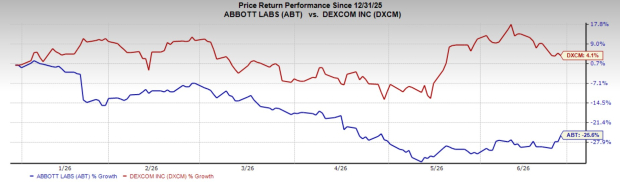
Image Source: Zacks Investment Research
Abbott is trading at a forward, five-year Price/Sales (P/S) of 2.99X, below its median of 4.63X. Meanwhile, DXCM sits with a five-year P/S of 4.88X, also lower than its median of 9.93X.

Image Source: Zacks Investment Research
Conclusion
Both companies are poised to benefit from the long-term growth trends of the CGM market. However, Abbott continues to face respiratory testing volatility in Diagnostics, dilution risk following the Exact Sciences acquisition and ongoing uncertainty in China. DexCom is gaining from elevated CGM demand worldwide, new product launches and expanding coverage for its sensors.
While DexCom trades at a premium to Abbott, it remains well below its historical median. The stock has also delivered stronger YTD performance relative to Abbott. Coupled with positive earnings estimate revisions, existing DXCM holders may find it prudent to stay invested to enjoy growth prospects. Meanwhile, those holding ABT stock may find it wise to sell for now until the short-term operating visibility improves.
DXCM carries a Zacks Rank #3 (Hold), while ABT has a Zacks Rank #4 (Sell).
You can see the complete list of today’s Zacks #1 Rank (Strong Buy) stocks here.
Beyond Nvidia: AI's Second Wave Is Here
The AI revolution has already minted millionaires. But the stocks everyone knows about aren't likely to keep delivering the biggest profits. AI’s second wave is moving from infrastructure to implementation and these companies are at the forefront of this transition, positioned to become what Amazon and Google were to the internet era.
See Stocks Now >>Abbott Laboratories (ABT) : Free Stock Analysis Report
DexCom, Inc. (DXCM) : Free Stock Analysis Report
This article originally published on Zacks Investment Research (zacks.com).
The views and opinions expressed herein are the views and opinions of the author and do not necessarily reflect those of Nasdaq, Inc.

