Stillwater Reports Multiple Large-Scale Polymetallic Magmatic Sulphide Targets From 2024 Geophysical Surveys in Montana's Historic Stillwater Mining District
VANCOUVER, BC / ACCESS Newswire / March 26, 2025 / Stillwater Critical Minerals Corp. (TSXV:PGE)(OTCQB:PGEZF)(FSE:J0G) (the "Company" or "Stillwater") is pleased to report multiple large-scale magmatic sulphide targets generated from a property-wide MobileMTm magneto-telluric ("MMT") geophysical survey completed in late 2024 by Expert Geophysics Limited at its flagship Stillwater West Ni-PGE-Cu-Co + Au project in Montana, USA.
Data from the 2024 MMT survey was processed and incorporated into the Company's 3D geological model of the lower Stillwater Igneous Complex to prioritize targets with a focus on expanding current mid- and high-grade mineral resources.
Highlights
Inversion and 3D modeling of results from 2024 MMT geophysical surveys provide multiple coincident multi-kilometer-scale resistivity lows and conductive highs, as shown in the attached Figures.
Magnetic inversion processing from the MMT data provides important information for project-wide structural interpretation and highlights relationships between the metasedimentary floor and ultramafic strata.
Multiple very low frequency ("VLF") data were also acquired, confirming near surface drilled mineralization and structures.
Limited drill testing has been completed on these new targets to date. Where available, drill results confirm polymetallic sulphide-rich Platreef-style mineralization across wide areas of the project, as shown in Table 1, Pictures 2 and 3, and Figure 6.
Results have expanded the detailed 3D geological model of the lower Stillwater Igneous Complex that has been developed by the Company from 9.5 kilometers to 20 kilometers, as shown in Figures 5 and 6.
Results have provided multiple priority drill targets for expansion of mineral resources with particular focus on mid- and high-grade mineralization.
Drill targets are now being finalized and prioritized for planned upcoming drill campaigns.
The Company is working with Glencore plc via the Stillwater West technical committee, and ALS Global (formerly GoldSpot) to harness their cutting-edge Artificial Intelligence and Machine Learning technology and geoscience expertise.
Stillwater's President and CEO, Michael Rowley, said "Having relied on globalized supply chains for decades, the United States has now made clear it intends to secure domestic inventories of, and processing capacity for, nine critical minerals that we have inventoried at Stillwater West. Last week's Executive Order from the White House is the strongest directive yet in this regard, building on similar initiatives that date from 2016, and earlier. As the third largest mineralized layered magmatic complex in the world, the Stillwater Igneous Complex is famously well-mineralized and offers both scale and grade, making it a foundational component of this Government- mandated national policy objective. The Stillwater Igneous Complex has provided the United States with critical minerals for over a century, including the on-going production of palladium, platinum, rhodium, nickel, copper and other metals by our neighbor Sibanye-Stillwater. Our Stillwater West project covers the lower Stillwater Igneous Complex, invoking direct comparisons to the parallel geologic setting of Anglo American's world-class Mogalakwena Mine, and Ivanhoe's Platreef Mine, in South Africa's Bushveld Igneous Complex. We are well positioned to bring these large, polymetallic mine models with robust economics to a similar geological setting in the United States. Following our recent meetings with State and Federal officials, we are focused on accelerating our path to mine development and production. We look forward to providing further updates and invite investors to meet the team at the upcoming shows listed below."
Dr Danie Grobler, Stillwater's Vice-President, Exploration, commented "The MMT electromagnetic, horizontal magnetic gradient, and TargetEM geophysical surveys performed by Expert Geophysics in late 2024 have imaged large coincident low resistivity, conductive and magnetic anomalies proximal to the footwall contact of the Stillwater Igneous Complex. As a result of uplifting during the Laramide tectonic event, these footwall targets can occur near surface, resulting in high quality drill targets that range in depth from shallow to over a kilometer or more. The most conductive anomalies are located proximal to the footwall contact and correspond with net- textured to massive sulphides, some of which have already been drill tested. For example, all six holes drilled during the 2023 exploration season intersected significant zones of net-textured to semi-massive sulphide within the Chrome Mountain area. The MMT results at Chrome Mountain display a large conductive anomaly extending from the historically drilled area towards the southeast along the footwall contact. A similar anomaly is imaged at Iron Mountain within the Camp Zone (CZ), HGR, and Crescent deposit areas. This particular anomaly is focused below Iron Mountain and is connected to the Camp Zone and Crescent deposit areas, extending at depth to around 1,500 meters below surface. The conductive anomaly displaces the highly magnetic anomalies of the Banded Iron Formation within floor rocks of the Stillwater Igneous Complex. Magmatic sulphide mineralization is known to extend below mafic-ultramafic intrusions either through a process of downward percolation or forming part of an intrusive feeder/conduit system. We look forward to drill testing these compelling targets with a focus on expanding our resources in the higher grade categories in particular in the upcoming planned campaign."
Results of Property-Wide Airborne Geophysical Surveys
Stillwater contracted Expert Geophysics Limited to perform large-scale geophysical surveys with the objective of providing comprehensive coverage of the highly prospective lower Stillwater Igneous Complex. Particular focus was given to modeling mid- and high-grade mineralization for expansion of existing mineral resources in these categories in upcoming drill campaigns.
The surveys totaled 1,322 line-kilometers including test surveys over the Chrome Mountain resource area to compare the TargetEM26 time-domain electromagnetic ("EM") survey with the MMT frequency-domain survey. Evaluation of these test surveys alongside the first generation DIGHEM airborne EM survey flown over the project in 2000, together with smaller surveys and extensive ground-based Induced Polarization and magnetic/VLF by the Company, resulted in the decision to fly the property-wide survey using the MMT system. The MMT system's ability to better distinguish and define multiple conductive targets to greater depths, which is not terrain dependent, was confirmed as a result of the survey. An advanced generation of airborne AFMAG, or Audio-Frequency Magnetic, techniques, Expert's MMT system combines the latest advances in electronics, airborne system design, and sophisticated signal processing techniques to use natural electromagnetic signals in the frequency range of 25 Hz - 21,000 Hz to map resistivity and conductivity in the earth below. Multiple VLF data were also acquired, confirming near surface drilled mineralization and structures.
The MMT surveys were completed in three grids, covering Chrome Mountain, Iron Mountain, and the Cathedral target areas at 100-meter line spacing, along with the Stillwater East claim block at 200-meter line spacing.
The surveys proved to be highly successful, with preliminary results enabling completion of the first-ever detailed 3D geological model of the lower Stillwater Igneous Complex. As announced October 16, 2024, that earlier version of the model made the important breakthrough of demonstrating continuity of mineralization across the central 9.5-kilometer length of layered magmatic stratigraphy which hosts the Company's current resources in five deposits.
Recent analysis, including inversion work, has extended the modeled area to approximately 20 kilometers as shown in Figures 5 and 6, with strong electromagnetic anomalies indicated along the footwall contact zone of the Stillwater West project. These anomalies are consistent with the massive sulphide and contact-style nickel- copper sulphide-rich bodies that the Company is targeting, and form important Platreef- or contact-style targets for drill testing.
The high-resolution EM, magnetic, and VLF data provide detailed information about several different lithology contacts, faults, major structures, and conductive geology indicative of nickel-copper sulphide mineralization.
This new survey has provided higher resolution of known and unknown targets that occur near surface and now to a depth of 1.5 kilometers.
The data maps the nature of the footwall contact and corresponding country rock xenoliths, which act as favorable zones for sulphide trap sites. The lower peridotite contact was also well imaged, which hosts most of the current resources, and shows continuity along strike within all three survey grids covering over 34 kilometers (Figures 1 and 2). Magnetic inversion processing from the MMT data proved useful for project-wide structural interpretation and highlights relationships of the metasedimentary floor and ultramafic strata. Strike-extensive, highly magnetic susceptibility anomalies, attributed to the iron formation interbedded within the hornfels floor, served to improve modelling of the down-dip geometry of the footwall contact. This highly prospective floor contact zone forms the main exploration target for polymetallic mineralization across the 34-kilometer span of the Stillwater West project.
Most of the strongest conductive anomalies (< 250 ohm-m) have never been drill tested to date and continue along strike up to five kilometers in the Chrome Mountain area and up to seven kilometers in the Iron Mountain area. Both the Cathedral grid and the Stillwater East grid also have robust conductive anomalies (< 250 ohm-m) that are multiple kilometers in strike length.
Southeast trending, southwest dipping, strike-extensive low magnetic susceptibility anomalies correlate to Laramide fore-thrusts within the floor. The low magnetic signature of these structures is thought to be related to alteration and resultant de-magnetization of the metamorphosed metasedimentary rocks. In addition, isolated low magnetic susceptibility anomalies caused by xenoliths are noted within the lower units of the Peridotite zone. In places these are correlated to drill interceptions of hornfels and fine grained norite which, locally, is out of stratigraphic position. From the xenoliths intersected within drilling and following results from the 2024 MMT program, several anomalously low-magnetic xenoliths were modelled with the bulk of these occurring proximally to the footwall of the Peridotite zone, intermittently along strike.
Drill holes CM2023-04, CM2023-06, and CZ2021-01 are now recognized to be early drill tests of mineralization under hornfels xenoliths:
Table 1 - Past Drill Intercepts of 2025 Target Geophysical Anomalies
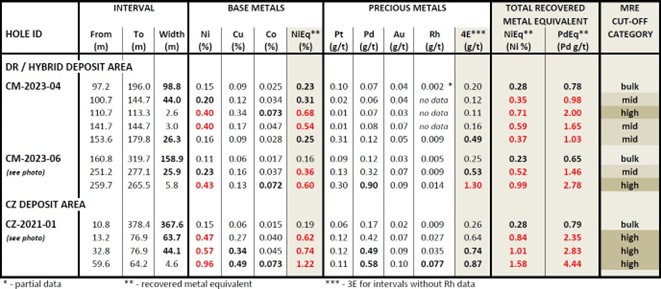
Highlighted significant intercepts with grade-thickness values over seven percent-meter recovered Nickel Equivalent ("NiEq") are presented above, except as noted. Recovered NiEq are presented for comparative purposes using conservative long-term metal prices (all USD): $8.00/lb nickel (Ni), $4.00/lb copper (Cu), $22.00/lb cobalt (Co), $1,000/oz platinum (Pt), $1,950/oz palladium (Pd), $1,850/oz gold (Au), and $10,000/oz rhodium (Rh). NiEq is determined as follows: NiEq% = [Ni% x recovery] + [Cu% x recovery x Cu price/ Ni price] + [Co% x recovery x Co price / Ni price] + [Pt g/t x recovery / 31.103 x Pt price / Ni price / 2,204 x 100] + [Pd g/t x recovery / 31.103 x Pd price / Ni price / 2,204 x 100] + [Au g/t x recovery / 31.103 x Au price / Ni price / 2,204 x 100]. In the above calculations: 31.103 = grams per troy ounce, 2,204 = lbs per metric tonne, and 100 and 0.01 convert assay results reported in % and g/t. The following recoveries have been assumed for purposes of the above equivalent calculations: 85% for Ni and 90% for all other listed metals, based on recoveries at similar nearby operations. Total metal equivalent values include both base and precious metals. In terms of dollar value, 0.20% nickel equates to a copper value of 0.40%, or a palladium value of 0.48 g/t, using the above metal values. Intervals are reported as drilled widths and are believed to be representative of the actual width of mineralization.
Picture 1 - Drill hole CM-2023-06 - High-grade polymetallic sulphide mineralization from near the central portion of the robust 5-kilometer-long conductive anomaly (
The views and opinions expressed herein are the views and opinions of the author and do not necessarily reflect those of Nasdaq, Inc.