
Will AMD's Acquisition Be Enough to Help It Compete With Nvidia AI?
As computing technology advances, it has become increasingly clear in recent years that tighter integration between semiconductor and software development is needed. The surge in artificial intelligence (AI) activity in 2023 embodies this. As Nvidia (NASDAQ: NVDA) CEO Jensen Huang has been explaining for years, AI is a full-stack problem -- meaning a successful deployment of AI-powered computing requires deep understanding of chips and the software that runs on it.
Unfortunately for Advanced Micro Devices (NASDAQ: AMD) and other semiconductor competitors, software is sorely lacking from their ecosystem. But AMD has been leaning into its efforts to narrow that gap, and just announced an acquisition to help. Will it be enough as AMD looks to cash in on the AI craze Nvidia ignited?
AMD's bet on a software start-up
Just as a reminder before delving into this discussion, AI has actually been around for decades. But more often than not, when folks in the tech world drop the phrase "AI" right now, they're talking about generative AI powered by large language models (LLMs) or something similar. This type of AI requires an algorithm (like an LLM) to be trained with massive amounts of data, using a computing chip accelerator (like a GPU) to train the algorithm and then deploy the finished product for use.
Nvidia has helped pioneer this type of AI, not just with its powerful GPUs, but also with an extensive library of algorithms and software frameworks. Nvidia often bundles these services together with its GPUs to make it easy for developers to get to work on an AI project.
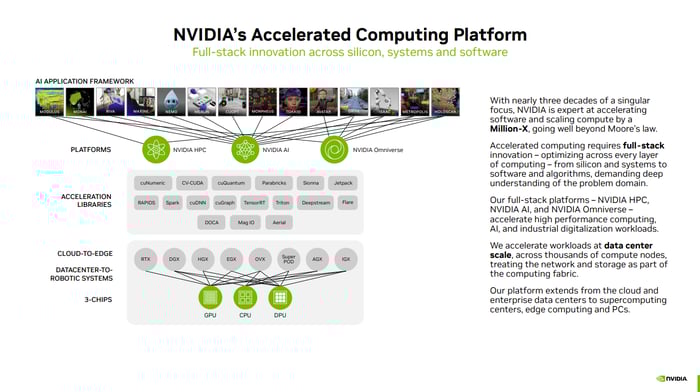
Image source: Nvidia.
It's precisely this "full-stack" know-how extending from chip to app that has catapulted Nvidia into the tech big leagues. Meanwhile, competitors like AMD and Intel make some powerful chips, too, but rely on a patchwork of third-party software providers to complete their full-stack AI toolsets.
AMD in particular seems to be hard at work to fix this deficiency. Earlier in 2023, AMD announced it was creating a dedicated AI segment, headed by Victor Peng -- formerly an executive at AMD's GPU business before leaving to head up Xilinx, the adaptive computing business that AMD acquired in 2022.
To accelerate the software component of today's biggest AI problems, AMD just announced it is acquiring Nod.ai. The start-up's engineers make software that helps accelerate the development of AI on AMD's library of hardware. Nod.ai says it is a top contributor and maintainer of AI algorithm libraries. AMD's goal with this purchase is clear: bolster its own in-house ability in AI software development, not just AI chips.
The cost of making this purchase wasn't divulged, but investors will be able to make some assumptions in the following quarters when AMD releases quarterly reports that include acquisition expenses on its cash-flow statement.
Is the AMD counteroffensive already in place?
Nvidia has captured the majority of this new emerging generative AI market, and a slew of competitors (including Alphabet's Google and Amazon Web Services, which are also Nvidia customers) are readying their own chips in response. But AMD could have a unique advantage as it seeks out a slice of the generative AI pie.
Its secret to future success could lay with Peng and the newly formed AI group, as well as assets brought over from Xilinx. You see, Xilinx was the leader in field programmable gate arrays (FPGAs), a type of chip that can be reprogrammed even after being deployed in a computing system. Engineers accomplish such reprogramming using software.
Perhaps AMD's purchase of Xilinx was more than just a bid on the company's fast-growing FPGA business. Xilinx software capabilities could be the foundation for AMD's own full-stack AI capabilities. Adding Nod.ai to the ecosystem could simply be an enhancement.
Of course, investors will need to monitor the situation carefully. Nvidia has a large lead, and though it has competitors lining up to gun for it, Huang and company aren't idly standing by waiting to be disrupted. Nvidia is obviously highly motivated to keep innovating to maintain its lead. So far, AMD's AI efforts have been lackluster from a financial standpoint.
AMD stock currently trades for 26 times Wall Street's estimate for 2024 earnings per share. Don't bet on that estimate being all that accurate. If AMD starts to make some headway next year, earnings could be far better than anticipated. Or they could greatly fall short of estimates. It's difficult to say just how good of a deal this stock is right now.
I for one continue to invest in a basket of top semiconductor stocks as the AI race heats up, with AMD featuring in that mix. I believe most investors would be well served by doing the same and spreading their bets out.
10 stocks we like better than Advanced Micro Devices
When our analyst team has a stock tip, it can pay to listen. After all, the newsletter they have run for over a decade, Motley Fool Stock Advisor, has tripled the market.*
They just revealed what they believe are the ten best stocks for investors to buy right now... and Advanced Micro Devices wasn't one of them! That's right -- they think these 10 stocks are even better buys.
*Stock Advisor returns as of October 9, 2023
Suzanne Frey, an executive at Alphabet, is a member of The Motley Fool's board of directors. John Mackey, former CEO of Whole Foods Market, an Amazon subsidiary, is a member of The Motley Fool's board of directors. Nicholas Rossolillo and his clients have positions in Advanced Micro Devices, Alphabet, Amazon.com, and Nvidia. The Motley Fool has positions in and recommends Advanced Micro Devices, Alphabet, Amazon.com, and Nvidia. The Motley Fool recommends Intel and recommends the following options: long January 2023 $57.50 calls on Intel and long January 2025 $45 calls on Intel. The Motley Fool has a disclosure policy.
