
Why Wayfair Stock Is Down 83% This Year
It wasn't long ago that Wayfair (NYSE: W) stock was a favorite on Wall Street. The e-commerce giant, which specializes in home decor and furnishings, posted soaring growth through the early phases of the pandemic. Those gains combined with a cost-cutting effort put the company on a seemingly unstoppable path toward ever-expanding earnings.
But times change. Wayfair stock is down about 83% since the start of the year in fact. Sure, a downturn in the wider market is a major factor in that decline. But the company also gave investors a few big reasons to worry about whether it can ever achieve the ambitious goals that management has for its global sales footprint.
Let's take a closer look at why Wall Street is running from this stock in 2022.
Everyone was surprised by Wayfair's growth slowdown
The main factor pressuring the stock is the extreme growth slowdown that investors have endured over the past nine months. Wayfair posted huge sales gains in 2020 and through most of 2021. Yet those trends started decelerating sharply as soon as the pandemic threat began to fade. The company is now shrinking its revenue base and losing customers, indicating that it pulled forward much of its earlier growth from future time periods.
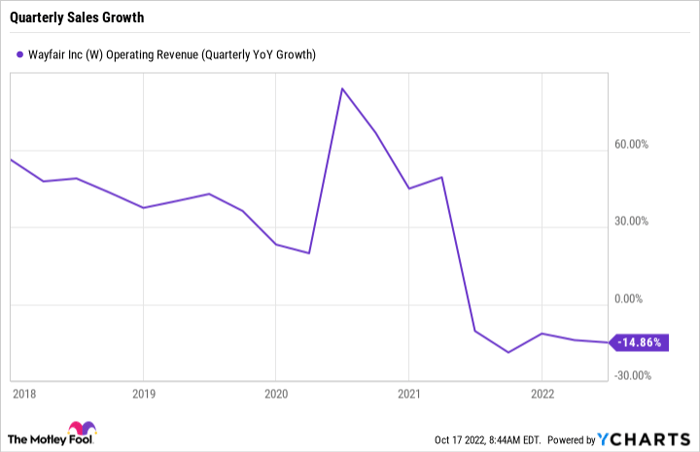
W Operating Revenue (Quarterly YoY Growth) data by YCharts
Wayfair isn't alone in this struggle. Most of its retailing peers, including Target and Shopify, had to pivot their businesses in response to the surprise spending shifts. But Wayfair is alone in this group in showing declining sales through mid-2022. The bigger picture is concerning, too.
Sales didn't budge in fiscal 2021 and are on pace to fall by double-digit percentages this year. That's a huge knock against a business that's targeting a much larger global sales base by 2030.
Things will get worse
Wayfair's asset-light operating model, which relies on manufacturers to handle inventory, wasn't the stabilizing force that investors hoped for, either. Gross profit is down over the first half of 2022, and the company swung from an operating profit of $172 million to a loss of $682 million. This slump occurred despite higher average order spending.
Worse still, Wayfair's engagement metrics imply continued weakness ahead. Its pool of active customers was down a jarring 24% last quarter compared with a year earlier.
Its remaining shoppers are ordering with less frequency, too, roughly 1.85 times per year compared with 1.96 times per year in mid-2021. These aren't the metrics you'd like to see heading into the holiday shopping season and a potential recession in 2023.
The outlook
Management kept its wider outlook that still envisions Wayfair reaching over $100 billion in annual sales in the next decade. Hitting that goal would be a more than eightfold revenue increase over that time.
The tech stock would likely soar if the company returns to that pace, perhaps by as early as 2023. The home furnishings market has a bright long-term future after all, and it has potential to return to more normal spending patterns in the next few quarters.
And Wayfair stock is cheaper today than it was before the pandemic, even though its annual sales base is about 40% higher. But investors still might want to simply follow this stock and watch for signs of stabilization before taking a big new position.
10 stocks we like better than Wayfair
When our award-winning analyst team has a stock tip, it can pay to listen. After all, the newsletter they have run for over a decade, Motley Fool Stock Advisor, has tripled the market.*
They just revealed what they believe are the ten best stocks for investors to buy right now... and Wayfair wasn't one of them! That's right -- they think these 10 stocks are even better buys.
*Stock Advisor returns as of September 30, 2022
Demitri Kalogeropoulos has positions in Shopify. The Motley Fool has positions in and recommends Shopify and Target. The Motley Fool recommends Wayfair and recommends the following options: long January 2023 $1,140 calls on Shopify and short January 2023 $1,160 calls on Shopify. The Motley Fool has a disclosure policy.
