
Why Duolingo Stock Fell 24% in February
Key Points
Duolingo reported a solid fourth-quarter report, but results were marred by a sequential decline in monthly users.
Guidance missed the mark for both the first quarter and the full year.
AI tools like Anthropic's Claude are beginning to compete with traditional software programs.
- 10 stocks we like better than Duolingo ›
Shares of Duolingo (NASDAQ: DUOL) were among the losers last month, as the foreign language learning app posted a decline in a key user metric in its fourth-quarter earnings report at the end of the month.
Prior to that, Duolingo shares had fallen on broader concerns about AI disruption, as investors see education apps like Duolingo as a prime target for AI.
Will AI create the world's first trillionaire? Our team just released a report on the one little-known company, called an "Indispensable Monopoly" providing the critical technology Nvidia and Intel both need. Continue »
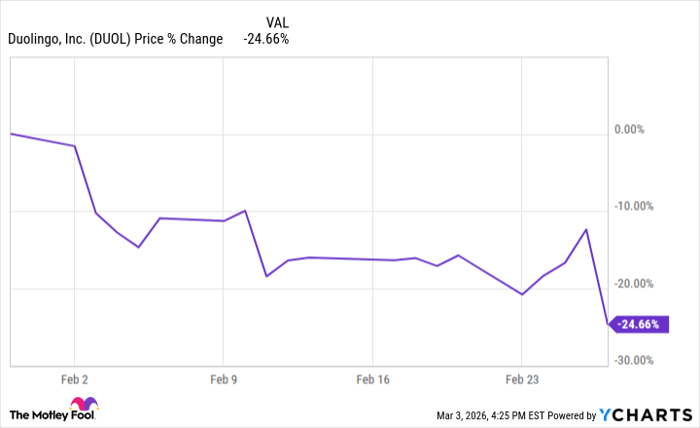
As a result, the stock finished the month down 25%, according to data from S&P Global Market Intelligence.
As you can see from the chart below, the stock steadily slumped for most of the month, before falling sharply on the earnings report on Feb. 27.
Is Duolingo about to get disrupted?
Outside of the earnings report, there was little news out on Duolingo, but concerns that AI programs like Anthropic's Claude would disrupt traditional software companies reached a fever pitch as Claude released new plug-ins that offered tools designed to compete with white-collar office tasks.
As a language-learning app, Duolingo seems vulnerable to AI disruption, both because a start-up could create a better app, or individual users can just use AI chatbots and other tools as they see fit to help them learn languages.
In fact, that seems to be happening to Duolingo as the company reported a sequential decline in monthly active users from 135.3 million to 133.1 million in the fourth quarter. Daily active users still grew, up from 50.5 million to 52.7 million.
That could indicate that Duolingo is converting its monthly active users to daily users, which is a good thing, but if it is, then its pipeline of new users seems to be drying up, which casts doubt on its long-term growth.
Overall growth in the business is still strong, with revenue up 35% to $282.9 million in the quarter, and it is profitable with net income at $42 million. However, the stock has been priced for long-term growth, so the user decline is concerning.
The company announced a $400 million share-buyback program, indicating it aimed to take advantage of its beaten-down share price.

Image source: Getty Images.
What's next for Duolingo
Making matters worse, Duolingo's guidance also missed the mark. For the first quarter, it called for $288.5 million in revenue, representing just 2% sequential growth and below the consensus of $291.2 million. For the full year, it also missed the mark, eyeing revenue of $1.2-$1.22 billion, below the average estimate of $1.26 billion.
Given the doubts about its growth, Duolingo will likely have to show solid user growth in both monthlies and dailies for the stock to bounce back.
Should you buy stock in Duolingo right now?
Before you buy stock in Duolingo, consider this:
The Motley Fool Stock Advisor analyst team just identified what they believe are the 10 best stocks for investors to buy now… and Duolingo wasn’t one of them. The 10 stocks that made the cut could produce monster returns in the coming years.
Consider when Netflix made this list on December 17, 2004... if you invested $1,000 at the time of our recommendation, you’d have $523,599!* Or when Nvidia made this list on April 15, 2005... if you invested $1,000 at the time of our recommendation, you’d have $1,118,640!*
Now, it’s worth noting Stock Advisor’s total average return is 951% — a market-crushing outperformance compared to 194% for the S&P 500. Don't miss the latest top 10 list, available with Stock Advisor, and join an investing community built by individual investors for individual investors.
*Stock Advisor returns as of March 3, 2026.
Jeremy Bowman has no position in any of the stocks mentioned. The Motley Fool has positions in and recommends Duolingo. The Motley Fool has a disclosure policy.
