
Shares of Shopify (NYSE: SHOP) climbed 11.7% in June, according to data provided by S&P Global Market Intelligence. Positive economic data for the e-commerce industry had investors bullish early in the month, but that momentum stalled after the Federal Reserve announced its decision to maintain interest rates.
Macroeconomic data was favorable for e-commerce
May's economic indicators were reported in June, and retail sales are an important metric for Shopify investors. Retail sales increased 0.2% from April, bringing full-year growth to 2%. That was slightly slower than expected, and it represents contraction if you consider the 3.3% increase in consumer prices, according to CPI data. Consumers continue to struggle with inflation, high borrowing costs, and a weakening job market. Conditions are tough for retailers right now.

Image source: Getty Images.
The underlying data wasn't so gloomy for e-commerce. Online sales climbed 6.8% from last year. The non-store retailers category, which includes e-commerce sales, increased 0.8% from April. In a weaker-than-expected month, e-commerce was one of the brightest spots.
Shopify's fee revenue is a function of online sales activity, and its subscription revenue depends on its customers staying in business. Consumer weakness is a cause for concern and should be monitored. However, Shopify is relatively well suited to navigate these lean times compared to companies in the more sluggish portions of the retail sector. That resulted in favorable analyst ratings in the first half of June, illustrating the generally positive sentiment around the stock.
The Federal Reserve is a huge part of the story
Shopify is a growth stock that's heavily influenced by consumer sentiment, so it's highly sensitive to the Fed's interest rate policy. Rate cuts tend to push growth stocks higher, and high interest rates are generally bad for consumer spending. Investors have anticipated multiple rate cuts by the Fed this year, but they have not come to fruition. The central bank has maintained rates in order to combat lingering inflation. Generally positive GDP and employment data have also encouraged the Fed's decisions.
Shopify stock moved higher leading up to the Fed's June 12 announcement. It seems that investors were hopeful that the monetary authority would announce plans to start slashing interest rates, but there was no such relief. The Federal Reserve kept rates steady once again, indicating that only one cut was likely later this year.
The announcement clearly impacted capital markets. One-year and two-year Treasury yields stabilized after tumbling earlier in the month, signaling doubt that the Fed would enact more accommodative policy imminently. Shopify's reversal coincided with that shift in the bond market immediately following the central bank's announcement.
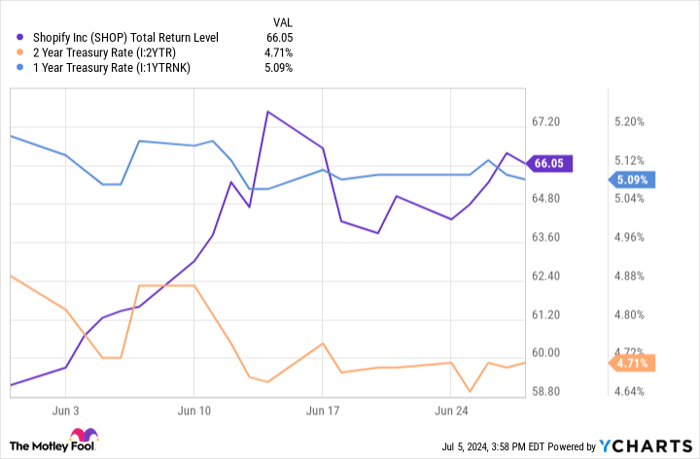
SHOP Total Return Level data by YCharts
Shopify occupies a key role in a growth industry, but the stock is prone to volatility. Its forward P/E ratio is nearly 50, which is high enough to result in steep losses following disappointing results or concerning macroeconomic data.
Don’t miss this second chance at a potentially lucrative opportunity
Ever feel like you missed the boat in buying the most successful stocks? Then you’ll want to hear this.
On rare occasions, our expert team of analysts issues a “Double Down” stock recommendation for companies that they think are about to pop. If you’re worried you’ve already missed your chance to invest, now is the best time to buy before it’s too late. And the numbers speak for themselves:
- Amazon: if you invested $1,000 when we doubled down in 2010, you’d have $22,254!*
- Apple: if you invested $1,000 when we doubled down in 2008, you’d have $41,863!*
- Netflix: if you invested $1,000 when we doubled down in 2004, you’d have $368,072!*
Right now, we’re issuing “Double Down” alerts for three incredible companies, and there may not be another chance like this anytime soon.
*Stock Advisor returns as of July 2, 2024
Ryan Downie has no position in any of the stocks mentioned. The Motley Fool has positions in and recommends Shopify. The Motley Fool has a disclosure policy.
The views and opinions expressed herein are the views and opinions of the author and do not necessarily reflect those of Nasdaq, Inc.

