When Performance Matters: Nasdaq-100® vs. S&P 500 Q3, 2023
The Nasdaq-100 and S&P 500 stand as two of the most prominent equity indices in the United States. With a significant focus on high-performing sectors like Technology, Consumer Discretionary, and Health Care, the Nasdaq-100 has managed to outshine the S&P 500 by a considerable margin from December 31, 2007, to September 30, 2023.
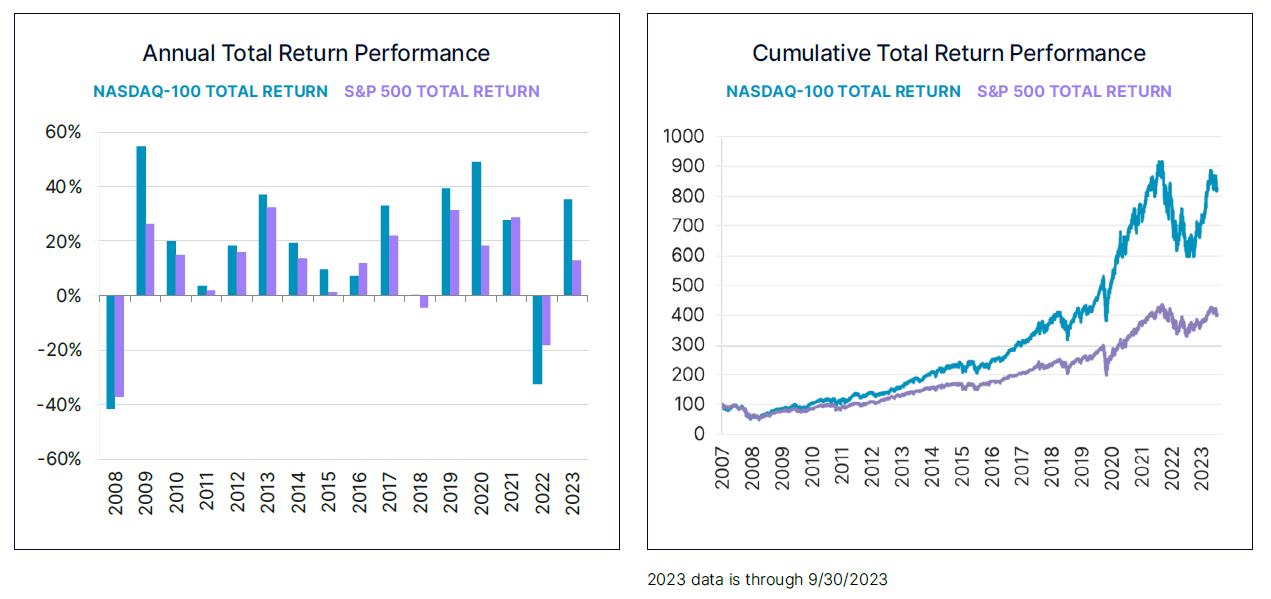
Let's delve into a detailed analysis of their annual total returns, factoring in reinvested dividends. The Nasdaq-100 Total Return™ Index has proven its mettle by outperforming in 12 out of the 16 calendar years in our study, resulting in an impressive average return of +17.5%. In 2022, a notable exception occurred when the Nasdaq-100 lagged the S&P 500 by -14.3%. This marked the most substantial underperformance within our study. This downturn was primarily attributed to the global weakness observed in the Growth stocks segment, which the Nasdaq-100 heavily comprises. However, there's a silver lining in the more recent data. The Nasdaq-100 made a strong recovery over the first three quarters of 2023, outperforming the S&P 500 by a substantial margin of 22.3%. This resurgence was fueled by the recovery of the Technology and Growth-related stocks within the index.

Historical Performance
Amidst recent market volatility, the Nasdaq-100 Total Return Index has consistently sustained cumulative total returns exceeding twice the performance of the S&P 500 Total Return Index.
Rolling Volatility (One Year)
The one-year rolling volatility, calculated by annualizing the standard deviation of daily returns, has shown a slight elevation in the Nasdaq-100 compared to the S&P 500. On average, it has been just 2.6% higher over the period spanning from December 31, 2007, to September 30, 2023. What's particularly noteworthy is the impressive overall correlation of daily returns, which is 93%. This level of correlation is impressive, especially considering the Nasdaq-100's heavy concentration in the Technology sector.
Current Industry Weights
As of September 30, 2023, there are notable disparities in sector allocations between the Nasdaq-100 and the S&P 500. As highlighted earlier, the significant weightings in the Technology and Consumer Discretionary sectors have played a pivotal role in driving the Nasdaq-100 to multiple years of outperformance over the past 16 years.

Conclusion
During the first three quarters of 2023, the Nasdaq-100 exhibited an impressive performance by gaining 35.4% on a total return basis, significantly surpassing the S&P 500's gain of 13.1%. This outperformance can be attributed to the Nasdaq-100's substantial allocations in high-performing sectors like Technology, Consumer Discretionary, and Health Care. Companies within these sectors have demonstrated notable resilience in maintaining their long-term growth trajectory, even in the face of various economic challenges, including concerns about inflation, disruptions in the supply chain, and potential shifts in central bank policies, among other factors. This resilience remains steadfast even in the midst of uncertainty surrounding interest rates. The pervasive influence of technology across global industries, fostering operational efficiency and innovation, underscores the Nasdaq-100's potential to sustain its long-term trend of outperformance. The strength and adaptability of companies within the Nasdaq-100 make them well-positioned for future growth.
Sources: Nasdaq Indexes, Bloomberg
Disclaimer: Nasdaq® is a registered trademark of Nasdaq, Inc. The information contained above is provided for informational and educational purposes only, and nothing contained herein should be construed as investment advice, either on behalf of a particular security or an overall investment strategy. Neither Nasdaq, Inc. nor any of its affiliates makes any recommendation to buy or sell any security or any representation about the financial condition of any company. Statements regarding Nasdaq-listed companies or Nasdaq proprietary indexes are not guarantees of future performance. Actual results may differ materially from those expressed or implied. Past performance is not indicative of future results. Investors should undertake their own due diligence and carefully evaluate companies before investing. ADVICE FROM A SECURITIES PROFESSIONAL IS STRONGLY ADVISED