
Viasat, Inc. VSAT announced a major upgrade to its network capabilities for government and military customers. The company is unifying its Viasat Ka-band satellites, the Global Xpress satellite fleet and select partner satellites into a single, fully integrated global Ka-band satellite communications (SATCOM) network. Fully interoperable with existing MILSATCOM Ka-band systems, this evolved network will deliver seamless, multi-orbit Ka-band connectivity worldwide, enhancing performance, coverage and resilience for missions.
Viasat Government Satcom, within the Communication Services segment, offers scalable service models designed to support multi-mission operations across entire military fleet, supported by abundant capacity and multiple layers of redundancy.
Management highlighted that the unified Ka-band network represents a significant step forward in delivering secure, resilient and high-capacity communications tailored to government mission needs.
What Does Ka-band Network Offer?
Viasat’s expanded Ka-band network will allow government users to seamlessly roam across multiple Ka-band satellite systems powered by an integrated waveform, upgraded gateways and a common ground architecture. This includes Viasat’s own satellites, Global Xpress Ka-band satellites, part of Viasat’s portfolio following the Inmarsat acquisition in 2023, and other commercial and government Ka-band assets. Users operating across different domains will be able to access the entire network through upgraded single-terminal solutions, eliminating the need for multiple hardware configurations.
Built for high performance and global reach, the unified Ka-band network delivers faster connectivity with data speeds of up to 200 Mbps using a 45-cm or equivalent antenna. It incorporates both electronically and mechanically steered beams, providing the flexibility to dynamically allocate bandwidth and deliver secure, dedicated links for mobile government operations. The network also leverages Viasat’s ultra-high-capacity ViaSat-3 satellites, which are designed to rapidly direct bandwidth to areas of concentrated demand. The recently launched ViaSat-3 F2 satellite adds resilience across the Americas, while the planned ViaSat-3 F3 satellite is expected to extend coverage throughout the Asia-Pacific region.
Viasat Inc. Price and Consensus

Viasat Inc. price-consensus-chart | Viasat Inc. Quote
The company’s global network has been specifically engineered to support national security and mission-critical requirements, including dedicated Mil-Ka access and advanced capabilities that enhance protection against jamming, interference and denial threats. As a core element of Viasat’s broader multi-orbit network strategy, the integrated Ka-band capability reinforces the company’s ability to deliver secure, resilient and adaptable connectivity tailored to a wide range of mission needs.
Notably, Viasat is benefiting from strength in information security and cyber defense, space and mission systems. Its strong bandwidth productivity sets it apart from conventional and lower-yield satellite providers that run on incumbent business models. Launch of ViaSat-3 F2 satellite is set to boost Viasat's network capacity in the Americas region and help to provide better performance to end users. The ViaSat-3 platform will help to form a global broadband network with sufficient capacity to allow better consumer choices with an affordable, high-quality, high-speed Internet.
VSAT Stock’s Price Performance
Viasat currently has a Zacks Rank #3 (Hold). Shares of Viasat have surged 286.9% over the past year compared with the Wireless Equipment industry’s growth of 21.1%.
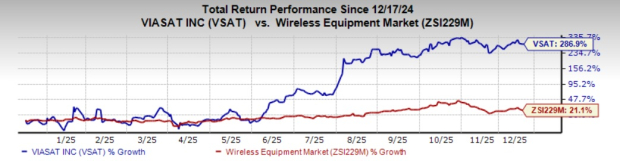
Image Source: Zacks Investment Research
Stocks to Consider From the Computer and Technology Space
Some better-ranked stocks from the broader technology space are Ubiquiti Inc. UI, Ericsson ERIC and Clearfield, Inc. CLFD. UI, ERIC and CLFD currently carry a Zacks Rank #2 (Buy). You can see the complete list of today’s Zacks #1 Rank (Strong Buy) stocks here.
UI’s earnings beat the Zacks Consensus Estimate in each of the trailing four quarters, with the average surprise being 54.15%. In the last reported quarter, Ubiquiti delivered an earnings surprise of 39.52%. Its shares have surged 46.8% in the past six months.
Ericsson earnings beat the consensus estimate in three of the trailing four quarters while missing in one, with the average surprise being 13.51%. Ericsson’s long-term earnings growth rate is 8.4%. Its shares have gained 19.3% in the past year.
Clearfield’s earnings beat the Zacks Consensus Estimate in each of the trailing four quarters, with the average surprise being 92.47%. In the last reported quarter, CLFD delivered an earnings surprise of 44.44%. Its shares have decreased 8.8% in the past year.
Zacks Naming Top 10 Stocks for 2026
Want to be tipped off early to our 10 top picks for the entirety of 2026? History suggests their performance could be sensational.
From 2012 (when our Director of Research Sheraz Mian assumed responsibility for the portfolio) through November, 2025, the Zacks Top 10 Stocks gained +2,530.8%, more than QUADRUPLING the S&P 500’s +570.3%.
Now Sheraz is combing through 4,400 companies to handpick the best 10 tickers to buy and hold in 2026. Don’t miss your chance to get in on these stocks when they’re released on January 5.
Be First to New Top 10 Stocks >>Ericsson (ERIC) : Free Stock Analysis Report
Viasat Inc. (VSAT) : Free Stock Analysis Report
Clearfield, Inc. (CLFD) : Free Stock Analysis Report
Ubiquiti Inc. (UI) : Free Stock Analysis Report
This article originally published on Zacks Investment Research (zacks.com).
The views and opinions expressed herein are the views and opinions of the author and do not necessarily reflect those of Nasdaq, Inc.

