Unrivaled performance! What is the Nasdaq-100®?
This article was first published in Manetatsu online on July 1, 2022. Click here for the original article in Japanese.
Rising prices bring us to a period of diminishing returns on time deposits
Since the collapse of the bubble economy, Japan has been in an economic slump referred to as the “lost 20 years” or even the “lost 30 years”. At the same time, we entered a period of deflation in which prices have fallen, and in our daily lives, we see that the prices are not going up again. In the asset management space, we cannot increase asset value through time deposits due to ultra-low interest rates, and while their value does not technically decrease, time deposits provide a sense of security that is only possible in times of deflation.
However, prices are now actually increasing due to the effects of rising oil prices, labor shortages, and the weak yen from 2021. We are entering into an era of so-called inflation, in which prices will rise, not only in Japan but also globally. As inflation rises, time deposits develop some risks, and the value of your assets will diminish if you just manage your assets with time deposits. What you could buy with 1,000,000 yen today, you will not be able to buy with the same amount 10 or 20 years from now.
Let’s look at an example: Even if you currently have 1,000,000 yen, if prices rise by 2% each year, in 10 years, your current 1,000,000 yen will only be worth 820,000 yen in today’s terms, and in 20 years, it will be worth 673,000 yen in today’s terms. This is an example of “buying power,” i.e., how much your yen would conceivably be able to get you today versus in 10 and 20 years at the aforementioned 2% annual price increase.
Since there is a limit to saving on its own, managing your assets that do not diminish their value is necessary to counter rising prices. Among the many asset management options available, the number of people, including beginners, who invest in stocks and investment trusts, which can be started with relatively small amounts, has been increasing for some time.
Invest in stocks, not just domestically, but overseas
When starting to invest in stocks or mutual funds, it is difficult to know which stocks or products to choose. Since we live in Japan, we are familiar with the stocks of domestic companies and information on corporate performance is readily available, making them an easy choice.
On the other hand, the “lost 30 years” has been a period of low economic growth in Japan, and it is difficult to expect growth in stock prices. Therefore, it is necessary to look overseas, especially to the United States, which has long been experiencing long-term economic growth, as a choice for investment. In the current COVID-19 turmoil, the difference between Japan and the U.S. is becoming even more obvious.
| 2017 | 2018 | 2019 | 2020 | 2021 | |
|---|---|---|---|---|---|
| Japan | +1.7% | +0.6% | -0.2% | -4.5% | +1.6% |
| U.S. | +2.2% | +2.9% | 2.3% | -3.4% | +5.7% |
Sources: National accounts (for GDP calculation) by Cabinet Office, Overview and basic statistics by JETRO, White Paper on International Trade 2019 by Ministry of Economy, Trade and Industry
Many people are hesitant to select individual stocks when purchasing U.S. equities because, although they may know about some top U.S. companies, it is more difficult to obtain information on corporate performance and other aspects of the business than it is for domestic companies. Therefore, if you want to incorporate the high growth rate of the U.S. markets into your own asset management, an investment linked to an index rather than to individual stocks is easy to understand and is a “safe” road to take for beginners and intermediate level investors.
What is Nasdaq-100®?
In the U.S., as in Japan, there are several indices. Among them, the Nasdaq-100 is particularly noteworthy.
Many of you might have heard of Nasdaq. It is one of the leading stock markets in the U.S. and has a high concentration of listings among technology companies, including all of the “big names” under GAFAM (Google, Apple, Facebook, Amazon and Microsoft). Nasdaq attracts not only U.S. companies to list their shares but also international companies, with over 3,000 stocks in all.
The Nasdaq-100 is a modified market capitalization-weighted index of 100 of the largest Nasdaq-listed non-financial companies, including a few international names, such as Lululemon, AstraZeneca and JD.com. The index is reconstituted in December of each year and rebalanced quarterly with a capping mechanism to limit concentration among its largest components.
In the U.S., there is another widely followed large-cap index, the S&P 500, which only includes U.S. companies and requires a committee selection in addition to certain rules, such as profit for four consecutive quarters to qualify as a new index addition.
The Nasdaq-100’s transparent, rules-based index methodology permits the inclusion of companies regardless of their profitability, which may lead to major differences in portfolio construction, such as when Tesla was added to the index in July 2013 versus December 2020 for the S&P 500.
Features of Nasdaq-100
The Nasdaq-100 has the following three characteristics:
- Attractive as a diversified investment target that mitigates risk versus single-stock investing
- Tracks many of the most innovative companies around the world
- High potential for outperformance given its historical record versus S&P 500 and other global benchmarks
These three characteristics make sense when viewed in terms of the Nasdaq-100’s constituent stocks, which include widely recognized, top world brands. It is comprised of stocks from key industries such as computer hardware and software, telecommunications, retail/wholesale trade, and biotechnology.
Specifically, the leading stocks are global high-tech companies such as Apple, Microsoft, Amazon, Alphabet (that includes Google) and Facebook, which create many essential products for consumers and businesses from around the world, including Japan. These are top-notch companies that represent not only the U.S. but also the world due to their unparalleled technological capabilities and know-how.
Additional Nasdaq-100 stocks which were added to the list in 2021 include Airbnb (stay-over brokerage service), Crowdstrike (a U.S.-based cybersecurity tech company), Honeywell (a diversified U.S. industrial brand that is evolving to become an integrated tech company) and Lucid Group (which specializes in electric automobiles).
As with any investment, the Nasdaq-100 is subject to periods of elevated volatility. The index was more volatile during the early 2000s than other U.S. equity market benchmarks but less volatile during the Covid-19 pandemic bear market in 2020. However, it is important to take a long-term view without panicking and without thinking only about the immediate future. In order to have a long-lasting relationship with asset management, a “long-term perspective” is one of the ironclad rules.
| Company/Sector | Symbol | |
|---|---|---|
| 1 | Apple/Technology | AAPL |
| 2 | Microsoft/Technology | MSFT |
| 3 | Amazon.com/Consumer Discretionary | AMZN |
| 4 | Meta Platforms/Technology | META |
| 5 | Tesla/Consumer Discretionary | TSLA |
| 6 | NVIDIA/Technology | NVDA |
| 7 | Alphabet Class C (no voting rights)/Technology | GOOG |
| 8 | Alphabet Class A (with voting rights)/Technology | GOOGL |
| 9 | Broadcom/Technology | AVGO |
| 10 | Adobe/Technology | ADBE |
Symbol: In domestic stocks, the stock code is indicated by a four-digit number, while in the U.S., it is indicated as a symbol to identify individual stocks.
Source: Nasdaq (fact sheet Nasdaq‐100/2021.12.31)
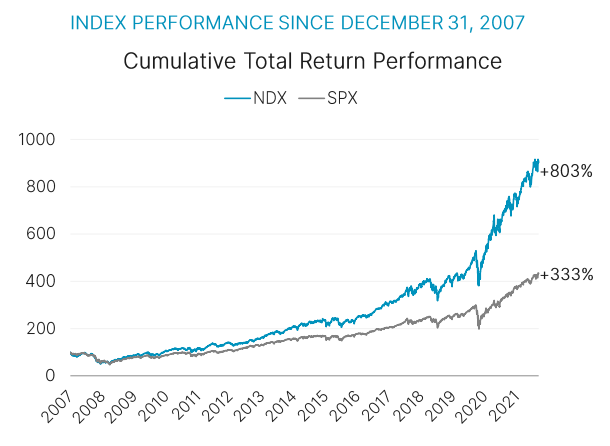
Overall return over the past 14 years is +803%. Unrivaled performance to date
Over the past 14 years, from December 31, 2007, to December 31, 2021, the Nasdaq-100 has had an overall return of +803%, with repeated ups and downs. In comparison, the S&P 500’s overall return over the same period was +333%.
This is about an eight-fold increase, meaning that if you held US$1,000,000 in a fund tracking the Nasdaq-100 as of December 31, 2017, it would have increased to a whopping US$9,030,000 (before taxes and fees) by the end of December 2021. This occurred despite events, such as the Lehman Shock and COVID-19 pandemic, that had a significant negative impact on stock prices along the way. This is truly an unrivaled performance.
Source: Nasdaq, 2021-12-31
Index Performance of Nasdaq-100 and S&P500 (total return)
Index Performance of Nasdaq-100 and S&P 500 (annual return)
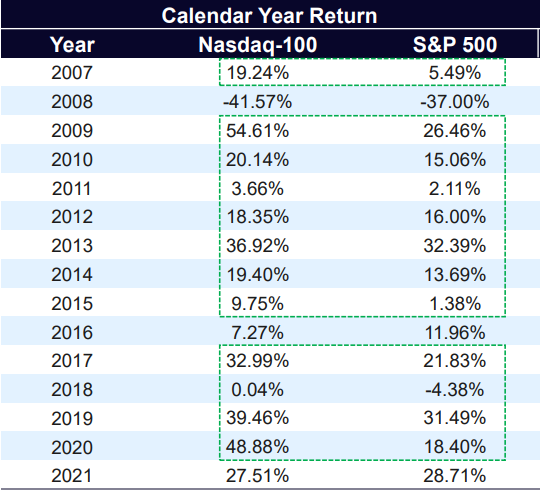
In addition to the overall performance, when we compare the performance of the Nasdaq-100 and the S&P 500 for each year from 2007 to 2021, the Nasdaq-100 has outperformed the S&P 500 12 times out of 15 years, with only marginal underperformance in the other three years. To outperform 12 times out of 15 years is not achieved by chance alone.
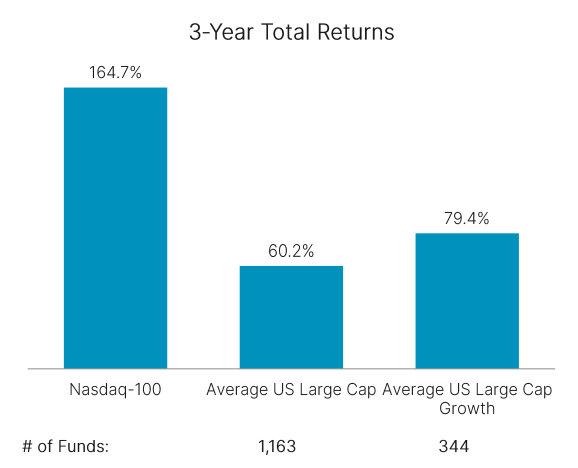
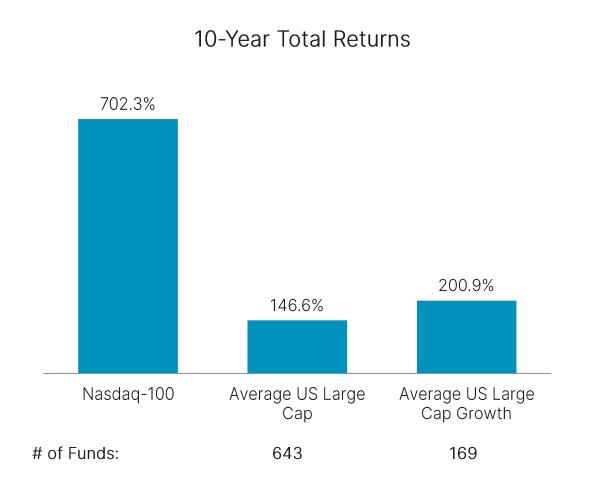
In addition to outperforming the S&P 500 and many other large-cap funds, the Nasdaq-100 has also outperformed the average U.S. large-cap growth fund (across both mutual funds and ETFs) by more than two times in any of the past three, five, or 10 years of total returns.
NASDAQ-100 vs. U.S. Large-Cap Average (3-, 5-, and 10-year total returns)

Unlike the past 30 years, we are now in an era in which asset management based solely on time deposits is diminishing due to future and ongoing price increases, and the less visible risks of time deposits have become apparent. Asset management has become indispensable in solving this problem. The question is, "Where do I start?". If you are wondering what to do, try riding the wave of growth! The appeal of the Nasdaq-100 is that it is an efficient way to track U.S. stocks capturing high-growth sectors and global trends. We should continue to watch the performance of the Nasdaq-100.