
Key Points
CEO Jensen Huang recently announced the company's new Rubin chips are in "full production."
Nvidia expects to bring in revenue of $65 billion in the fourth quarter of its fiscal 2026, which ends Jan. 25.
Nvidia's market capitalization is $4.5 trillion.
- 10 stocks we like better than Nvidia ›
At CES 2026 this month, Nvidia (NASDAQ: NVDA) CEO Jensen Huang discussed the upcoming delivery of the chipmaker's Rubin platform, named for Vera Florence Cooper Rubin, an American astronomer and trailblazer who helped shape our understanding of the universe. Huang touted many of Nvidia's innovations at the trade show, particularly in physical artificial intelligence (AI), but it's the Rubin platform that has analysts most excited for the near term.
Better performance, efficiency, and cost
The Rubin platform is composed of six separate Nvidia chips. Rubin's performance is based on proprietary data. This is what sets it apart from the hardware offered by competitors such as AMD (NASDAQ: AMD). The performance of the Rubin platform will accelerate agentic AI and advanced reasoning while lowering the cost per token for AI inference workloads by as much as 90% compared to the Blackwell platform.
Where to invest $1,000 right now? Our analyst team just revealed what they believe are the 10 best stocks to buy right now, when you join Stock Advisor. See the stocks »
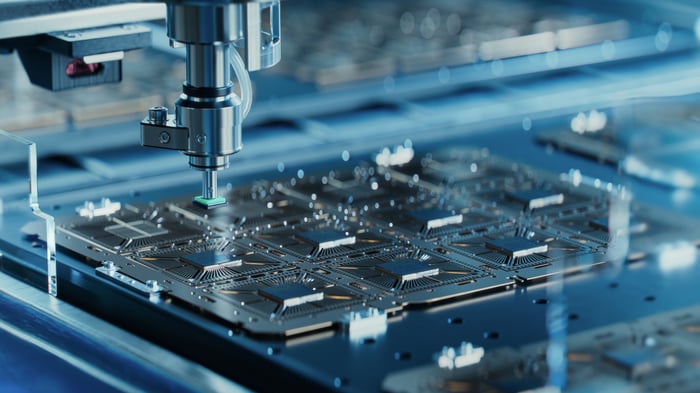
Image source: Getty Images.
The Rubin platform will be a boon for data center operators, as it's expected to have substantial impacts on performance and efficiency at scale. The company, which currently has a market capitalization of about $4.5 trillion, anticipates that Microsoft, Oracle, Amazon, Alphabet, and CoreWeave, among other notables, will be among the first to install the Rubin systems after it begins shipping them in the second half of 2026.
Nvidia still dominates the AI training landscape, but it's now going toe-to-toe with AMD and even some of its own customers in chip design. Most importantly, Nvidia's evolution from chip supplier to end-to-end platform provider will prove a crucial long-term growth engine.
Nvidia's revenue will continue to soar
So what could this next iteration of Nvidia's AI ecosystem mean for the stock? Nvidia anticipates that the combined sales of the Rubin and Blackwell platforms could equal around $500 billion in 2026. Compared to Nvidia's most recent quarterly revenue of $57 billion and its trailing-12-month revenue of $187 billion, that would be a massive step up. And given the size of its sales backlogs for Rubin and Blackwell, investors can have confidence that the company will continue to grow steadily for at least the next few years.
Of course, Nvidia isn't without risk. If demand for AI falters, if there are missteps in the Rubin launch, or if it hits unforeseen speed bumps in converting its current backlog into completed sales, the stock could suffer.
Nvidia's share price growth thus far has been remarkable: It's up by 1,300% over the past five years. Yet even after all that, it trades today at a reasonable forward price-to-earnings (P/E) ratio of about 25 and a price/earnings-to-growth (PEG) ratio under 1. (Stocks with positive PEG ratios below 1 are generally viewed as underpriced.) Considering the promise of the Rubin platform, Nvidia shares look fairly priced or even slightly undervalued. So picking up shares of Nvidia before the Rubin platform starts shipping to customers could be quite a profitable investment if its revenue forecasts are correct.
Should you buy stock in Nvidia right now?
Before you buy stock in Nvidia, consider this:
The Motley Fool Stock Advisor analyst team just identified what they believe are the 10 best stocks for investors to buy now… and Nvidia wasn’t one of them. The 10 stocks that made the cut could produce monster returns in the coming years.
Consider when Netflix made this list on December 17, 2004... if you invested $1,000 at the time of our recommendation, you’d have $482,451!* Or when Nvidia made this list on April 15, 2005... if you invested $1,000 at the time of our recommendation, you’d have $1,133,229!*
Now, it’s worth noting Stock Advisor’s total average return is 968% — a market-crushing outperformance compared to 197% for the S&P 500. Don't miss the latest top 10 list, available with Stock Advisor, and join an investing community built by individual investors for individual investors.
*Stock Advisor returns as of January 12, 2026.
Catie Hogan has positions in Oracle. The Motley Fool has positions in and recommends Advanced Micro Devices, Alphabet, Amazon, Microsoft, Nvidia, and Oracle. The Motley Fool recommends the following options: long January 2026 $395 calls on Microsoft and short January 2026 $405 calls on Microsoft. The Motley Fool has a disclosure policy.
The views and opinions expressed herein are the views and opinions of the author and do not necessarily reflect those of Nasdaq, Inc.

