

Gold is one of the most important metals on the planet. For millennia it has been used in jewelry, art and currency, capturing the collective imagination as a thing of wonder. Gold's association with royalty and wealth has inspired explorers and treasure hunters alike, who put themselves at risk for a chance to strike it rich.
Today, gold's hold on us as a precious metal is no less powerful. Still used for jewelry and as a store of wealth, the metal also has a variety of modern industrial and electronic applications.
Even though gold seems to be everywhere, in reality it's a finite resource. According to the World Gold Council data from 2025, only 219,891 metric tons of gold have ever been mined, and two-thirds of that have been extracted since 1950. Comparing that amount to the more than 700 million metric tons of copper that have been pulled from the ground provides an idea of how precious a resource gold truly is.
For investors interested in gold and the companies that mine it, it’s important to understand global gold reserves and data. This data can provide critical information on the long-term viability of supply and which countries have room to grow.
Data for this article comes from the US Geological Survey's 2026 Mineral Commodity Summary and mining companies' annual reports.
While gold is often measured and discussed in troy ounces, the USGS uses metric tons for its gold data, so this article will contain a mix of the two measurements. For perspective, 1 metric ton of gold is equal to 32,151 troy ounces and worth US$145 million at a price of US$4,500 per gold ounce.
Global identified economic gold reserves currently stand at 66,000 metric tons globally, according to the USGS. This is a significant jump from 64,000 metric tons in the previous report, with reserves for many countries revised to the upside. Read on to learn about the top 10 gold reserves by country.
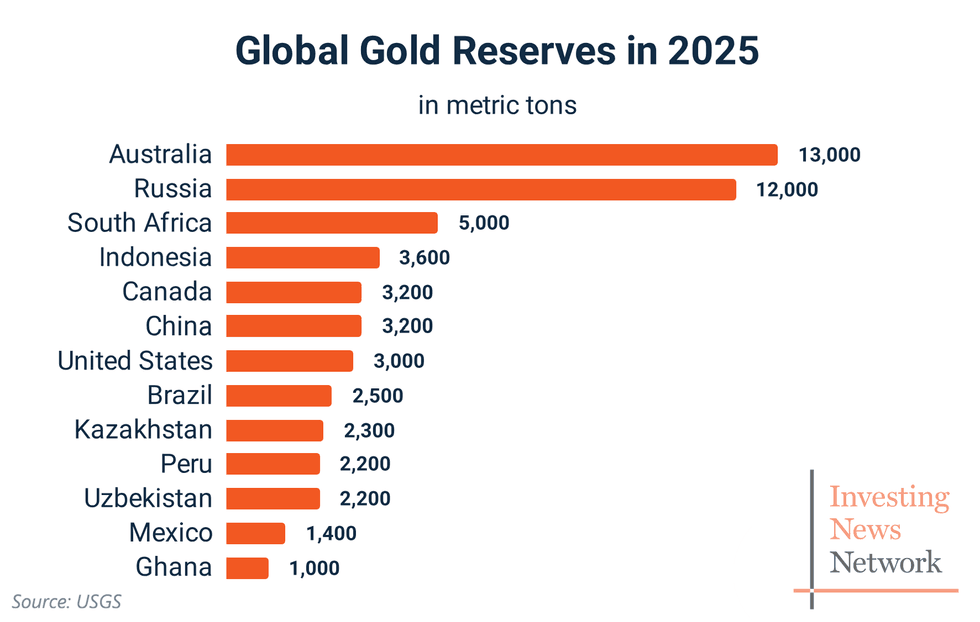
1. Australia
Gold reserves: 13,000 metric tons
Australia contains the highest gold reserves of any nation at 13,000 metric tons, with over 60 percent of its gold deposits located in Western Australia. Its gold reserves were revised upwards from 2024's 12,000 metric tons, breaking its previous tie with Russia.
The mining nation is also one of the world's top producers of gold, with its 280 metric tons mined in 2025 landing it in third place.
Australia is home to many large gold mines, including Newmont's (NYSE:NEM,ASX:NEM) Boddington and Cadia Valley operations, which produced 565,000 ounces and 385,000 respectively in 2025. It also hosts the Tropicana mine, a 70/30 joint venture between AngloGold Ashanti (NYSE:AU) and Regis Resources (ASX:RRL,OTCPL:RGRNF) that produced 436,000 ounces of gold last year.
2. Russia
Gold reserves: 12,000 metric tons
Russia, which has the largest land area of any country, hosts 12,000 metric tons of gold reserves. The majority of the county's gold reserves are located in Eastern Siberia.
Additionally, Russia’s gold output remained steady in 2025 with 310 MT extracted. Russia has several large gold mines, but none are more prolific than Polyus’ (MCX:PLZL) Olimpiada mine in the Krasnoyarsk Krai region of Siberia. According to the company's most recent data, the mine produced 926,000 ounces in 2025.
Russian gold is having difficulties reaching most markets following the country's invasion of Ukraine. The London Bullion Market Association halted trading and removed Russian refiners from its accredited list in March 2022. However, a significant portion of the metal was exported to the United Arab Emirates following the sanctions, according to Reuters, and Russian gold has also made its way into the country's stockpiles.
3. South Africa
Gold reserves: 5,000 metric tons
South Africa remains a powerhouse in terms of global gold reserves at 5,000 metric tons, and the country's Witwatersrand Basin is among the top gold jurisdictions in the world.
Although South Africa remains comfortably in the top three countries for reserves, the country has lost some of its luster when it comes to production. At the turn of the century, South Africa was the top gold-producing country, with 431 metric tons extracted in 2000. The country's output has slowly fallen in the decades since, and has hit all-time lows in recent years — South Africa produced just 90 metric tons of gold in 2025.
One reason for lowered production is decreasing gold grades, which have led miners operating in the country to move to greater depths. In fact, eight of South Africa's gold mines are among the world's 10 deepest mines for any commodity, with AngloGold Ashanti's (NYSE:AU,JSE:ANG) Mponeng gold mine topping the list at 2.4 kilometers to over 4 kilometers below surface. This has made industrial mining operations prohibitively expensive and more dangerous.
Harder to reach resources and problems with the country's electricity grid have resulted in limited investment in exploration as companies looked to lower cost projects in other countries like Australia and Canada.
4. Indonesia
Gold reserves: 3,600 metric tons
Indonesia is home to 3,600 metric tons of gold reserves, the fourth highest globally. While this was steady year-over-year, the country's reserves are up significantly from the 2,600 metric tons reported for 2023.
Indonesia is home to the Grasberg complex, one of the world's largest gold operations and host to 23.9 million recoverable gold ounces. Operated by Freeport-McMoRan (NYSE:FCX), Grasberg includes several underground mines and the Kucing Liar deposit, which is currently being developed.
Once Kucing Liar is operational, Freeport expects it to deliver an additional 520,000 ounces of gold per year for 6 million total ounces between 2029 and 2041.
5. Canada
Gold reserves: 3,200 metric tons
Canada, another one of the world's largest countries, hosts 3,200 metric tons of gold reserves. The country's reserves had remained constant since 2012 at around 2,300 metric tons, but received a sizeable increase in 2024.
The country has more than doubled its gold output in that time, jumping from 97 metric tons in 2012 to 200 metric tons in 2025.
Canada has a rich history of gold mining since the metal was first discovered in Québec in the early 1800s. Mining operations can now be found across Canada, but just under 70 percent of the country's gold is produced in the eastern provinces of Ontario and Québec, at 40 percent and 28 percent respectively. Other significant producers are British Columbia with 9 percent and the Yukon with 3 percent.
Canada has a number of very large gold mines, the largest of which is Agnico Eagle Mines' (TSX:AEM,NYSE:AEM) Canadian Malartic Complex in Québec. The mine produced 642,612 ounces of gold in 2025 and hosts proven and probable gold reserves of 1.4 million ounces.
Because of its well-established natural resource sector, Canada is leading the way in sustainable initiatives to protect the environment and communities. The Mining Association of Canada’s Toward Sustainable Mining initiative has been adopted by organizations around the world, including those in Australia, Finland, Brazil and the Philippines.
5. China
Gold reserves: 3,200 metric tons
China hosts 3,200 metric tons of gold reserves, tying it for fifth place globally. The large nation is another country whose economic reserves have increased significantly in recent years, in this case jumping from 1,900 metric tons in 2022 to 3,000 in 2023.
While its reserves land it in fifth, China has held first place in global gold production since 2007. China's Shandong province is home to some of the country's biggest gold deposits and mines, including the Jiaojia and Sanshandao mines.
Many of the country's gold-mining companies are wholly state-owned, but there are several state-backed companies with significant gold mines that are partially publicly traded.
This includes one of the country's biggest miners, Zijin Mining Group (HKEX:2899), whose Shanxi gold mine produced 177,250 ounces of gold in 2025. Another is China Gold International Resources (TSX:CGG,HKEX:2099), which owns a 96.5 percent stake in the Chang Shan Hao gold mine located in the autonomous region of Inner Mongolia. Chang Shan Hao produced 96,816 ounces of gold last year.
In addition to its high gold reserves and production, China also has a strong impact on thegold marketthrough significant purchases by the People's Bank of China in recent years. At the end of 2025, the Chinese central bank held an estimated 2,306.3 metric tons of gold.
7. United States
Gold reserves: 3,000 metric tons
Gold reserves in the United States have remained steady at 3,000 metric tons since 2012. The country is home to well-developed infrastructure, highly experienced companies and an advanced workforce. However, over the last decade, production and refinement of the yellow metal in the US has been in a slow decline, dropping from 230 metric tons in 2012 to 160 metric tons in 2025.
The largest gold-mining assets in the US are Turquoise Ridge, the Cortez Complex and the Carlin Complex, which are all owned by Nevada Gold Mines, a joint venture between Barrick Gold (TSX:ABX,NYSE:GOLD) and Newmont. Between them, the mines produced 2.59 million ounces of gold in 2025 with 1.59 million ounces and 999,000 ounces attributable to Barrick and Newmont respectively.
8. Brazil
Gold reserves: 2,500 metric tons
Brazil currently has 2,500 metric tons of economic gold reserves. Home to the first modern gold rush over 300 years ago, the country has an undeniable history with the precious metal. As for production, Brazil's 80 metric tons of gold in 2025 landed it just outside the top 10 gold producers.
The largest gold mine in Brazil is AngloGold Ashanti's AGA Mineração operation in Minas Gerais. In 2025, the mine produced 273,000 ounces of gold, and hosts 1.84 million ounces of proven and probable reserves as of the year's end. Additionally, G Mining Ventures (TSX:GMIN,OTCQX:GMINF) declared commercial production at its Tocantinzinho mine in September 2024; in 2025, its first full year in operation, the mine produced 171,871 ounces.
However, gold mining in Brazil has a darker side as well. Illegal operators are impacting both sensitive rainforest ecosystems and local Indigenous communities. Despite government crackdowns, new operations continue to pop up throughout the Amazon.
9. Kazakhstan
Gold reserves: 2,300 metric tons
Kazakhstan's gold reserves total 2,300 metric tons, landing the country in the top 10 of this global gold reserve list for the second year in a row after its gold reserves received a sizeable boost of 1,300 metric tons in the 2025 USGS report.
The jump is owed to a significant increase in exploration, which saw 23 new deposits, including 20 metric tons of gold, added to the country's subsoil registry. Launched in 2023, the registry has helped to streamline the exploration process and allowed modern technology to be applied to historical data sets.
Kazakhstan’s largest gold-mining operation is the Altyntau Kokshetau mine in Northern Kazakhstan. It produces gold from the Vasilkovskoye gold deposit, which hosts 40 million tonnes of ore reserves at a grade of 2.1 grams per metric ton.
The mine is owned by Kazzinc, a 69.6 percent owned subsidiary of mining giant Glencore's (LSE:GLEN,OTCPL:GLCNF). In its 2025 production report, Glencore stated that it produced 543,000 ounces of attributable gold across all its Kazakhstan assets, the majority of which came from the Altyntau Kokshetau mine.
10. Peru
Gold reserves: 2,200 metric tons
Gold has been an important part of Peru’s economy for centuries. The country has a well-documented mining industry, and it ranks as one of the top nations in the world when it comes to gold reserves. Its gold reserves peaked in 2022 with 2,900 metric tons before falling to 2,200 metric tons in 2025.
Peru's gold production saw a slight increase last year to 110 metric tons, from 108 metric tons in 2024.
Large players make up the bulk of Peru's gold industry, with major miner Newmont leading the way at Yanacocha, the biggest gold mine in Peru. In 2025, output from the mine reached 515,000 ounces of gold, a significant jump from the 276,000 ounces produced just two years earlier.
There are also artisanal operations in the country, along with operations being run by criminal organizations. While environmental concerns are common in the mining industry, illegal and small-scale gold miners often employ mercury during the extraction process, which is very damaging to the environment. To counteract illegal mining operations, the Peruvian government instituted Operation Mercury in 2019, which involved military interventions at illegal mine sites and the destruction of mining operations.
For small-scale and artisanal mining, programs such as the Fairmined Ecological Gold certification exist to encourage environmentally friendly mining methods by introducing premium prices for gold that meets particular requirements. This also allows gold buyers to identify gold from legal operations that reduce the use of toxic treatments like mercury during the extraction process.
Don’t forget to follow us @INN_Resource for real-time news updates!
Securities Disclosure: I, Dean Belder, hold no direct investment interest in any company mentioned in this article.
The views and opinions expressed herein are the views and opinions of the author and do not necessarily reflect those of Nasdaq, Inc.

