

Please find Running Oak's most recent performance and letter below. Prior letters can be found at Nasdaq.
Why Invest in Efficient Growth:
- Top 6 percentile: Running Oak’s Efficient Growth separate account has performed in the top 6% of all Mid Cap Core funds - despite being historically out of favor - in Morningstar's database over the last 10 years, net of fees.1
- Opportune: A little known - yet very large - hole exists in the typical equity portfolio, precisely where the most attractive risk/reward asymmetry currently lies. Efficient Growth fills that hole - and opportunity - like few portfolios do.
- 5 Stars: Efficient Growth has a 5-Star Morningstar rating.
- Since inception, Efficient Growth has provided 18% more return than the S&P 500 Equal Weight Index, given the same level of downside risk, gross of fees. (Ulcer Performance Index)*

Differentiated Approach and Construction
- Mid Cap stocks are at their cheapest in 25 years relative to Large. Efficient Growth provides significant Mid Cap exposure.
- Efficient Growth is built upon 3 longstanding, common sense principles: maximize earnings growth, strictly avoid inflated valuations, protect to the downside.
- Running Oak utilizes a highly disciplined, rules-based process, resulting in a portfolio that is reliable, repeatable, and unemotional.
How to Invest
- Efficient Growth is currently available as an SMA and ETF. (ETF specifics and SMA historical performance can't be shared in the same letter - sorry, it's annoying, I know. Please inquire for the ticker or more information.)
- In just over 2 years, The ETF Which Shall Not Be Named has grown over 19,000% since launch - from 2 to 382mm.
Performance Update
- Running Oak’s Efficient Growth portfolio was up 1.65%, gross of fees (1.61%, net), in August.*
"Toga! Toga! Toga!" – Bluto, Animal House
An advisor recently shared that he is pairing Efficient Growth with the QQQ, saying Efficient Growth is his clients’ designated driver – there to get them home safely, while the QQQ brings the fun. In his words, the market is a historic party. His clients’ friends, coworkers, neighbors, hair stylists, Uber drivers are all partying. His clients, too, want to party, and telling them they can’t attend isn’t an option. That would get him fired. Therefore, he has opted for a balance between what clients think they want (speculation) with what he knows they will want – but have forgotten - in the long term (discipline and risk aversion). He can’t have a revolt:
“What? Over? Did you say ‘over’? Nothing is over until we decide it is! Was it over when the Germans bombed Pearl Harbor? Hell no! And it ain’t over now!”– Bluto, Animal House
I am regularly asked my opinion on how to best use our Efficient Growth strategy within a larger, diversified portfolio. Our longest relationships utilize it just as I would:
Core
- Efficient Growth sits in the asymmetric risk/return sweet spot of MARGE (Upper Mid/Lower Large). MARGE is the intersection of two asymmetries, that between Small and Large and the over-invested barbell of Large and Small.
- It’s Growth-y, but the discipline around valuations and risk bring it to the middle and away from the excesses.
Foundational
Reliable – The strategy’s rules-based investment process is repeatable, disciplined, unemotional and, therefore, reliable.
Consistent – The rules ensure that the portfolio consistently has the same qualities: higher earnings growth, attractive valuations, lower downside risk. That consistency makes it easy to build a diversified portfolio around; it isn’t a moving target.
Rock-like – Over 36 years, Efficient Growth outperformed the S&P 500 and did so with roughly 50% of the downside risk.* Downside risk is a primary focus in both security selection and portfolio construction. The portfolio is diversified across companies (mid 60s on average), industries (30+ on average), and equally-weighted.
Weighting
Our longest relationships utilize Efficient Growth in the above manner, allocating between 10 and 30% of client assets. Investing in too many strategies and too little in your best ideas is suboptimal, adds complexity, makes your life more difficult, and likely leads to just getting beta at a higher cost.
Your Clients' Designated Driver
The stock market is currently a historic rager. In the words of OpenAI CEO, Sam Altman, "When bubbles happen, smart people get overexcited about a kernel of truth.” He added, “Are we in a phase where investors as a whole are overexcited about AI? My opinion is yes. Is AI the most important thing to happen in a very long time? My opinion is also yes.” On several occasions, he clearly appeared to compare AI to the Tech Bubble. The internet was world-changing; investors also got overexcited, and many were hurt.
Consider the following:
- Households have roughly 30% more of their net worth invested in stocks than at the peak of the Tech Bubble.
- Roughly 55% of equity assets are now invested in 1 approach, 1 portfolio construction: cap-weighted/passive/index funds.
- A record 41% of the S&P 500 is invested in only 10 companies.
- The forward PE of those 10 largest holdings is well beyond that of the 10 largest at the very peak of the Tech Bubble.
Completely overlooked but adding considerable risk to the above:
- Large Cap Growth managers are all-in on the same tiny number of stocks; that has been the only way to keep up. The only way to beat insanity is to be more insane.
- Individuals, if they own single stocks, own the same tiny number of stocks.
In Looney Tunes terms, here’s what the typical portfolio looks like:

Buy Low, Sell High vs. Buy High, Sell Never
Remember that mantra? Buy Low, Sell High – once the most trite (because it was the most obvious) proscription of successful investing – has somehow been replaced with Buy High… and Higher... and Higher, Never Sell. Efficient Growth is an excellent complement and – in several obvious ways – the exact opposite of passive investing, providing true diversification from what many own far too much of.

Uncertainty
I’m not saying the Passive Momentum Money Train is going to end in a fiery crash… yet. It appears inevitable, but anything can happen, and I’m also not predicting when. 55% of equity investment can’t be driven by Buy Higher, And Higher, And Higher, Sell Never indefinitely. Valuations well beyond the Tech Bubble are a clear sign of the irrationality of such a practice. However, there are numerous dynamics driving the market: AI (both real and imaginary), record stimulus and deficits, Fed cuts, etc. While valuations and irrational investing warrant caution, I’m pro investing thoughtfully and the American spirit.
“But you can’t hold a whole fraternity responsible for the behavior of a few sick, perverted individuals. For if you do, then shouldn’t we blame the whole fraternity system? And if the whole fraternity system is guilty, then isn’t this an indictment of our educational institutions in general? … Well, you can do what you want to us, but we’re not going to sit here and listen to you badmouth the United States of America!” - Otter, Animal House
Reasons to Consider a Designated Driver Imminently
“We can’t have anyone freak out out there, okay? We gotta keep our composure! We’ve come too far! There’s too much to lose!” – Frank the Tank, Old School
"UBS has sounded an alarm over the U.S. economy, saying its proprietary model places the risk of recession at 93% based on “hard data” covering May through July 2025. While the bank stopped short of making an official recession call, it described the probability as “historically worrying” and pointed to a meaningful risk of stagnation ahead." - Unusual Whales
It isn't just UBS.

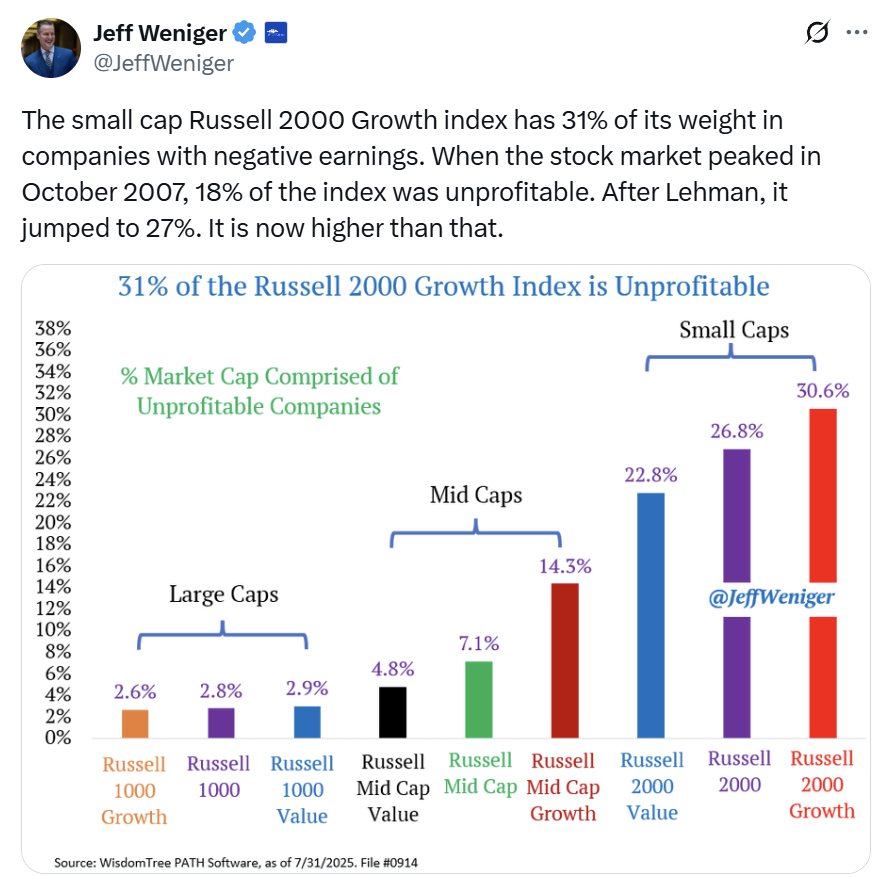
Higher than post Lehman...
Sun Microsystems, the poster child of Tech Bubble valuations, topped out around 10x Price to Sales. Roughly, 35% of the S&P 500, by weight, is over 10x. That's nuts.

With foam? The most volatile of stocks are up roughly 100% in only a few months, the best run since 2004.

Pump and... dump?

Quick hitters:
Consistently Not Stupid - Running Oak in 3 Words
Invest Where Others Aren't (MARGE - Upper Mid/Lower Large Cap)
- Investing where everyone else is investing means higher prices, higher valuations, lower implied returns, higher implied downside.
- Investing where others aren't means lower prices, lower valuations, higher implied returns, lower implied downside and a margin of error.
- Investing where others aren't also provides valuable diversification.
- If the market goes up, others are likely to follow, propelling prices.
- If the market goes down, others can't sell what they don't own, meaning less selling and downside pressure.
It's win/win.
Running Oak's goal is to maximize the exponential growth of clients' portfolios, while subjecting them to far less risk of loss. In other words, we aim to help your clients realize their dreams and avoid their nightmares.
If you appreciate critical thinking, math, common sense, and occasional sarcasm, we would love to speak with you. Please feel free to set up a time here: Schedule a call.
And if you're going to be sick, please roll down the window.
Seth L. Cogswell
Founder and Managing Partner
Edina, MN 55424
P +1 919.656.3712
For additional data and context regarding the claims made within this letter, please refer to the Disclosures and Additional Data document located here.
Investment Advisory Services are offered through Running Oak Capital, a registered investment adviser.
The opinions voiced in this material are those of Running Oak Capital’s, do not constitute investment advice, and are not intended as recommendations for any individual. To determine which investments and strategies may be appropriate for you, consult with us at Running Oak Capital or another trusted investment adviser.
*Past performance is no guarantee of future results. Performance expectations are no guarantee of future results; they reflect educated guesses that may or may not come to fruition. All indices are unmanaged and may not be invested into directly.
*Returns prior to September of 2013, while unaudited, were documented and generated on a real-time (not back-tested) basis. Such results are from accounts managed at other entities prior to the formation of Running Oak Capital. It reflects the strategy’s performance since the beginning of 1989. Downside risk is calculated by dividing the average drawdown of the strategy, observed on a quarterly basis, by the average drawdown of the S&P 500 index since 1989.
*Statements regarding the large gap in the middle of the typical equity allocation reflect the opinion of Running Oak Capital This is based on informal feedback and experience from interactions with investors and other financial professionals. Further, statements on where the most attractive risk/reward asymmetry lie, although based on observable data, reflect the opinion of Running Oak Capital.
*Statement regarding Mid Cap stocks outperforming Large is reflective of historical performance of the Russel Midcap Index vs Russell 1000 Index.
*Source of Mid Cap undervaluation & Large Cap overvaluation: Bloomberg
This email transmission and any documents, files or previous email messages attached to it may contain information that is confidential or legally privileged. If you are not the intended recipient, you are hereby notified that you must not read this transmission and that any disclosure, copying, printing, distribution, or any action or omission of this transmission is strictly prohibited. If you have received this transmission in error, please immediately notify the sender by telephone at (919) 656-3712 or return and delete the original transmission and its attachments without reading or saving in any manner.

Latest articles

This data feed is not available at this time.
Data is currently not available