Credit:
 By True North Alger :
Despite Snap's ( SNAP ) lackluster performance since going public in March of 2017, Apple ( AAPL ) recently revealed that Snap's Bitmoji and Snapchat apps were the number one and two most downloaded apps in the US in 2017 , respectively. Snap has gotten a lot of flak for calling itself a "camera company" and many investors took this in the literal sense: that Snap wants to sell camera hardware, like Spectacles and drones . While Snap CEO Evan Spiegel has said hardware will eventually become an important part of Snap's business in the next decade , in simpler terms Snap defined itself as a camera company because it believes that the camera is the next major computing platform (a la PC, the smartphone, etc) and it is setting itself up to be the camera that consumers use to bridge the digital and physical world (more on this later). Based on the iOS download rankings provided by Apple, it looks like Snap is well on its way to doing so.
On Snap's Q3earnings call Spiegel stated that Snap's three priorities for 2018 were user growth, content, and augmented reality. While I touched on how the Snapchat redesign may help spur growth , and will do another write-up on Snaps' content strategy at a later date, I wanted to give my thoughts on Snap's augmented reality ambitions.
Defining the Opportunity in Augmented Reality
"Augmented reality" (( AR )) in itself is an ambiguous word. I define AR as any form of digital data or media that is viewed within the context of the real, physical world. Virtual Reality (( VR )) on the other hand exists in an entirely different, computer generated space. Finally, Mixed Reality ((MR)) can be thought of as a sort of in-between state of AR and VR. These definitions are often used interchangeably by the media, marketing materials, and management teams on conference calls. When I refer to AR throughout this piece, I am specifically referring to the blend of the physical and digital as defined above.
Allison Wood, CEO of Camera IQ (which helps companies build marketing and advertising experiences for smartphone cameras), predicts that " Camera media will be bigger than TV ". This is a bold statement, and most likely not realistic until you realize that AR is entirely experienced through a camera (currently smartphones, and eventually smart glasses). What she refers to as "camera media" is augmented reality.
And AR is truly a revolutionary concept. In the words of Matt Miesnieks (great resource for understanding AR, will link to his work below), "through all of history we have consumed visual content through a rectangle (from stone tablets, to cinema, to smartphones, etc.) and AR is the first medium that is completely unbound ."
At the same time as being completely unbound and everywhere, AR can be very scarce. Experiences and content can be delivered and targeted unique to each user, and certain events and ads can be tied to specific physical places in the real world - a McDonald's ( MCD ) logo on the field of a baseball game, a one-day-only promotional coupon appears as a collectible AR Pepsi logo in Times Square, etc. All of these lead to content, marketing, and branding opportunities that are completely unimaginable in a non-AR environment.
Initially, the most successful apps and experiences in AR will be features tacked on to native mobile apps (think 3D arrows giving you directions in Google ( GOOG ) (GOOGL) Maps instead of 2D… or Snapchat lenses). Eventually, technology and consumer adoption of AR will get to a point where entirely new experiences that have not yet been imagined are capable. Watching entire TV shows or music videos collectively as a group at a stadium in AR, exploring old buildings that have been completely re-imagined in AR, or interactive 3D games that play out over a user's living room are a few potential thoughts that come to mind. This video of " Augmented, Augmented Reality " gives a hint at just one of the many possibilities that will evolve over time.
Matt has a nice piece explaining where the true value-add will come in AR, which is in controlling the AR Cloud . It is a relatively easy read in comparison to his overviews of Apple's ARKit and Google's ARCore , both of those very informative as well. Matt describes the AR Cloud as such:
He predicts that there will be many different versions of the AR Cloud, presumably each company having its own (or perhaps overseeing some sort of open network). While I think it is nearly impossible to actually predict exactly how a concept like the AR Cloud will evolve, I think it is valuable to understand in the context of how it relates to Snap's AR strategy. Snap wants to own the world's camera usage, acting as the bridge between the digital and physical world.
Examining the Release of Snap's Lens Studio
On Snap's Q3 '17 call, Spiegel mentioned that Snap's Lens Studio product was going to see a wider release, specifically in terms of the community. While writing this piece, Snap officially released its Lens Studio product on December 14 th , a slightly stripped down version from the one it uses internally. This 29 second video gives us a brief overview of the product.
TechCrunch says it is designed for simplicity , allowing basic 2D image overlays to immersive AR characters. This significantly opens up to door to who can use the product, and opening the Lens Studio up to everyone (not just advertisers) is the same approach Snap took with its popular geofilters product back in 2015. Snap recently stated that more than 95% of geofilters on the platform are community made, and Snap could use a similar strategy with AR as it did with geofilters.
Per TechCrunch: "Developers can build static or animated objects, 2D cutouts, windows into other worlds, floating picture frames, and even 3D objects that react when you tap, look at, or approach them." Based on a tweet from Snap's Chief Strategy Officer Imran, it seems Netflix (NFLX) took advantage of Lens Studio to create its viral Stranger Things 3D World Lens it released on conjunction with the show's second season. The lens can be seen in action here , which gives us an idea of what is possible in Snap's Lens Studio. Here is another example of a 3D lens made in the studio, which sort of reminds me of Snapchat's dancing hot dog from this past summer. This one of a dancing Donald Trump is amusing as well.
After a quick moderation process, users are given both a Snapcode and a deeplink to share the lens on other platforms (as well as in the physical world using the Snapcode). Additionally, lenses will be able to be sent to other users over Snap's internal chat system (basically the same way they are already creating and sharing 3.5 billion snaps per day), essentially giving lenses created by both the community and brands the opportunity to go viral if users share. Lens creators will also see metrics on how often their lens has been used or shared.
Aside from being open to the community, this release also marks the first time that advertisers can create 3D world lenses for the front-facing camera without going through Snap's internal ad team (still required for face lenses, which Snap appears to be withholding as a premium ad unit). Per Digiday, lenses can be created in Snap's Lens Studio in as little as an hour . Advertisers will also be able to work with Snap's seven new creative partners to create custom lenses, cutting down the historical six to eight week development period when working with Snap to only a few days (which also required a $300,000 minimum ad spend). Now brands can buy CPM distribution of their Snapchat Lens in the camera app's carousel for a cost of $8-$20 CPM based on targeting , which is lower than almost all premium video content on all large platforms .
Before it was mentioned on the Q3 call, I had a hunch that Snap was working on building out these sort of capabilities. Back in February of 2017, Snap hired longtime Adobe VP David Salesin to lead a new research group at the company. Per the link:
I think the current state of Snap's Lens Studio will continue to evolve, and it will be interesting to see the direction they choose to go with it.
Facebook's AR Studio
A day prior to Snap's Lens Studio, Facebook ( FB ) announced its AR Camera Effects Platform and AR Studio were in open beta (more details here ), which were first announced at its F8 Conference in April (the same day Snap first announced world lenses ). Here is a video highlighting Facebook's Camera Effects platform (which is essentially a web-based platform on Facebook's website).
Here is a video I was able to find previewing Facebook's AR Studio product, with another available here . At 0:31 in the second video, the interface where the 3D render is being created looks completely different than the first. Further, in this video of the Stranger Things world lens Netflix ran with Facebook (which I was not able to find any press on), you see the Facebook AR Studio appear at 0:18, going on to show a few other screenshots of an external editing software (that we are maybe supposed to believe is also Facebook's AR Studio?). If you pause at 0:19, however, you see that the interface is exactly identical to Autodesk's 3D animation software, Maya (see screenshot here ).
Based on some of the quick shots of the interface of Snap's Lens Studio in links above, the two appear similar: you create your 2D/3D art elsewhere (Sketchpad, Maya, Blender , etc) and import into the respective program to port them into the apps.
This tweet thread highlights how Snap's product appears to be much better: "On my initial overview, Lens Studio looks incredible - it blows AR Studio out of the water. Audio, Pairing, Interactivity w/ Events, Snapcode integration, Lighting/Shadows. Best-in-class development ecosystem for the AR era". Snap also rolled out 11 detailed documentation videos , which will no doubt help jumpstart development on the platform.
Is Facebook Really Killing Snap?
Much has been said about the battle between Facebook and Snap. My thoughts are summarized in detail in prior writings, but my belief is that Facebook has ultimately run into the problem of no one actually using its in-app camera, which makes developing for Facebook's camera much less attractive than Snap's (in addition to Snap's studio software appearing better at the moment). One of Facebook's primary competitive advantages is the AI it deploys to curate/target ads in its news feed (it took years to develop, and only took Instagram engineers five weeks to tweak for Instagram when its feed went algorithmic ), and I do not see Facebook ever cannibalizing its AI-powered news feeds in Facebook or Instagram to fully embrace the camera (will touch more on Instagram Direct below).
I believe that one AR platforms will eventually win out, or at least be much more profitable than the others (how Microsoft (MSFT) "won" PC's, Google "won" search, Facebook "won" social, etc). Having great tech will be important, but it seems to have been commoditized with all of the advances in computer vision and machine learning, especially with AR Kit and AR Core being baked into every new smart phone. I believe that Snap still has a sizeable lead when it comes to AR simply due to its massive network of extremely engaged users. Snapchat is also incenting developers to create AR that interacts with the world around them, whereas Facebook appears to be starting with face lenses to get users to actually start using its in-app camera in the first place (same strategy used by Snapchat when it introduced face lenses in the summer 2015). Snapchat's decision to push world-interacting AR may very well give it a head start in developing a network of usage and engagement with the aforementioned AR Cloud.
Below remains a good summary of my thoughts on the network effect of Snapchat's messaging network:
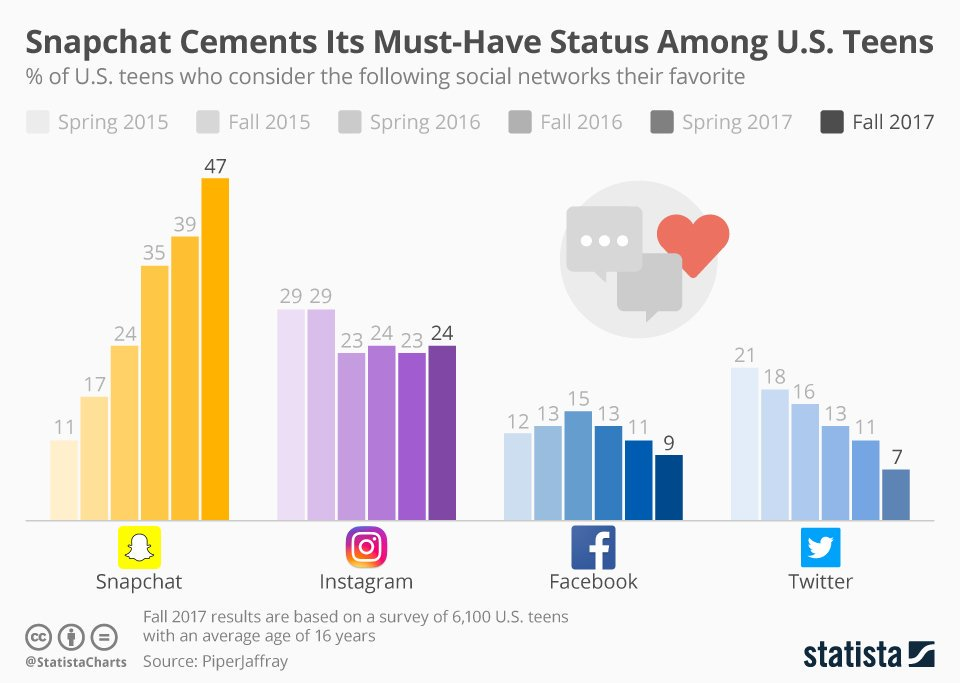
Also supporting my thoughts on Snap's staying power is Pipar Jaffray's recent Fall 2017 Taking Stock with Teens report. This bi-annual report showed that Snapchat is now the favorite social media platform of 47% of teens in the US - up from 11% in the Spring of 2015, and up from 24% in the Spring of 2016 (the survey prior to the release of Instagram Stories).
Since Snap was first founded in 2011, Facebook has made no shortage of attempts to crush Snapchat. Snap declined a $3 billion buyout offer from Facebook in December of 2012 (was rumored to be higher ), and the next day Facebook launched its first Snapchat clone, Poke (shut down in 2014). After being unable to acquire Snap in the fall of 2013, Facebook acquired WhatsApp in February of 2014 for a final price tag of $22 billion (originally $19 billion, adjusted post-close). Facebook also added messaging to Instagram in August of 2013, and recently announced it would be ripping that messaging feature out of Instagram and force users to download a new app called Direct, just like it did with Facebook Messenger (another shot at Snapchat). Facebook launched Slingshot in the summer of 2014 ( shut down December of 2015 ) and Instagram launched Bolt in July of 2015 (never got enough users to take off). This tirade of attacks seemed to finally see some success in August of 2016 when Instagram launched Stories.
Why does any of that matter? It shows that competition from Facebook is nothing new. True, Spiegel and co-founder Bobby Murphy are young (it was reportedly Murphy's idea that they could build a business around the camera). But they have consistently defended Facebook's attacks. Snapchat actually saw US monthly active users (MAUs) decline by approximately 20% in the summer of 2014 (which Snapchat said was due to a seasonal decline in engagement during the summer in its S-1 ), so slowing/declining user growth is nothing new. Spiegel and Murphy reportedly bought Sun Tzu's Art of War for all six of their employees when Snapchat declined Facebook's buyout offer in 2012, and Snap took on the corporate strategy of attacking Facebook where it was weak. As stated below, Facebook is very effective as a one-to-many communication model, not as a network for close friends. Snapchat on the other hand was able to create the first extremely tight-knit network of interpersonal communication in the smartphone era, as it was an area where Facebook was weak. Snap then leveraged its interpersonal messaging network to build premium content (vs the clickbait popular on Facebook), advertising (full screen, skippable vertical videos that play with sound by default), and now augmented reality networks.
Facebook finally found a hit with Stories for the simple reason that influencers (athletes, celebrities, etc.) already had millions of existing followers on the platform and were able to quickly reach every single one with a medium that was familiar to its userbase. Snapchat historically made it very difficult to amass a large following , and has been known for historically not courting celebrities or influencers (which could be changing with Snap's new Discover Feed that shows users content based on their interests, not on who they are following). Instagram Stories allowed these influencers to quickly blast posts that appeared top of the Instagram news feed, ensuring their post would not be lost within the algorithmic Instagram feed. I have always assumed that a very low % of Instagram users are actually using the camera to create content, and Facebook has been very vague on numbers that show its usage.
Snap has told us that approximately 107 million users create on its camera daily (60% of its 178 million Q3 user base), whereas Facebook gives no such numbers. Facebook has disclosed that Instagram Stories, WhatsApp, and Messenger Day have 300 million , 300 million , and 70 million users using these "stories" features on a daily basis, respectively, however it does not give any breakdown of how many users are actually creating stories versus just viewing the stories of celebrities, influencers, or small businesses and brands; or a geographic breakdown of where those users are located. Both these are important. When it comes to creating, each message pushes a notification to multiple users that brings them into the ecosystem (a pulling mechanism that gets more difficult to pull off effectively as users reduce the amount of content they are directly sharing on the platform). On the viewership side, the value of those viewers to advertisers also comes in to play as well. Sure, Snapchat has fewer users around the world, but the charts in this article show the majority of Snap's user base is located in the largest advertising markets in the world .
Is Instagram Direct: Too Little, Too Late?
Facebook recently announced that Instagram was taking its internal messaging featuring, Direct, and ripping it out into its own separate app , which will open to the camera, not a news feed (its most blatant Snapchat clone to date). Ripping messaging out to create an entirely new app is the exact same playbook Facebook executed with its own in-app messaging system , forcing users to download Facebook Messenger back in 2014.
I remain highly skeptical that Instagram Direct will actually spur significant usage of Instagram's in-app camera, at least in comparison to Snapchat. It competes directly against Snap's competitive advantage, camera-based messaging, an area where Facebook has much less data than Snap. The majority of Instagram messaging is the sharing of news feed posts and/or text messages responding to a story. Ripping this out into an entirely new app and completely changing the core use case of its messaging feature, while a bold move by Facebook (and probably a necessary move at this point to slow down Snapchat's increasing dominance of the camera), may end up hurting engagement in the core-Instagram app in the long-term if fewer users are sharing and discovering new content over the messaging system. On the other side of this, the animation between Instagram and Direct seems to be seamless (the video also shows us that the user only sent and/or received five messages over Instagram in the 37 weeks prior to downloading Direct, which supports earlier my point).
Obviously, Facebook's goal here is to get a critical mass of users engaging with the camera in at least one of its apps, which will help court more advertisers and developers to generate AR content and advertising on the platform. Most likely, Facebook will eventually allow Direct users to share messages or "stories" to other app's in Facebook's portfolio too (similar to how it recently let users post their Instagram Stories to Facebook ). But that will probably be more effective at increasing vertical video ad inventory, as you see musicians and celebrities cross-posting their Instagram Stories to Facebook Stories, not necessarily increasing camera usage by a critical mass of every day users.
The new camera-first Instagram Direct may very well end up being too little, too late. Snapchat's camera-centric messaging network has a massive established user base of teenage and young adult users in the developed world, users who are more likely to engage directly with a camera for messaging than an older user. Snapchat has disclosed that over one third of its users interact with Snap's AR lenses every day, with the average Snapchat user spending over three minutes per day doing so. Three minutes multiplied by 178 million users gives Snap over 534 million total minutes (or 500 million years ) of AR playtime per day. That can be used not only for ad inventory, but also provides a rich set of data collection on how users interact with AR. Additionally, it also means that one third of Snapchat users plays with lenses for nine minutes per day - which, again, based on Snapchat's user demographics, is going to be heavily tilted towards young users in developed advertising markets.
Marketers Prefer Snapchat for Augmented Reality
Brands and marketers looking to explore opportunities in AR seem to realize how much more reach Snapchat has as well: Marketers say Snapchat blows its competitors away when it comes to AR advertising . Despite this article predating the public release of Snap and Facebook's respective AR developer tools, advertisers have been using both Snap and Facebook's AR features for quite some time.
For example, HBO ran promotional AR face lenses for Game of Thrones seventh season (Snapchat in mid-July , Facebook in late-August ). Over the course of about a week in 16 countries, the "Game of Thrones" lens got over 122 million total impressions, with more than 45 million individual users posting or viewing the sponsored selfies (compared to 224 million views for Taco Bell's May 2016 Cinco de Mayo campaign , which is the overall record-holder for sponsored Snapchat lenses). According to Snap, the average user played with the Game of Thrones lens for 23 seconds. The average for a sponsored lens on Snapchat is 15 seconds, which in of itself is incredible when you think of trying to get that same audience of 59 million (one third of Snapchat's 178 million users) to actually watch a video ad in a Facebook or Instagram news feed (that plays without sound by default) for at least 15 seconds. I have not been able to find any sort of metrics for Game of Thrones' Facebook campaign, but my hunch is that it was used much less than the Snapchat lens.
The Game of Thrones Snapchat lens performance was undoubtedly boosted by promotions by the show's stars Kit Harrington , Sophie Turner and Nikolaj Coster-Waldau on Twitter ( TWTR ); but they promoted the Snapchat filter in the first place due to Snapchat's unmatched reach within Game of Thrones target audience. This in itself is a testament to Snap's network effect of early AR adopters, which I believe is further bolstered by Snap's content agreements with literally every major TV network. These sort of partnerships go beyond just Time Warner (TWX). which owns HBO - but includes the likes of A&E Networks , ABC , BBC , CBS (CBS), NBC (SNL, Jimmy Fallon, The Voice), MGM , Scripps Networks , TBS , and Viacom (VIA), which have all signed agreements to not only produce content, but many of them to also sell ad space within their Snapchat content. This has helped bring their traditional TV advertisers onto Snapchat, and gets them accustomed to using Snap's ad auction platform.
The networks also have a vested interest to use their talents' social media followings to send their viewers to Snapchat (as seen in the Game of Thrones example above) in order to watch their made-for-mobile, vertical content, essentially creating a flywheel of sorts that continues to create more Snapchat usage. While not a new strategy, the release of the Snap's new Lens Studio will allow marketing teams to efficiently whip up Snapchat lens campaigns for nearly every movie or TV show, then leverage both Snap's vertical video ads and the social media followings of the shows talent to quickly distribute the lens to millions of fans.
The Importance of Physical Location in AR
The market seemed to shrug off Snap's acquisitions of Placed and Zenly in the summer of 2017, however they highlight Snap's growing ambitions to bridge the digital and physical worlds. Placed seems to relate to Snap's Snap to Store ad product (lets advertisers measure if an ad caused a user to visit a store and/or make a purchase), and has proprietary tech that measures physical building outlines. Placed's technology may prove vital to not just Snap's own internal mapping of the digital/physical worlds, but also generate revenue externally as Snap chose to have Placed run independently and continue to measure location attribution for other advertisers.
Zenly is very similar to Snap's internally developed Snap Map product and was reportedly acquired despite Snap creating the Snap Map internally on its own . In my opinion, this shows that Snap saw the importance of owning location-based media and chose to acquire one of the larger players in the space. Zenly is also used more like a video game than a social network , potentially precluding ways that management may continue to gamify Snapchat in the future. Snap has given zero indication on how Zenly is doing, however looking at the twitter feed of the CEO of Zenly gives you an idea of both how much it is being used (look at how many friends that user has on the map), and also where it is growing growing . His Twitter feed is filled with retweets of photos of young Japanese users with nearly a hundred friends on the map - a large advertising market that Snapchat has had trouble penetrating amidst the sea of Asian messaging apps. Zenly's artwork is also very eclectic, seeming to put it in a favorable spot to slowly introduce AR concepts to the app's interface over time.
All said, location will be extremely important in AR. There will be many successful concepts that incorporate a user's immediate environment (like IKEA's AR app ) into an app, but in order to have true staying power, the AR experience will need to be matched with the world (which is what made Pokemon Go so successful). And Snap appears to be setting itself up to be very successful in both AR and location attribution.
Snap's Augmented Reality Advertising May Increase Margins
Facebook saw success in the initial move to mobile as it was able to create a massive inventory of mobile ad inventory by creating a newsfeed rich with interesting content. Advertisers had many way to reach mobile users, but Facebook was able to leverage the way that users interact with content in its news feed to target ads better than anyone had done before. Snap can do the same with content in its own app (and has already been doing so, which I will detail at a future date), as well as capture a unique black box of data using image and audio recognition presented every time a Snapchat user sends a snap .
When it comes to AR, advertising can be unlimited ( unique targeted lens experiences ), while also being very controlled (one advertiser is able to control the digital world associated with a specific location). AR may very well bring back the scarcity model that existed in traditional TV advertising. And Snap is not new at implementing AR engagement and measuring ad attribution.
Snap acquired Bitmoji , a "digital avatar" of sorts, in the first half of 2016. Snap rolled out 3D Bitmoj's back in September and two weeks ago we saw the first sponsored Bitmoji from McDonald's . As referenced above, Apple reported that Bitmoji was the #1 most downloaded iOS app in the US in 2017. While hard to tell exactly how many consumers have their own Bitmoji character since Snap has not released any user numbers, Bitmoji has been intertwined with Snapchat, and I believe that Bitmoji represents the first " AR Avatar " to really gain a critical mass of users in the developed world. Friendmoji's (two friends' Bitmoiji combined in the same image) and Actionmoji (your Bitmoji appears in-app based on your actual activity) both add to Bitmoji's network effect: the more people that have it, the more useful it becomes for existing and new users. And not specifically related to AR, the Bitmoji app also gives Snap a back-door to collect data in every other messaging app, as Bitmoji can be used within any app with a keyboard (Facebook, Facebook Messenger, WhatsApp, etc).
As a branding tool, a Snapchat AR ad is as immersive as it gets. Snap has many case studies on its website showcasing the success that some of the largest brands in the world (who Snap has historically targeted over SMB's). This presentation by Snap's Global Head of Creative Strategy, Jeff Miller, at NY Advertising Week back in September highlights how Snap offers many more creative ad possibilities than Facebook (while not mentioning Snap's over 300 targeting capabilities). Snap's AR products are great for large brands because it spurs consumers to "play" with the brand. The presentation linked above shows Jeff playing around in Snapchat with his three year-old daughter (begins at 1:40), in which they try three different lenses. Two of them were ads, and the kid loved each one. This is ultimately the goal of these massive brands (with massive ad budgets): to get consumers to interact with and fall in love with their brand.
And by removing the bottleneck of Snap's in-house design team, it puts Snap (and its advertisers) in a position to quickly scale ad campaigns.
Snapcodes are produced for every AR lens and distributed everywhere - digitally on other social media platforms or a brands website, but also in the physical world. Here it's on product packaging (Evian and Wendy's (WEN) here ), stickers to hand out at company events, on clothing (example from Coach (COH) here ), on TV, or even on the doors of businesses. The classic "add us on Facebook" marketing strategy required users to look them up; a Snapcode allows users to bypass the keyboard and immediately access content by simply scanning with the Snapchat camera. And there are supposedly " 160 undecillion " possible Snapcodes, so it is unlikely Snap will run out any time soon. In addition to Snapcodes, a "deep link" is provided with each lens created in Snap's Lens Studio, which can be shared outside Snapchat. This will open Snapchat directly to the lens, and can even be utilized within Snapchat itself by deep linking to lenses in Snap's vertical video Snap Ad format bought on Snap's Ad Manager.
It is important to remember that Snap is still building out its ad products and showing the market its monetization strategy. As we have seen time and time again, Snap continues to roll out new, innovative products (on both the consumer and advertising side). While developing these is evidently expensive, the costs related to these significant announcements post-IPO have been baked in over the last two years. Snap's employee count has increased from 330 at the end of Q3 '15 to 2,995 two years later (per Snap's Q3earnings call, an increase of over 800% (The Information also reported that Snap hired more employees in Q1 and Q2 of 2017 than they expected to hire in the entire year ). We are just now going to start seeing the beginning of what kind of revenue a fully automated, affordable, made-for-mobile, targeted, augmented reality advertising system truly looks like. This revenue is likely to come at a relatively low marginal cost as employee costs are relatively fixed and Snapchatters are already racking up large hosting expenses doing nearly the same thing. This could give a significant boost to Snap's margins as it grows revenue.
And it is not like Snap's ad business has not been growing. Snap said on its Q3 '17earnings callthat ad impressions were up over 400% year-over-year (with ad load still "very low" according to management). The lower than expected Q3 revenue was driven by Snap's effort to move its ad business to its new progmmatic ad auction. Management said average ad pricing dropped 60% year-over-year, as 80% of Q3 ad sales were delivered progmmatically. The move to a progmmatic auction is very important as it lets everything on the platform be purchased automatically and to target specific users. Originally, all ads were placed manually through its sales reps - which is much slower and less scalable. 2018 will be the first year where every ad product on Snapchat is available on-demand - Snap Ads in Discover, World Lenses, Geofilters, Stickers (good write-up on potential of stickers ), the same system that has made Facebook and Google so profitable. Eventually, I predict advertisers will be able to bid on digital/physical space around the world in real-time (similar to geofilters), but that is most likely still a few years away.
The aforementioned drop in ad prices also reportedly puts Snap's CPM's around $8-20 (and as low as $2.50 in some cases ), which compares to premium digital ad prices on Facebook, Google and other digital properties ($2-6 for display, and $12-20 for video ). CPM's on traditional TV can be anywhere from $14 to $80 . Snap first set advertisers pricing expectations very high in order to gain traction in its ad business. By lowering prices in-line with other digital ad products, it may help Snap build a near monopoly on camera-based advertising. We saw this play out with geofilters; Snap was the de facto due to controlling the camera usage of anyone who would be receptive to that sort of ad.
It will take a significant effort for a competitor to build out a comparable advertising platform on the camera, especially while most likely not being able to charge any sort of premium over Snapchat lenses or other digital ads due to Snap's scale (same as Google in search and Facebook in social). Facebook and Google are probably in the best position to challenge Snap. But as I stated previously, I do not see Facebook cannibalizing its news feed to truly challenge Snapchat's dominance of the camera. And Google's Lens/Pixel integration is impressive, but it lacks the social network to implement it at the same scale as Snapchat, hence why I believe it offered $30B to buy Snap .
Conclusion: The Camera as a Platform and Why Spectacles are Still Important
Tying back in to the AR Cloud and the bridge between the physical and digital world, owning the bridge between these (the camera) will create immense shareholder value. The camera is going continue gaining more significance as smart glasses approach mainstream adoption. While we are obviously still years away from that point, it makes sense to own and build in that space now in order to be in a favorable position for the future.
Owning the camera today gives Snap sway to get developers to start adding utility to its camera platform. Not much has been said on Snap's context cards , but it is a first look at Snap's attempts to bring outside developers onto Snap's camera platform. Developers will need scale of users in order to justify building, and so will advertisers. Snap has partnered to bring reviews, (TripAdvisor (TRIP), Foursquare, Goop), restaurant reservation tools (OpenTable, Bookatable, Resy), and ride hailing (Uber (UBER), Lyft (LYFT)) to Snapchat. Many other apps, new forms of media, and games will eventually be developed on the camera as well. While Snap has some experience developing camera-based games on its platform, Tencent's (TCEHY) 12% stakes becomes an interesting component in this regard as they bring in a whole new layer of expertise running MMO's like League of Legends and King of Glory .
While Spectacles very first iteration has been declared a flop, Spiegel described Spectacles as a toy ; an experiment in AR/VR. The first iteration of the product highlighted a areas it needed to improve, specifically an instance where the charging case caught on fire and a lack of battery longevity and photo-taking options. While I do not expect Spectacles to drive significant revenue growth in the immediate future, I believe Spectacles will be instrumental in Snap's long-term strategy.
Evan Spiegel is known to be an admirer of Steve Jobs , and I believe Snap will take the same approach to Spectacles that Apple did with the iPod and iPhone. The first few iterations of the iPod only played music. Apple added video capabilities, introduced 3G connectivity, added the iPad, and continued to evolve (and gain a sticky user base) with each product cycle, getting it to the point where it is at today. The iPhone we know today may not have existed if it were not for the iPod.
I believe Spectacles will follow a similar path. The first product was basically a video recorder on your face. It was simple, but was also practical in the sense that it looked similar to the sunglasses kids wear to music festivals . Spectacles also solved the problem of having to use at least one hand to record video. The next version of the product is rumored to incorporate augmented reality (which would make sense in light of recent company announcements). Future generations will most likely incorporate data connectivity (currently connects to a users phone via Bluetooth), ability to instantly upload to a Snapchat account (currently a manual process), ability to actually live stream from Spectacles, integration with other external apps, more advanced AR capabilities, eye tracking, etc.
This is why Spectacles are important to Snap's long-term strategy - not how many it sells in Q4 '17, but over the next decade. The CEO of Pinterest (PINIT) recently said the camera will be the next keyboard . Snap said the same in its S-1 . The next major operating system, smart glasses, will be built on the camera, and Snap is in a prime position (and a supposed 15-year product road map ) with its massive user base of young, early adopter users in wealthy markets.
See also Omega Healthcare Investors: A 9.2% Yield And Big Upside Are Still Up For Grabs on seekingalpha.com
The views and opinions expressed herein are the views and opinions of the author and do not necessarily reflect those of Nasdaq, Inc.
The views and opinions expressed herein are the views and opinions of the author and do not necessarily reflect those of Nasdaq, Inc.