
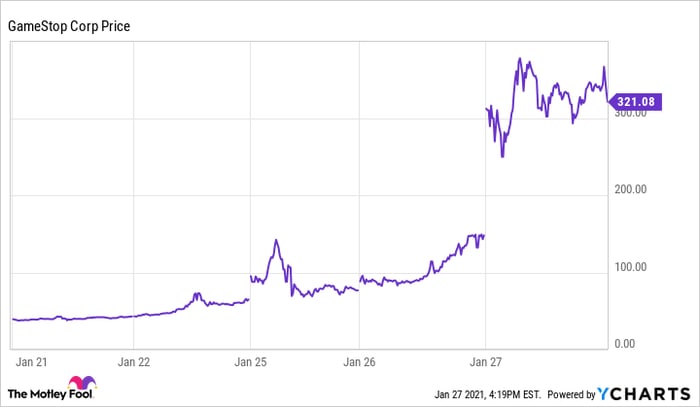
GameStop's (NYSE: GME) share price is up over 670% in the last five days alone. Fueling the rise is a group of individual traders who use social media sites like Reddit, Discord, Facebook, and Twitter to discuss opportunities to profit in the stock market. Still, volatility in the stock is also extreme, and it can be hazardous for someone trying to buy and sell it with the hopes of short-term gains. As Andrew Left of Citron Research accurately describes it, "It's just a get-rich-quick scheme."
Undoubtedly, many are profiting tremendously from the rapid rise in its share price, but should you buy into the GameStop hype?
Data source: YCharts.
What will the future hold for GameStop?
Ultimately, GameStop is a retailer that gets a significant portion of its revenue from the sale of physical copies of video games in a world where sales are transitioning to digital versions. Still, there is a group of the most active gamers who prefer physical copies. That's because a physical copy of a game can be re-sold after one is finished or bored with a certain game. The same cannot be done with a digital copy. Until this point, game developers are not offering digital games at much of a discount compared to their physical counterparts. As long as this dynamic exists, GameStop is a viable company with a sustainable business model.
However, that may not be enough to justify having 5,000 stores across 10 countries as GameStop does. Indeed, the company is already well into its plan of what it calls de-densification, which basically means that it's reducing the number of locations in operation.

GameStop shares are on a meteoric rise. Image source: Getty Images.
The recent launches of intensely popular next-gen gaming consoles from Sony and Microsoft make GameStop management confident that sales will get a boost in 2021 and beyond. Still, over the last decade, revenue has decreased for GameStop at a compounded annual rate of 3.3%. And while it may get a boost in sales from next-gen consoles and games, it may not be enough to offset declines from sales moving to digital channels. Even if it did turn around sales growth from negative to positive, the gains are likely to be modest.
What about GameStop's valuation?
Data source: YCharts.
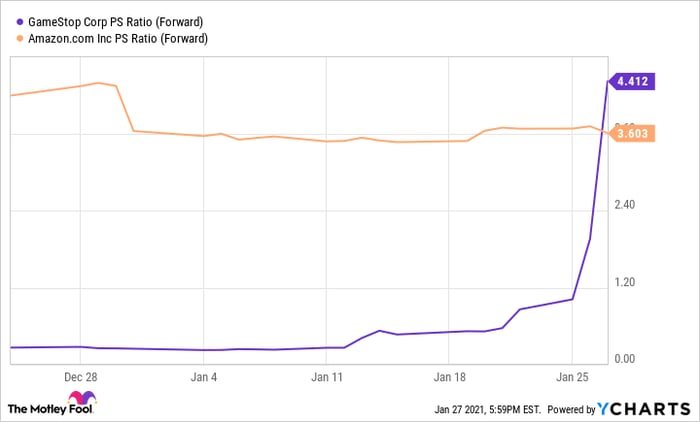
The rise in its share price is leading GameStop's stock to be trading at astronomical valuations. For instance, GameStop is trading at a forward price-to-sales ratio of 4.4 as of this writing. Comparatively, Amazon is selling at a forward price-to-sales of 3.6. Admittedly, this is not an apples-to-apples comparison, but it just goes to demonstrate that GameStop's valuation is getting expensive. And it would be hard to argue the merits of a valuation for GameStop that surpasses that of Amazon.
That being said, no law says the stock price cannot remain elevated. However, as a long-term investor, it is prudent to weigh a company's prospects and valuation and compare it to other opportunities you have with your hard-earned money. And from that perspective, it does not make sense to buy into the GameStop stock hype.
10 stocks we like better than GameStop
When investing geniuses David and Tom Gardner have a stock tip, it can pay to listen. After all, the newsletter they have run for over a decade, Motley Fool Stock Advisor, has tripled the market.*
David and Tom just revealed what they believe are the ten best stocks for investors to buy right now... and GameStop wasn't one of them! That's right -- they think these 10 stocks are even better buys.
*Stock Advisor returns as of November 20, 2020
John Mackey, CEO of Whole Foods Market, an Amazon subsidiary, is a member of The Motley Fool's board of directors. Teresa Kersten, an employee of LinkedIn, a Microsoft subsidiary, is a member of The Motley Fool's board of directors. Randi Zuckerberg, a former director of market development and spokeswoman for Facebook and sister to its CEO, Mark Zuckerberg, is a member of The Motley Fool's board of directors. Parkev Tatevosian owns shares of Facebook. The Motley Fool owns shares of and recommends Amazon, Facebook, Microsoft, and Twitter and recommends the following options: long January 2022 $1920 calls on Amazon and short January 2022 $1940 calls on Amazon. The Motley Fool has a disclosure policy.
The views and opinions expressed herein are the views and opinions of the author and do not necessarily reflect those of Nasdaq, Inc.

