
Key Points
Over the past year, UltraPro S&P 500 ETF has gained 26%.
Vanguard S&P 500 ETF has risen nearly 15% over the past year.
There's an important lesson for investors around leveraged ETFs when you compare leveraged ETFs to non-leveraged ETFs.
- 10 stocks we like better than Vanguard S&P 500 ETF ›
Who wouldn't want to consider themselves a "pro" at investing? So when you see an exchange-traded fund called UltraPro S&P 500 ETF (NYSEMKT: UPRO), you might think you've found the perfect tool to build wealth. Over the past year, it has beaten a boring old S&P 500 index fund like Vanguard S&P 500 ETF (NYSEMKT: VOO) by over 10 percentage points. Think twice before you buy UltraPro S&P 500 ETF; the leverage it employs may be more than you can handle.
What does UltraPro S&P 500 ETF do?
UltraPro S&P 500 ETF is what is known as a leveraged ETF. Its goal is to produce a return that is three times larger than the return of the S&P 500 index each day. So, if the S&P 500 rises 1%, UltraPro S&P 500 ETF aims to gain 3%. To achieve this, it uses fairly complex investment techniques, but the real story for investors boils down to the time period that is being targeted: one day.
Will AI create the world's first trillionaire? Our team just released a report on the one little-known company, called an "Indispensable Monopoly" providing the critical technology Nvidia and Intel both need. Continue »

Image source: Getty Images.
In fact, the ETF's webpage clearly warns, "For any holding period other than a day, your return may be higher or lower than the Daily Target. These differences may be significant." If you are a long-term investor, you need to tread very carefully with an investment that is focused on achieving a daily goal.
It's a basic math problem
First, remember that the S&P 500 index goes up and down over time. Second, you need to keep in mind that the three times performance goal cuts both ways. And third, you need to consider the basic math of returns.
If a stock is trading hands at $10 and falls to $5, the loss is 50%. To get back to $10, a 100% gain is required. This is the math that works against you during downturns when you have a leveraged ETF as a long-term holding. The chart below is telling.
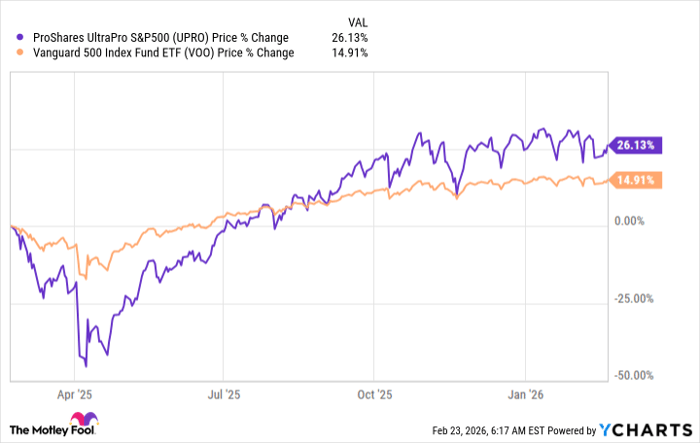
Vanguard S&P 500 ETF rose nearly 15% over the past year, but UltraPro S&P 500 ETF increased by only 26%, which is nowhere near three times the gain of the S&P. The reason is the massive share price decline in early 2025. That drop was way worse than the corresponding drop in Vanguard S&P 500 ETF, leaving UltraPro S&P 500 ETF with a huge hole to dig out of.
The risk-return profile of owning a leveraged ETF over the long term leans heavily toward risk. These ETFs admit that they aren't likely to live up to the multiples they target on a daily basis over the long term. And unless you are willing to endure painful drawdowns during bear markets, the long-term reward probably isn't worth it.
Should you buy stock in Vanguard S&P 500 ETF right now?
Before you buy stock in Vanguard S&P 500 ETF, consider this:
The Motley Fool Stock Advisor analyst team just identified what they believe are the 10 best stocks for investors to buy now… and Vanguard S&P 500 ETF wasn’t one of them. The 10 stocks that made the cut could produce monster returns in the coming years.
Consider when Netflix made this list on December 17, 2004... if you invested $1,000 at the time of our recommendation, you’d have $456,188!* Or when Nvidia made this list on April 15, 2005... if you invested $1,000 at the time of our recommendation, you’d have $1,133,413!*
Now, it’s worth noting Stock Advisor’s total average return is 916% — a market-crushing outperformance compared to 194% for the S&P 500. Don't miss the latest top 10 list, available with Stock Advisor, and join an investing community built by individual investors for individual investors.
*Stock Advisor returns as of February 28, 2026.
Reuben Gregg Brewer has no position in any of the stocks mentioned. The Motley Fool has positions in and recommends Vanguard S&P 500 ETF. The Motley Fool has a disclosure policy.
The views and opinions expressed herein are the views and opinions of the author and do not necessarily reflect those of Nasdaq, Inc.

