
Following a beating in 2022, semiconductor stocks stormed back in the first half of 2023 before pulling back over the past few months. Below are 5 reasons the worst is over for semiconductors:
Historical Seasonality Trends
Equity investors often utilize historical seasonality trends as a valuable tool to gain an edge in the market. By analyzing past price movements and patterns specific to certain times of the year, investors can identify recurring trends in stock and industry performance. It’s difficult to find a more robust and reliable historical seasonality trend than the semiconductor stocks. The PHLX Semiconductor Index was higher 80% of the time over the past twenty years for an average gain of 3.9%. Select individual names do even better in November. For example, Advanced Micro Devices (AMD) has been higher 8 of the past 10 Novembers for an average gain of 15.9%. Meanwhile, industry group peer Nvidia (NVDA) has racked up gains of 9.1% on average over the same time.
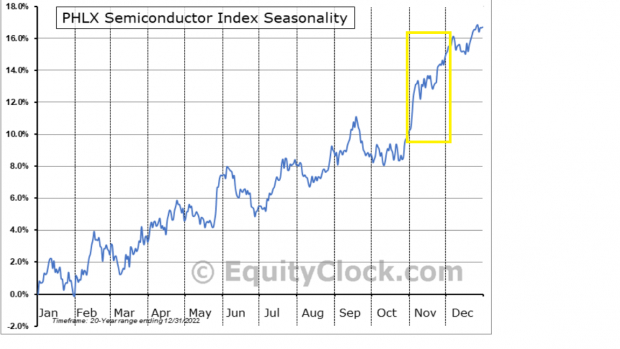
Image Source: Equity Clock
Strong Earnings
Thus far this earnings season, semiconductor earnings are mixed. For example, ON Semiconductor (ON) plunged more than 20% after reporting disappointing earnings. That said, industry leaders such as AMD and Intel (INTC) have produced impressive results.
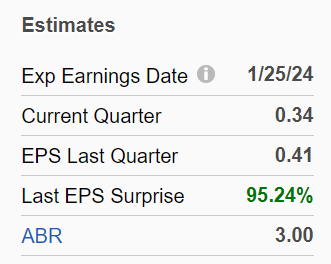
Image Source: Zacks Investment Research
AI Investment is Proliferating
Earlier this week,Arista Networks (ANET), a leading provider of cloud networking solutions, reported blockbuster earnings growth of 46% year-over-year. Arista’s earnings prove that the AI revolution is still in the early innings because as artificial intelligence technologies continue to advance, the demand for high-performance, low-latency networking infrastructure rises. Semiconductors are another group of stocks that directly benefit from growth in AI.
End of Year Institutional “Window Dressing”
On Wall Street, the term window dressing refers to the practice where institutional money managers make their portfolios appear more attractive or healthier than they actually are to clients, especially before reporting periods like quarterly and annual statements are due. To dress up their portfolios, many managers will sell laggards and buy into high-performing ones just before the reporting date. By showcasing these stronger assets in their reports, fund managers aim to impress clients by creating a false impression of the fund’s performance. In other words, the manager shows that the fund did not miss out on the year’s big winners. With the Semiconductor Index ETF (SMH) up ~40% year-to-date (and many individual names like NVDA up more), institutional investors are likely to pile into semiconductors into year-end for window dressing purposes.
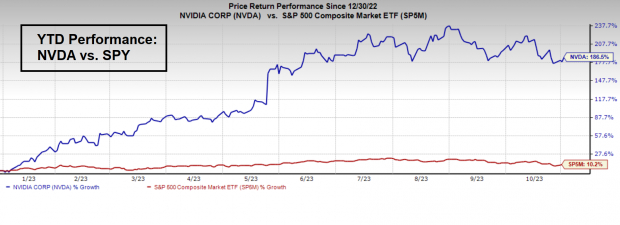
Image Source: Zacks Investment Research
Bullish Technicals
Though many investors have become bearish on semiconductors after the latest correction, the longer-term chart patterns show signs of life. For example, industry leader AMD is finding support at its rising 200-day moving average and is poised to break a downtrend line going back to June.
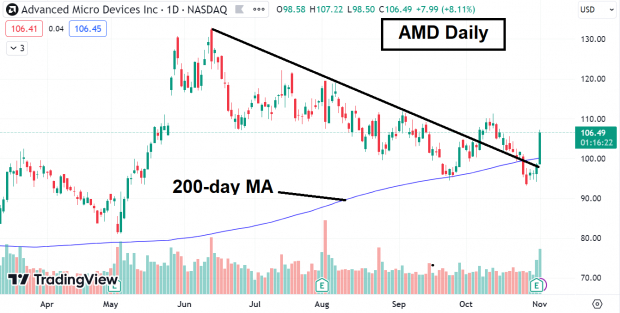
Image Source: TradingView
Zacks Names #1 Semiconductor Stock
It's only 1/9,000th the size of NVIDIA which skyrocketed more than +800% since we recommended it. NVIDIA is still strong, but our new top chip stock has much more room to boom.
With strong earnings growth and an expanding customer base, it's positioned to feed the rampant demand for Artificial Intelligence, Machine Learning, and Internet of Things. Global semiconductor manufacturing is projected to explode from $452 billion in 2021 to $803 billion by 2028.
See This Stock Now for Free >>Intel Corporation (INTC) : Free Stock Analysis Report
Advanced Micro Devices, Inc. (AMD) : Free Stock Analysis Report
NVIDIA Corporation (NVDA) : Free Stock Analysis Report
VanEck Semiconductor ETF (SMH): ETF Research Reports
Arista Networks, Inc. (ANET) : Free Stock Analysis Report
ON Semiconductor Corporation (ON) : Free Stock Analysis Report
To read this article on Zacks.com click here.
The views and opinions expressed herein are the views and opinions of the author and do not necessarily reflect those of Nasdaq, Inc.

