
Rivian Stock Is Outrageously Cheap, but Does That Make It a Buy Now?
Key Points
Tesla's relative valuation premium is warranted.
Rivian stock still offers compelling value due to 2026 upside.
- 10 stocks we like better than Rivian Automotive ›
Compared to other electric car stocks, Rivian (NASDAQ: RIVN) shares are undeniably cheap. Tesla stock, for example, trades at 15.8 times sales. Lucid Group, a struggling EV competitor, trades at 3.3 times sales. Yet Rivian -- a promising EV maker with an exciting few years ahead of it -- trades at just 2.9 times sales.
From this perspective, Rivian stock looks extraordinarily cheap, especially following the recent correction. But does that make shares a buy? You might be surprised by the answer.
Will AI create the world's first trillionaire? Our team just released a report on the one little-known company, called an "Indispensable Monopoly" providing the critical technology Nvidia and Intel both need. Continue »
Don't compare other EV stocks to Tesla
The valuation gap between Rivian and Tesla is huge. The same is true for Lucid's valuation versus Tesla's. And while relative valuation techniques are still useful in this context, you'll need to take this valuation gap with a grain of salt.
For years, Tesla has been one of the largest EV makers in the world, particularly in key markets like the United States. The company has universal name brand recognition, with existing manufacturing capabilities that smaller competitors can only dream of.
All this provides Tesla with a steep capital advantage. The company doesn't need to worry about financial insolvency and can afford to dedicate billions of dollars per year for growth opportunities.
I'm very encouraged by Rivian's efforts to move into self-driving technology and artificial intelligence (AI). But when it comes to the sheer financial ability to scale up autonomous and AI capabilities, Tesla is significantly ahead of Rivian. Even big tech firms like Alphabet -- the parent company of Google that operates the popular Waymo autonomous taxi service in parts of the U.S. -- can easily outspend Rivian in these categories. This gives Tesla and participating big tech firms a considerable advantage in lucrative markets like robotaxis, which some experts believe could eventually be worth $5 trillion to $10 trillion globally.
In short, don't buy Rivian shares simply because they are miles cheaper than Tesla stock. The valuation gap is largely warranted. But that doesn't mean Rivian isn't an attractive buy at these prices. In fact, 2026 could be a pivotal year for Rivian's growth trajectory, even though its current valuation doesn't fully reflect this year's potential.

Image source: Rivian.
Rivian should exceed expectations in 2026
A major factor behind Rivian's discounted valuation has been its stagnating growth. When Rivian stock traded at a price-to-sales ratio of 8 and above, sales were growing by 50% or more annually. In recent quarters, that growth rate has flatlined, leading to a sharply lower valuation.
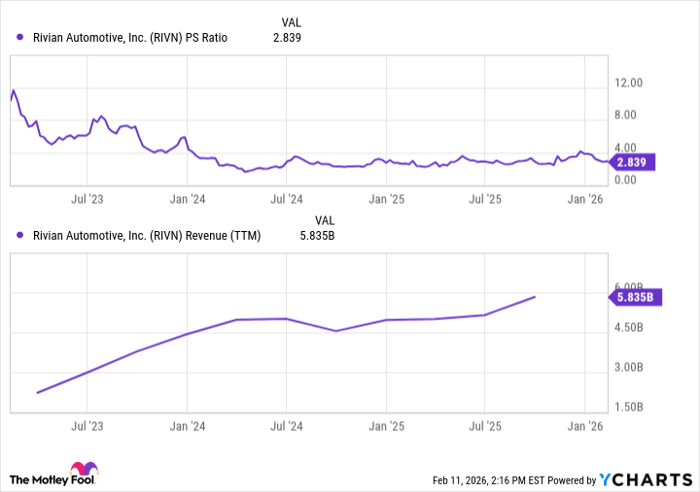
RIVN PS Ratio data by YCharts
I expect growth rates to pick up considerably in 2026 following the release of Rivian's first mass-market vehicle: the R2. This will be the first of three new models, all priced under $50,000, that the company expects to release in 2026 and 2027. When Tesla released its first affordable models -- the Model Y and Model 3 -- growth rates surged. The same should prove true for Rivian.
Right now, analysts expect sales growth of just 6% in 2026 for Rivian. This seems very conservative for a company about to release its first affordable model. For reference, Tesla's two affordable models now account for more than 90% of its vehicle sales. When shipments begin for the R2, great potential exists for Rivian's growth rates to surprise, likely leading to a sharply improved valuation.
Should you buy stock in Rivian Automotive right now?
Before you buy stock in Rivian Automotive, consider this:
The Motley Fool Stock Advisor analyst team just identified what they believe are the 10 best stocks for investors to buy now… and Rivian Automotive wasn’t one of them. The 10 stocks that made the cut could produce monster returns in the coming years.
Consider when Netflix made this list on December 17, 2004... if you invested $1,000 at the time of our recommendation, you’d have $456,188!* Or when Nvidia made this list on April 15, 2005... if you invested $1,000 at the time of our recommendation, you’d have $1,133,413!*
Now, it’s worth noting Stock Advisor’s total average return is 916% — a market-crushing outperformance compared to 194% for the S&P 500. Don't miss the latest top 10 list, available with Stock Advisor, and join an investing community built by individual investors for individual investors.
*Stock Advisor returns as of February 27, 2026.
Ryan Vanzo has no position in any of the stocks mentioned. The Motley Fool has positions in and recommends Alphabet and Tesla. The Motley Fool has a disclosure policy.
