A Push-Me, Pull-You Market
Expect choppy markets ahead. That's what we've seen lately, and there's more reason than ever to expect this to continue. Bullish and bearish factors are at war, producing frustrating up-and-down stock market movements.
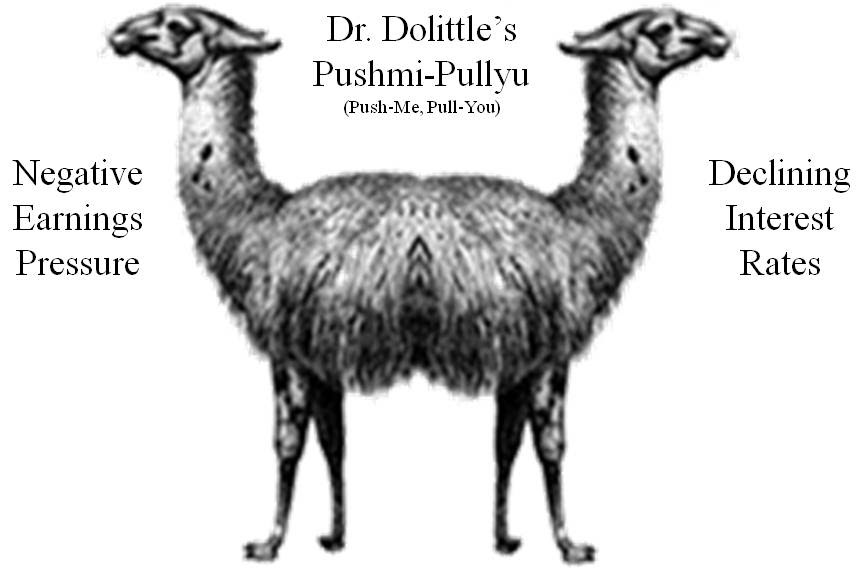
This is reminiscent of the children's book character Dr. John Dolittle , who in a 1920 book - made into a 1967 film - discovered the Push-Me, Pull-You effect. Embodied in a two-headed llama called a Pushmi-Pullyu, the animal is symmetric in opposite directions. It is a conflict of juxtaposed, equal forces.
The U.S. stock market is currently somewhat like a Push-Me, Pull-You. In one direction, we have falling oil prices and a strong dollar placing downward pressure on earnings near-term (bearish). In the other direction, we have international monetary easing, which may cause U.S. long-term interest rates to trade sideways or lower (bullish).
On March 10, for instance, economic turmoil in Europe pulled U.S. stocks down almost 2%. Then on March18, after the Federal Reserve seemed to show no hurry in raising interest rates, they powered to a nice advance. The S&P 500 Volatility index, or VIX, which measures how stocks gyrate, is tame at the moment, but has spiked up several times over the past few months.
The opposing forces are indeed formidable:
1. Downward pressure on first quarter earnings. First quarter earnings season begins in April. Earnings reports may be disappointing as the energy sector struggles with lower oil prices and as roughly 46% of the Standard & Poor's 500 revenues are facing currency headwinds because they have international operations.
A 10% rise in the dollar could lower U.S. gross domestic product from 1.1% to 1.5%, depending on whether the International Monetary Fund, New York Fed or the Macroeconomics Advisors are making the forecast. Of the 21% rise in the value of the dollar since last July, almost half of the appreciation occurred in the first quarter of this year. The Fed lowered its real GDP growth forecast range to 2.3-2.7% from 2.6-3% for this year.
2. Interest rate outlook. In the wake of Fed's statement after its mid-March meeting - seeming to signal its caution about tightening monetary policy -stocks traded higher on the belief interest rate hikes are further out than expected before. The rising dollar, low inflation (the Fed is forecasting 0.6-0.8% inflation in 2015, well below its 2% target rate) and moderating economic growth are factors that may cause the Fed to continue to be patient on rate hikes. Beyond the Fed, developed country central banks are aggressively driving interest rates lower.
Shown below is a sampling of government bond yields from Europe and Canada over the past year.

The average 10-year rate from the sampling above a year ago was 2.28%. Today, the average rate is 0.75%. The downtrend in rates steepened recently when the European Central Bank began its first round of quantitative easing , where it buys bonds to keep rates low in hopes of spurring economic growth. Before the Fed's March announcement, the U.S. 10-year Treasury yield was just above 2%, and then it edged down only slightly lower. That 2%, relative to a sampling of developed country rates at 0.75%, seems high, especially in a free-flowing global capital markets world.
In the next few months, investors will have to sort out the following:
1.Will near-term earnings reductions caused by falling oil prices and a rising dollar materially harm the S&P 500 forward 12-month earnings estimates? Or will the positive effects of low energy costs on consumption and manufacturing offset reduced near-term earnings later in the year?
2.Will the Fed be able to raise short-term rates in 2015, given the strong dollar and quantitative easing in Japan and Europe?
If interest rates and earnings projections both decline, the stock market may find upward pressure from P/E multiple expansion offsets downward pressure of declining earnings estimates. It is possible that any combination of rising/falling interest rates and earnings estimates may materialize in the next several months. As investors work to figure out which side of the push-me, pull-you market is dominant, expect continued erratic stock trading.
Follow AdviceIQ on Twitter at@adviceiq.
Nicholas Atkeson and Andrew Houghton are the founding partners of Delta Investment Management,a registered investment advisory firmin San Francisco, and authors of the new book, Win by Not Losing: A Disciplined Approach To Building And Protecting Your Wealth In The Stock Market By Managing Your Risk . Additional market commentary andinvestment adviceis available via their websitesat www.deltaim.comand www.deltawealthaccelerator.com .
AdviceIQ delivers quality personal finance articles by both financial advisorand AdviceIQ editors. It ranks advisors in your area by specialty, including small businesses, doctors and clients of modest means, for example. Those with the biggest number of clients in a given specialtyrank the highest. AdviceIQ also vets ranked advisors so only those with pristine regulatory histories can participate. AdviceIQ was launched Jan.9, 2012, by veteran Wall Street executives, editors and technologists.Right now, investors may see many advisor rankings, although in some areas only a few are ranked. Check back often as thousands of advisors are undergoing AdviceIQ screening. New advisors appear in rankings daily.
The views and opinions expressed herein are the views and opinions of the author and do not necessarily reflect those of Nasdaq, Inc.