One-Way Ticket For The Yen
The yen is well known as a “safe haven” currency: that is, one that appreciates when there’s some major trouble in the world. This phenomenon is well documented but not that well understood. For example, the graph below shows how USD/JPY tends to fall (i.e., the yen tends to strengthen) when risk aversion rises, as measured by the Westpac risk aversion index.
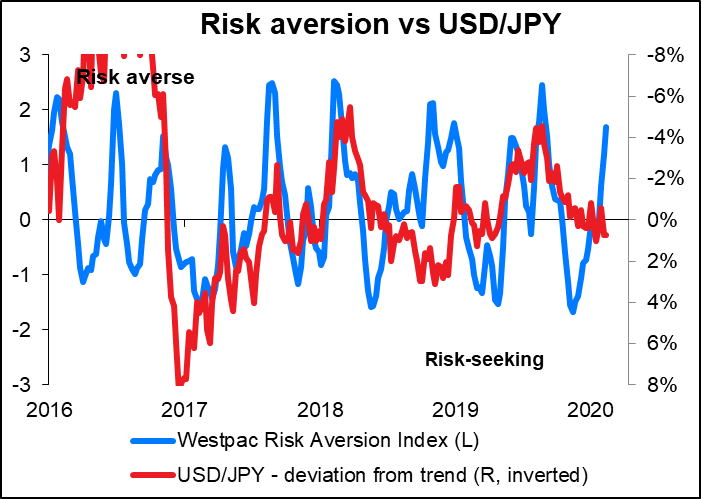
Many people wonder just why the currency of the most indebted G10 country in the world, one with a high reliance on exports for growth – a currency often called “a bug in search of a windshield” -- should be a “safe haven” when things get bad. It’s particularly bizarre when the trouble is a North Korean missile test right in Japan’s backyard.
The reason for this behavior has little to do with the safety of the Japanese economy, much less the islands themselves. According to a paper by the IMF (The Curious Case of the Yen as a Safe Haven Currency : A Forensic Analysis) it basically comes down to the hedging behavior of Japanese investors when either they get nervous about the world outside their country or they start losing money in the Tokyo stock market.
But what’s noticeable now is how the yen has not been exhibiting this behavior for the last day or so. That’s significant. For you Sherlock Holmes fans, the fact that this dog isn’t barking suggests where the yen may be headed.
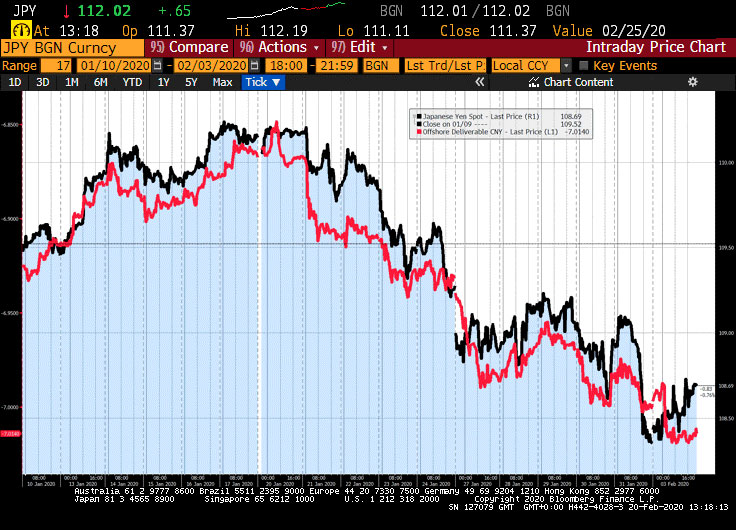
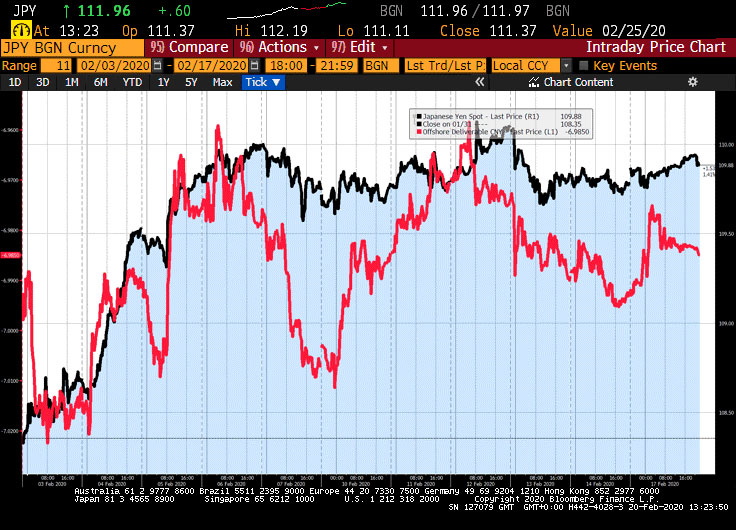
The following graphs shows USD/JPY (black line) and USD/CNH (red line, inverted). The first graph is from 10 Jan to 3 Feb, the second from 3 Feb to 17 Feb. Note how closely correlated they: a rise in USD/CNH – bad news for China -- was generally accompanied by a fall in USD/JPY (risk-off behavior among Japanese investors). Moreso in the first graph, but still generally in the second graph as well.
But now? The following graph shows the two from 18 February (Tuesday). It seems to me that this relationship has totally broken down.
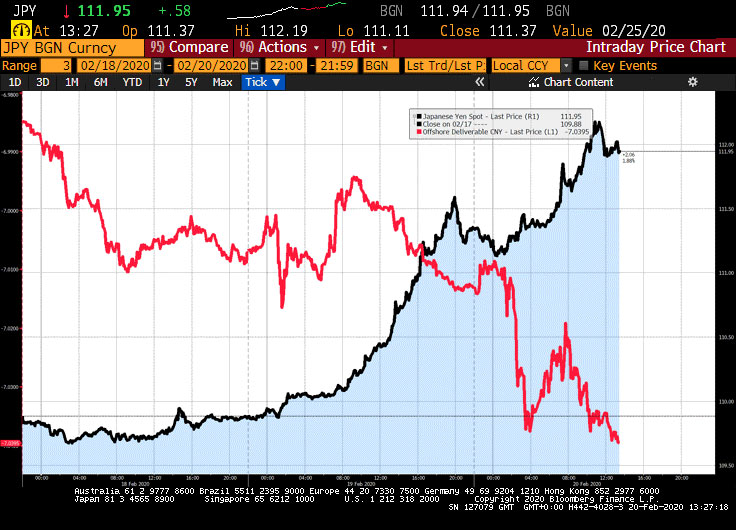
What might be causing this? I think the market has realized that problems in China are particularly bad for Japan. The worse-than-expected Q4 GDP figures, which came out right before the start of 17 February on these graphs (which are done in GMT) may have been the trigger, even if it took a day or two to hit home.
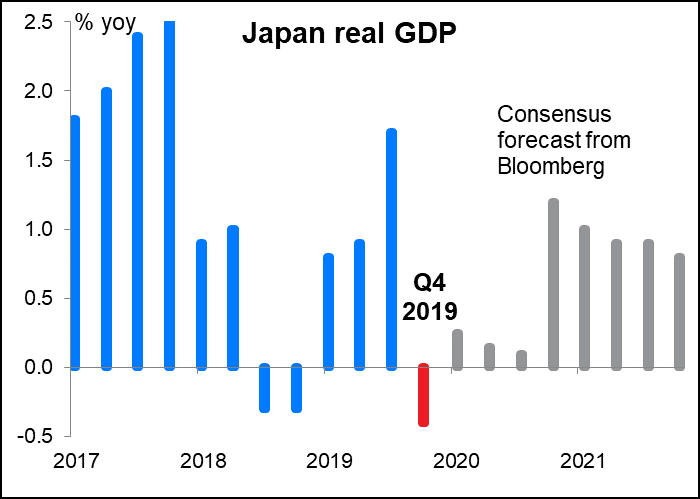
The January trade figures were better than expected – exports especially – but machinery orders plunged in December and are likely to be even worse in coming months, as one-quarter of orders come from abroad.
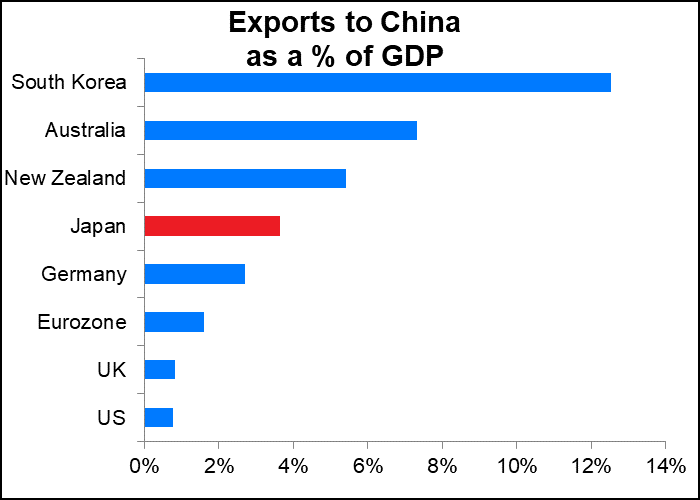
Japan’s exposure to China is indisputable: exports to China as a percent of GDP are significantly higher than that Germany or the US and nearly on par with New Zealand (although nowhere near South Korea).
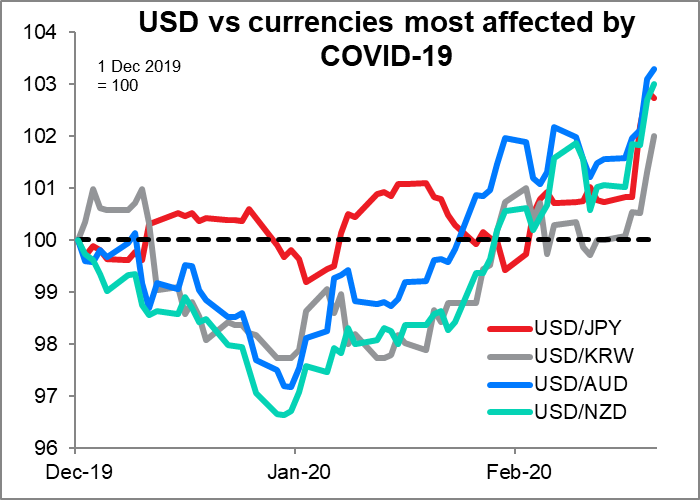
Probably as a result, JPY has depreciated as much as those other countries that will be strongly affected by the China slump, with a good portion of the depreciation coming suddenly in the last few days. (Note that AUD and NZD have been turned around from the way they’re usually quoted.)
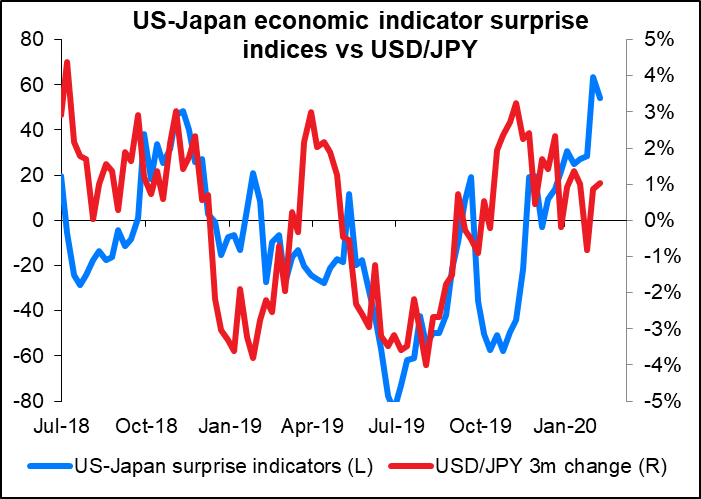
As the virus affects Japan’s economy more and more, it’s going to show up in the indicators, which have been missing expectations recently. Indicators are likely to miss expectations more and more, until the market has revised down its expectations for Japan sufficiently. This is of course different from the US, where indicators have been beating expectations recently.
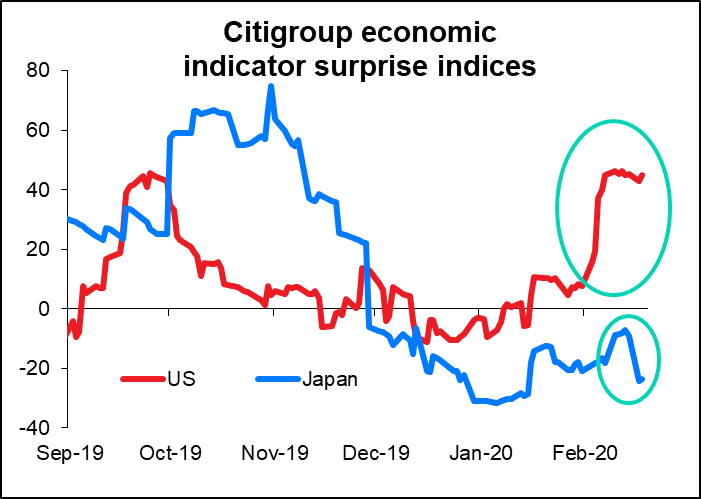
The difference between the surprises to the market’s expectations for US and Japanese indicators is a fairly good indicator of where USD/JPY is headed. Right not, it says the pair is likely to be headed higher.
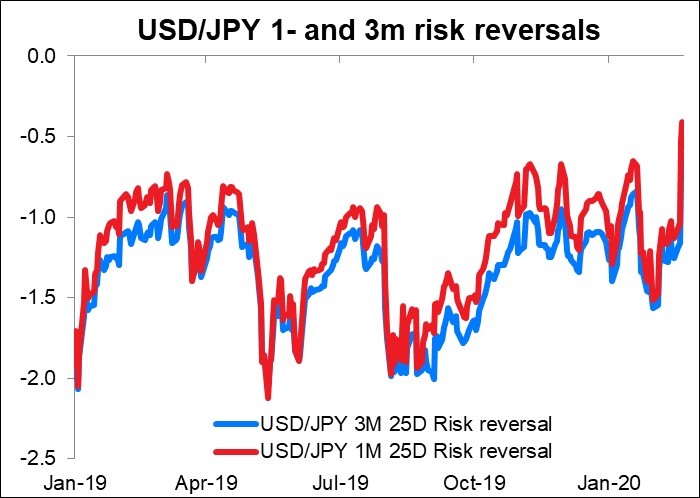
One sign of the turnaround in sentiment to JPY: USD/JPY risk reversals, which have been showing a premium puts over calls (i.e., positioning for a decline in USD/JPY or a strengthening of the yen), suddenly went shooting up.
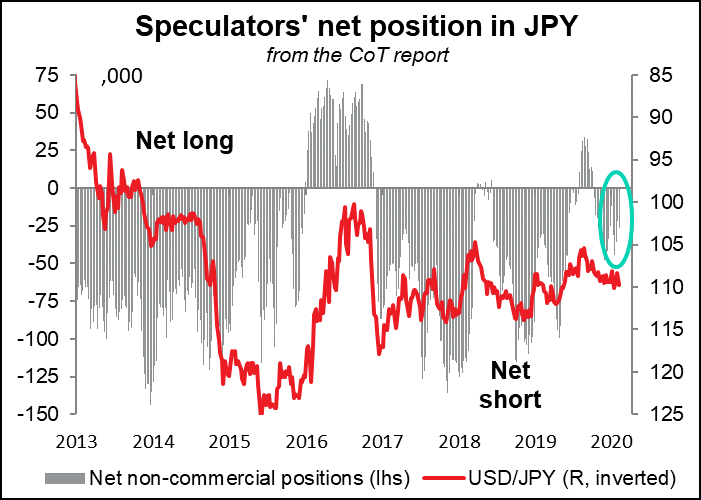
As far as we know, speculators are already short JPY, but only modestly so. Positioning should be no obstacle to further declines.
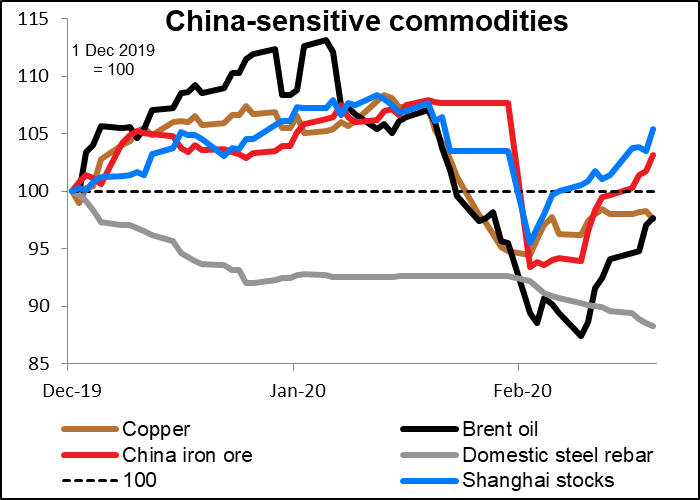
Of course, it is possible that I’m totally wrong. Maybe I have it backwards. It could be that the market is simply discounting the end of the COVID-19 virus entirely and expecting a prolongued “risk on” period that will naturally lift USD/JPY. Indeed, looking at the Shanghai stock market or the China iron ore price, one could be forgiven for thinking that the virus was a thing of the past, while copper and oil are certainly saying it’s not likely to be as bad as people thought. Only domestic steel rebar, used in construction, seems to be indicating any major problems in China.
However, we’re talking about Japan – those wonderful people who brought you Fukushima. Have you been following the saga of the Diamond Princess cruise ship that just discharged 3,700 people – of whom at least 621 were known to be infected? The US Centers for Disease Control and Prevention said tactfully that Japan’s efforts “may not have been sufficient to prevent transmission among individuals on the ship.” For a less diplomatic discussion, watch this YouTube video by Prof. Kentaro Iwata, Professor of Infectious Diseases Therapeutics at Kobe University. Start from 4 minutes in, where he says, “It turns out that the cruise ship was completely inadequate in terms of infection control…It was completely chaotic.” “…There was no single infection control person inside the ship and there was nobody in charge of infection control as a professional…Only the bureaucrats were doing the job, completely layman’s work, violating all the infection control principles.” “I can’t bear it,” he cried.
According to a recent study in the Journal of Travel Medicine (“Potential for global spread of a novel coronavirus from China”), Tokyo is the third most popular destination for visitors from China. It received 1.086mn visitors between February and April last year (Taipei was #1 with 1.359mn and Bangkok was #2 with 1.232mn.) Visitors to the US were quite low by comparison: 473,497 to Los Angeles, San Francisco and New York combined, or less than half the number going to Tokyo alone. Japan meanwhile also had a good number of visitors to Nagoya, Osaka, Fukuoka, Okinawa and Sapporo as well as Tokyo.
While Japan is rated much higher than most other Asian countries in terms of its ability to deal with an epidemic, the experience of the Diamond Princess does not give me much confidence in the government. I also remember the AIDS-tainted plasma scandal back in the 1980s that the Ministry of Health hid; the chaos during the Kobe earthquake of 1995; the disaster in Fukushima; and various other episodes that give me no reason to expect the Japanese government to handle this crisis any better than it’s handled others.
So which is it going to be? Is the COVID-19 virus going to spread further globally and domestically, wreaking havoc with Japan’s growth? Or is it a big scare that will be no more than a severe flu and quickly pass? The point is, for JPY it doesn’t seem to matter: either way points to a weaker yen. If the virus proves resilient and spreads further, Japan will be one of the countries most severely affected and the yen will most likely weaken as a result. If on the other hand the virus turns out to be not so serious, then the market is likely to switch into a “risk on” mood that should also cause the yen to weaken. It seems to me that the yen is likely to weaken either way.
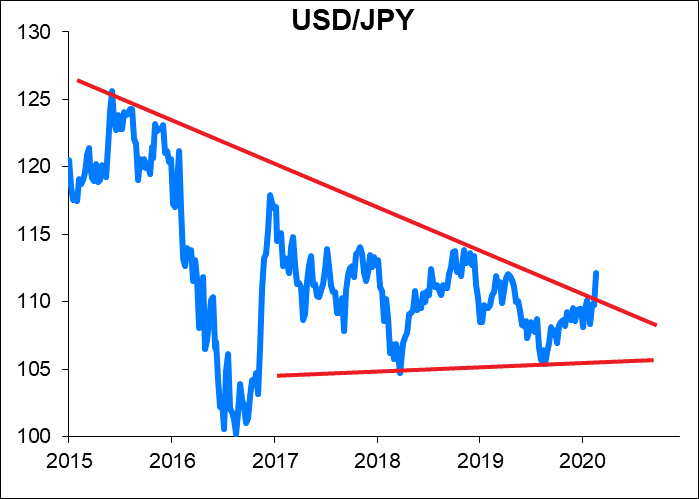
Technically, the pair has recently broken through the long-term resistance at 109.80. That too signals an upturn, in my view.
DISCLAIMER
The information and opinions in this report were prepared by Marshall Gittler. Though the information herein is believed to be reliable and has been obtained from public sources believed to be reliable, the author makes no representation as to its accuracy or completeness. This report is provided for informational purposes only and does not take into account the particular investment objectives, financial situations, or needs of individual traders. It is not an offer or a solicitation of an offer to buy or sell any financial instruments or to participate in any particular trading strategy.
The author is not acting as a financial adviser, consultant or fiduciary to you or any of your agents (collectively, “You” or “Your”) with respect to any information provided in this report. Information contained herein is being provided solely on the basis that the recipient will make an independent assessment of the merits of any investment decision, and it does not constitute a recommendation of, or express an opinion on, any product or service or any trading strategy. The information presented is general in nature and is not directed to retirement accounts or any specific person or account type, and is therefore provided to You on the express basis that it is not advice, and You may not rely upon it in making Your decision.
The author may hold positions in any of the currencies that he is writing about. He may also be holding debt or equity securities in any of the markets or issuers he writes on.
Hyperlinks to third-party websites in this report are provided for reader convenience only. The author neither endorses the content nor is responsible for the accuracy or security controls of those websites.
'The key is not to predict the future, but to prepare for it.' Pericles, 500 BCE
The views and opinions expressed herein are the views and opinions of the author and do not necessarily reflect those of Nasdaq, Inc.
Other Topics
Markets
Marshall Gittler
Marshall Gittler: Head of Investment Research at BDSwiss Group -- Marshall is a renowned expert in the field of fundamental analysis, with over 30 years’ experience researching the markets. His career spans a range of elite investment banks and international securities firms including UBS, Merrill Lynch, Bank of America and Deutsche Bank. Marshall has established himself as global thought leader, educating and delivering high level FX research, helping traders to make the best trading decisions.
Read Marshall's Bio