
Microsoft MSFT is pressing deeper into proprietary artificial intelligence, with the April 2, 2026, launch of three in-house foundational models that mark a meaningful step toward building its own full-stack AI capability. The models — MAI-Transcribe-1, MAI-Voice-1 and MAI-Image-2 — are now available through Microsoft Foundry and the MAI Playground, developed by the company's MAI Superintelligence team under a philosophy the company describes as Humanist AI, centered on practical communication and human-centered design.
MAI-Transcribe-1 delivers state-of-the-art speech-to-text transcription across the top 25 most-used languages and operates at 2.5 times the batch transcription speed of Microsoft's existing Azure Fast offering. MAI-Voice-1 is built to generate natural, realistic speech with emotional range, while also supporting custom voice creation in Microsoft Foundry from just a few seconds of audio. MAI-Image-2, meanwhile, delivers at least two times faster generation speeds on Foundry and Copilot compared with prior iterations, with phased rollouts underway in Bing and PowerPoint.
The launch builds on the strong financial momentum Microsoft reported in its second-quarter fiscal 2026 results. Revenues rose 17% year over year to $81.3 billion, with operating income increasing 21% to $38.3 billion. Microsoft Cloud revenues climbed 26% to $51.5 billion, while the commercial remaining performance obligation surged 110% to $625 billion. Within the Intelligent Cloud segment, Azure and other cloud services posted 39% revenue growth. That commercial backlog figure is particularly significant — it points to deepening enterprise commitment at precisely the moment Microsoft is expanding its proprietary model portfolio.
Microsoft is rapidly deploying the MAI models to power its own consumer and commercial products while making them available to Foundry customers at competitive pricing. MAI-Image-2 was developed in close collaboration with photographers, designers and visual storytellers, with an emphasis on natural lighting, accurate skin tones and clear in-image text. All three models were developed, tested and red-teamed under the company's responsible AI commitment, with built-in guardrails and governance controls in Foundry.
With Azure serving as the backbone for enterprise AI workloads and Foundry as its developer deployment hub, Microsoft's MAI model push positions the company to drive greater AI monetization across a customer base that is already leaning in.
How Amazon and Google Are Approaching the Same Race
Amazon AMZN and Alphabet GOOGL-owned Google are pursuing comparable strategies in the proprietary foundational model space. Amazon's Nova portfolio spans text and multimodal needs, with models built on AI technologies originally developed for Amazon's internal applications, such as Alexa+ and Amazon Ads, now available to AWS customers through Amazon Bedrock. Amazon's Nova 2 family extends this across speech, image and video modalities. Google, meanwhile, released Gemma 4 — its most capable open model family to date — built from the same research foundation as Gemini 3, with the 31B model currently ranked among the top open models globally. Google also launched Gemini Embedding 2, its first fully multimodal embedding model, mapping text, images, videos, audio and documents into a single unified embedding space across more than 100 languages. Amazon and Google both distribute their models through cloud platforms — Amazon Bedrock and Google's Vertex AI, respectively — while Google additionally targets developers through open-source licensing, a distribution path Amazon and Microsoft have not prioritized to the same degree.
MSFT’s Share Price Performance, Valuation & Estimates
MSFT shares have lost 29% in the past six-month period, outperforming the Zacks Computer – Software industry's decline of 32.3% but underperforming the Zacks Computer and Technology sector's decline of 4.9%.
MSFT’s 6-Month Price Performance
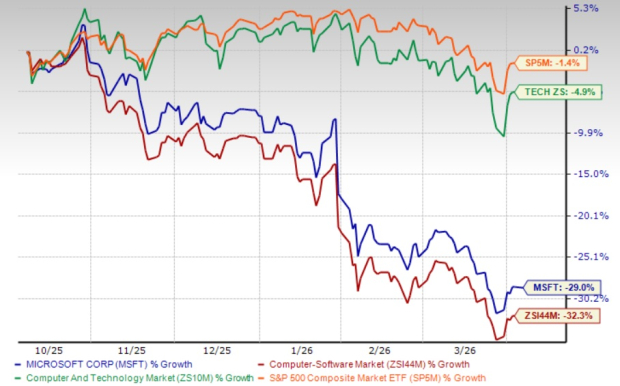
Image Source: Zacks Investment Research
From a valuation standpoint, MSFT stock is currently trading at a forward 12-month Price/Sales ratio of 7.62X compared with the industry’s 6.42X. MSFT has a Value Score of D.
MSFT’s Valuation
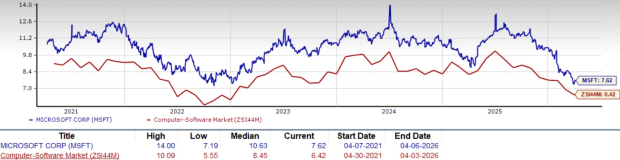
Image Source: Zacks Investment Research
The Zacks Consensus Estimate for MSFT’s fiscal 2026 earnings is pegged at $17.10 per share. The estimate indicates 25.37% year-over-year growth.
Microsoft Corporation Price and Consensus

Microsoft Corporation price-consensus-chart | Microsoft Corporation Quote
Microsoft currently carries a Zacks Rank #2 (Buy). You can see the complete list of today’s Zacks #1 Rank (Strong Buy) stocks here.
5 Stocks Set to Double
Each was handpicked by a Zacks expert as the favorite stock to gain +100% or more in the months ahead. They include
Stock #1: A Disruptive Force with Notable Growth and Resilience
Stock #2: Bullish Signs Signaling to Buy the Dip
Stock #3: One of the Most Compelling Investments in the Market
Stock #4: Leader In a Red-Hot Industry Poised for Growth
Stock #5: Modern Omni-Channel Platform Coiled to Spring
Most of the stocks in this report are flying under Wall Street radar, which provides a great opportunity to get in on the ground floor. While not all picks can be winners, previous recommendations have soared +171%, +209% and +232%.
See Our Newest 5 Stocks Set to Double Picks >>Amazon.com, Inc. (AMZN) : Free Stock Analysis Report
Microsoft Corporation (MSFT) : Free Stock Analysis Report
Alphabet Inc. (GOOGL) : Free Stock Analysis Report
This article originally published on Zacks Investment Research (zacks.com).
The views and opinions expressed herein are the views and opinions of the author and do not necessarily reflect those of Nasdaq, Inc.

