
This Is the Most Important Thing Investors Can Do During a Volatile Market
Key Points
Keeping your long-term goals in focus helps prevent poor decisions during volatile, negative market conditions.
Know what you want from your portfolio, and if you are stressed about recent price fluctuations, figure out why that's the case.
Investors stressed about market volatility may need to increase their cash positions, shift to low-volatility stocks, or diversify over time.
- These 10 stocks could mint the next wave of millionaires ›
Investors enjoy seeing their stock charts trend upward over time, but volatile markets that feature plenty of red days can rattle many of these same people. It's during corrections that an investor's resolve is tested.
Unfortunately, it is common for investors to panic and sell their assets without considering why. Falling stock prices often cause many investors to ignore fundamentals and focus on the current sentiment instead of long-term catalysts. However, if you maintain a long-term perspective, you give yourself a better shot at riding volatility without making costly mistakes and emerging with a higher net worth when the stock market rebounds.
Will AI create the world's first trillionaire? Our team just released a report on the one little-known company, called an "Indispensable Monopoly" providing the critical technology Nvidia and Intel both need. Continue »
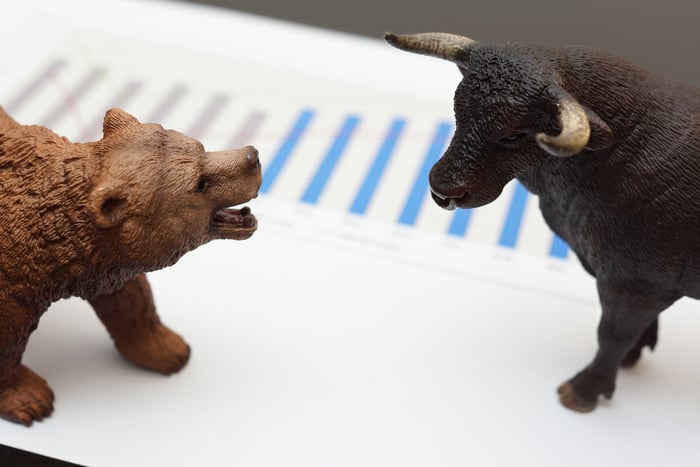
Image source: Getty Images.
Ignore the noise and stay focused on your long-term strategy
Everyone views investing as a means to an end. People do not buy stocks just for fun; they have long-term objectives in mind. Some people want to save enough money to buy a house, while others want to have robust nest eggs by the time they retire.
Short-term volatility is a part of investing in the stock market, and if you have a multiyear horizon, short-term price swings become less important. While it's good to review your portfolio and see if it still aligns with your goals, you shouldn't rush to action just because of volatility. It's often optimal to sit back and do nothing when the stock market goes into a correction, thanks to short-term headwinds.
Reassess your risk tolerance
Long-term investors must be willing to ride the ups and downs of their investments without panicking, but if you are tempted to sell, you must ask yourself why. It's usually a sign that you have too much money invested in a single stock or not enough cash to hedge against a stock market correction.
The latter scenario can affect retirees who are just starting to live off their nest eggs. If you have a $1 million portfolio that drops by 20%, you end up with an $800,000 portfolio. People with longer time horizons are generally better positioned to recover, but if you must withdraw from that portfolio to cover living expenses, a correction early in retirement can put you at a disadvantage.
Investors shouldn't rush to sell their assets at lows, but if you feel pressured to sell assets, it may be worth holding cash. If you almost panicked, don't be in a rush to invest future paychecks. Keeping money in the bank can build a good buffer and make you less prone to stressing during market corrections. Investors can also consider allocating capital into low-beta stocks that do not fluctuate as much as the broader market.
Panicking is never the right option. Markets and headlines can change rapidly, but calm heads prevail during these times. Reassessing your risk tolerance and long-term financial goals can help you make the moves that lead to meaningful wealth.
Where to invest $1,000 right now
When our analyst team has a stock tip, it can pay to listen. After all, Stock Advisor’s total average return is 913%* — a market-crushing outperformance compared to 185% for the S&P 500.
They just revealed what they believe are the 10 best stocks for investors to buy right now, available when you join Stock Advisor.
*Stock Advisor returns as of March 24, 2026.
The Motley Fool has a disclosure policy.
