

MongoDB’s (NASDAQ: MDB) Q4 fiscal year 2026 (FY2026) earnings release and guidance update left something to be desired but offered no explanation for the 25% share-price decline. The movement, which can only be described as a knee-jerk reaction to less-than-earth-shattering news, puts the market at a deep-value level while growth remains robust and profitability improves.
The primary catalyst for selling, if it can be called that rather than an excuse, is an unexpected management shakeup. As instrumental as the president of field operations, Cedric Pech, and the chief revenue officer, Paul Capombassis, have been to MongoDB's success, they are not critical to its future. Their loss will be felt, but the incoming chief customer officer, Erica Volini, has much to offer this business and its investors. Formerly with ServiceNow (NYSE: NOW), where she worked with MongoDB CEO CJ Desai, Volini is responsible for shifting the company's go-to-market strategy and helping it sustain a strong 20% compound annual growth rate.
MongoDB Falls After Robust Quarter, Strong Guidance
MongoDB had a solid Q4 with revenue growth accelerating sequentially and on a year-over-year (YOY) basis. Revenue growth topped 26.5%, outpacing the consensus by approximately 375 basis points, on strength in core offerings, client growth, and penetration. Atlas, the core cloud-based database product, grew by 29%, with Subscriptions up 27% and Services up 26%. Client count grew by 2,700, and penetration improved as clients added services in the quarter.
Margin news is also strong. The company maintained its gross margin at 73% GAAP and 75% adjusted, compounding the performance with improved operational quality. Operating margins widened incrementally, leaving the operating and net income, cash flow, free cash flow (FCF), and earnings per share up by 29%, offset slightly by a YOY increase in share count. The share count increase is a concern, but it’s minimal, only 2% YOY in Q4, and tied to share-based compensation. As it stands, with positive cash flow and FCF growing approximately 9x to over $175 million, share buybacks are in this company’s future; it’s only a matter of time before they begin.
The guidance is also solid, albeit providing the market with another excuse to sell. The issue is the Q1 FY2027 forecast, which expects revenue and earnings below the consensus, but it is offset by the full-year guide. Management expects revenue and earnings growth above consensus for the year, and was likely cautious in their estimation. The likely outcome is that MDB will outperform in Q1 and for the year, potentially increasing its guidance as the year progresses.
Analysts Lower Targets for MongoDB: Long-Term Outlook Intact
The two primary takeaways from the analysts’ response are that price targets were lowered and the long-term outlook remains intact.
Price targets were lowered due to the management shift, but the long-term outlook was maintained, given the company’s AI position and Q4 strengths, which set this market up with a catalyst.
The catalyst is a reversion to price-target increases, likely driven by upcoming earnings reports.
Not only is there potential for results to outperform the guidance, but also for incoming chief customer officer Volini to boost performance and drive significant outperformance and an improved long-term outlook by year’s end.
Institutions and Short Sellers Pose a Risk to MongoDB Price Action
Institutions and short sellers pose risks to MDB price action, though neither is strong as of early March. Institutions, which own nearly 90% of the stock, accumulated throughout 2025 but shifted to distribution in early calendar year 2026. The balance is only marginally in favor of bears, but presents a headwind for price action strengthened by short selling. The short interest is also not strong, at only about 5%, but rising in the latest releases and adding downward pressure on stock prices. The risk is that these groups continue to sell into the market; the opportunity is that they shift to accumulation/covering now that price action has retreated to long-term lows.
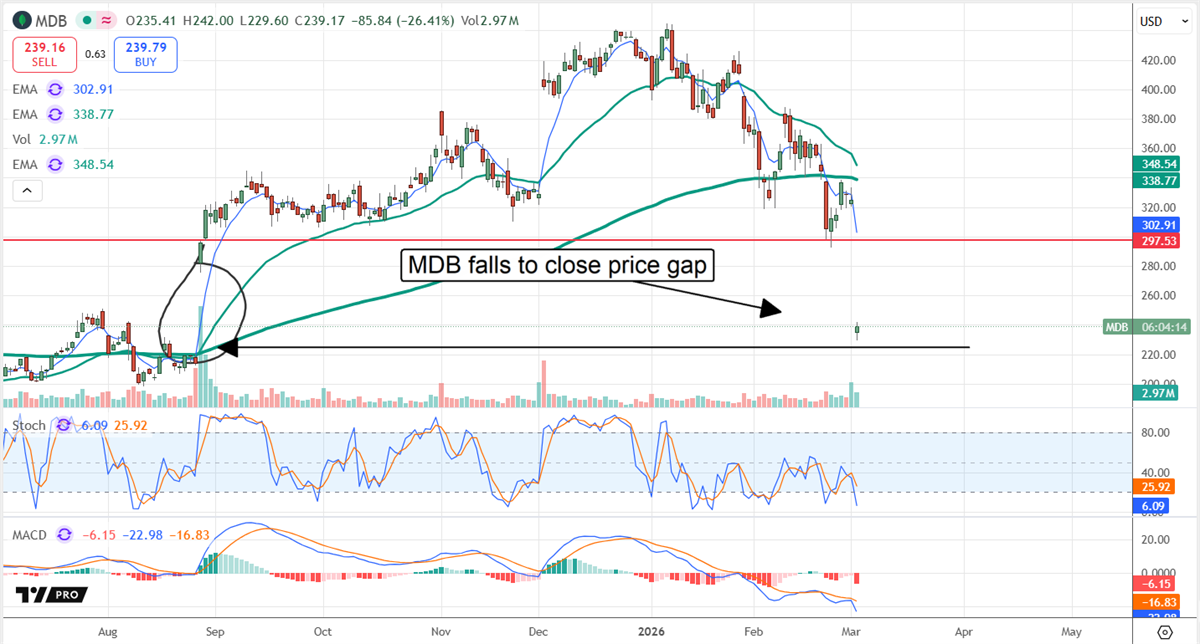
The price action is sketchy. The 25% market decline presents a serious overhang; however, early indications are that this dip is getting bought. Price action opened with a 25% loss, then held steady, trading within a tight range. Pulling back to look at the action from a longer-term perspective, the decline closes a gap formed in mid-2025, placing it at levels where institutional accumulation has been robust.
Where Should You Invest $1,000 Right Now?
Before you make your next trade, you'll want to hear this.
MarketBeat keeps track of Wall Street's top-rated and best performing research analysts and the stocks they recommend to their clients on a daily basis.
Our team has identified the five stocks that top analysts are quietly whispering to their clients to buy now before the broader market catches on... and none of the big name stocks were on the list.
They believe these five stocks are the five best companies for investors to buy now...
The views and opinions expressed herein are the views and opinions of the author and do not necessarily reflect those of Nasdaq, Inc.

