
The powerful performance in the semiconductor sector continues to broaden amid the AI boom. Micron Technology (MU) and Intel (INTC), two legacy chip names that spent much of the last cycle in very different chapters of their respective stories, are again pushing record highs, carried by a structural demand surge in AI infrastructure and a wave of analyst upgrades that shows no sign of cresting.
Intel is up more than 14% just today as news of an exploratory partnership with Apple emerges, while Micron is up nearly 13% after the company announced that it was ready to ship its newest SSDs.
Micron Stock Gains on Structural HBM Shortages
Micron shares have more than doubled in 2026, up over 100% year-to-date after the company delivered a fiscal Q2 revenue print of nearly $24 billion, almost triple the year-ago quarter. Non-GAAP EPS came in at $12.20, up roughly 680% year-over-year, while gross margins hit a company record near 75%. Even more striking: management guided fiscal Q3 revenue to approximately $33.5 billion with margins expanding to around 81%. These are not typical memory-cycle numbers.
The engine behind Micron's breakout is high-bandwidth memory (HBM), which is the specialized DRAM stacked alongside AI accelerators to deliver the bandwidth that large-model inference and training require. Micron is one of only three global HBM suppliers alongside SK Hynix and Samsung, and the company has signaled it can fulfill only 50% to two-thirds of customer demand in the medium term. Order books reportedly stretch into 2027. That kind of structural scarcity, locked into Nvidia Blackwell and AMD Instinct accelerator roadmaps, has given Micron rare multi-year visibility in what has historically been one of the most cyclical businesses in tech.
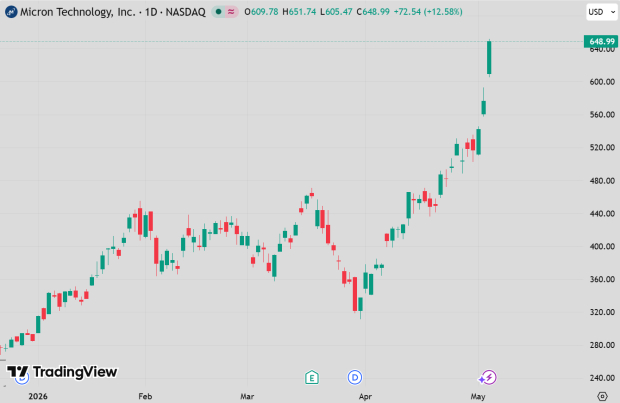
Image Source: TradingView
Intel Shares Gain on Business Turnaround
Intel's story is different in origin but equally dramatic in scale. INTC has surged roughly 166% year-to-date, with April alone delivering a 114% monthly return, one of the most explosive single-month moves in the stock's history. The catalyst was a Q1 earnings report that obliterated expectations: revenue of $13.6 billion beat estimates by over $1 billion, and adjusted EPS of $0.29 dwarfed a consensus that had penciled in just a penny.
But the real story isn't just the beat, it's the narrative shift. For years, Intel was priced as a turnaround with existential risk: massive capex, falling market share, and a foundry strategy that Wall Street viewed more as a liability than an asset. The Q1 print, Intel's sixth consecutive earnings beat, effectively removed the bankruptcy risk premium. The Data Center and AI segment posted 22% revenue growth. Foundry sales rose 16%. Strategic partnerships with Tesla (as an anchor customer for Intel's upcoming Terafab manufacturing complex) and Alphabet (deploying Xeon processors across Google Cloud's AI infrastructure) validated CEO Lip-Bu Tan's turnaround roadmap in tangible, commercial terms.
Intel also appears to be benefiting from a broader reshoring dynamic. The CHIPS Act has underwritten a national-scale reindustrialization, and Intel is the primary domestic beneficiary. With geopolitical risk around Taiwan continuing to shape procurement decisions at the hyperscaler level, Intel's US-based manufacturing footprint is increasingly viewed as a strategic asset rather than a cost center.

Image Source: TradingView
Caution Is Necessary on Both INTC and MU Stock
Still, the bears haven't disappeared entirely, and they shouldn't. Micron trades at roughly 26x trailing earnings after a 600%-plus one-year move, and the memory industry's cyclical history is littered with episodes where elevated margins attracted supply that eventually crushed pricing. Intel's forward P/E sits near 100x, a multiple that requires sustained earnings acceleration to justify. Both stocks have left themselves little margin for error.
The key question for both names is durability. For Micron, it comes down to whether HBM allocations and AI inference scaling represent a genuine structural break from the boom-bust memory cycle. For Intel, the test is whether foundry wins and AI PC demand can translate into consistent operating leverage or whether the rally has already priced in several years of execution. In both cases, the next earnings prints, Micron's fiscal Q3 expected in late June, Intel's Q2 likely in July will matter enormously.
For now, the tape is clear: the market is treating Micron and Intel as core AI infrastructure plays, not legacy cyclicals. Whether that repricing holds will define the second half of the semiconductor trade in 2026.
Zacks' Research Chief Names "Stock Most Likely to Double"
Our team of experts has just released the 5 stocks with the greatest probability of gaining +100% or more in the coming months. Of those 5, Director of Research Sheraz Mian highlights the one stock set to climb highest.
This top pick is a little-known satellite-based communications firm. Space is projected to become a trillion dollar industry, and this company's customer base is growing fast. Analysts have forecasted a major revenue breakout in 2025. Of course, all our elite picks aren't winners but this one could far surpass earlier Zacks' Stocks Set to Double like Hims & Hers Health, which shot up +209%.
Free: See Our Top Stock And 4 Runners UpIntel Corporation (INTC) : Free Stock Analysis Report
Micron Technology, Inc. (MU) : Free Stock Analysis Report
This article originally published on Zacks Investment Research (zacks.com).
The views and opinions expressed herein are the views and opinions of the author and do not necessarily reflect those of Nasdaq, Inc.

