
The Long Case For Aritzia
By Kara Stessl :
Relevant Comps
Kate Spade & Company (KATE)
Urban Outfitters, Inc. ( URBN )
Lululemon Athletica Inc. ( LULU )
Francesca's Holding Corporation ( FRAN )
Canada Goose Holdings ( GOOS )
Catalyst
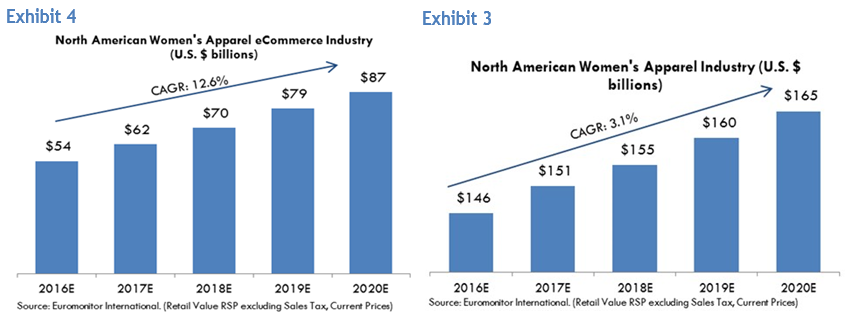
Online Apparel Growth - The North American women's apparel industry is forecast to grow at a compound annual growth rate ("CAGR") of 3.1% between 2016 and 2020. Over the same time frame, women's apparel e-commerce sales are expected to grow at a CAGR of 12.6%.
Increase in Millennial Purchasing Power - It has been forecast that by 2021, millennials will account for one-third of consumer spending. Millennials are those born between 1980 and 2000, and Aritzia's target market of females ages 15-45. The growing purchasing power in millennials will serve as an opportunity to exploit this growing market demographic.
Fashion Cycle Disruption - Traditional fashion cycles are being abandoned as retailers adapt to the "see now, buy now" purchasing culture.
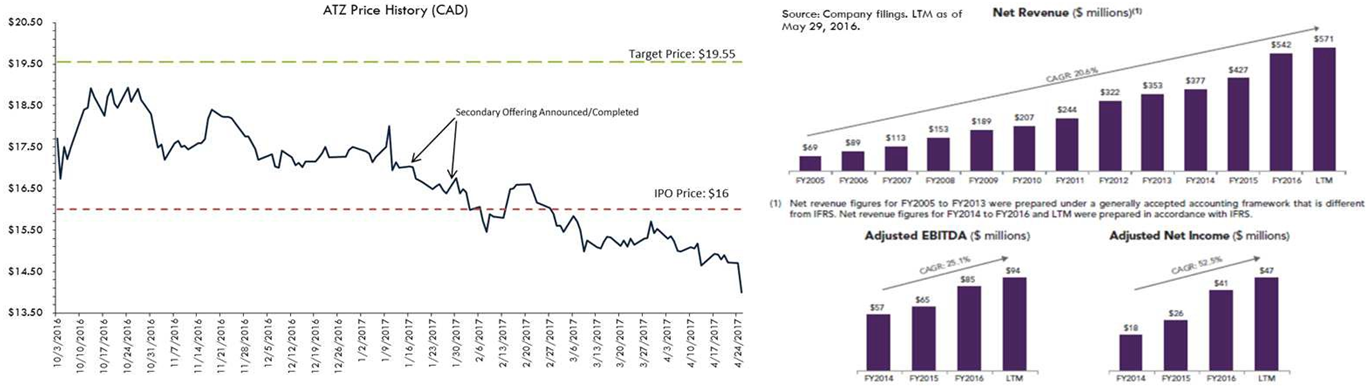
Secondary Offering - In January 2017, Aritzia completed a secondary market offering, nearly doubling the amount of float shares. The offering flooded the market with additional supply, pushing prices below the IPO price of CAD 16. The secondary offering has provided an opportune entry point into the investment.
US Expansion - Disciplined and sustainable growth plan into an underpenetrated U.S. market.

A Quality Stock in a Discount Environment: A Winner Among Last Season's Duds
Aritzia Inc. ( ATZAF ) ("Aritzia" or the "Company") is a uniquely positioned retailer of women's apparel. With less than 25 stores in the U.S.,Aritzia is severely under-penetrated in the U.S. market. The market is undervaluing Aritzia based on the recent weak retail performance of its U.S. competitors without adequate consideration for Aritzia's attractive fundamentals and compelling growth strategy.Additionally, a secondary offering completed in January 2017 has also pushed the stock price down below the IPO price of $16.Together, these forces have created an excellent entry point to an undervalued stock positioned for strong future growth.
Summary
Growth at a Reasonable Pace: After decades of growth through store expansions and increasing mall presence, the retail market in the United States ("U.S") has become oversaturated, particularly in regards to apparel retailers. Additionally, the penetration of e-commerce in apparel sales has transformed customer shopping habits. At a time when many competitors are trying to unload unprofitable stores, Aritzia is just entering the U.S. market with a disciplined, sustainable growth strategy. In its 32 years of operation, Aritzia has never closed a store due to poor performance.
Changing Purchasing Habits: Physical stores are shifting from revenue generators into destination "showrooms" with the intent to entertain customers and generate online sales post-visit. The creation a cohesive physical and online retail experience will be key to success (and survival) in the future of the retail industry.
Flexibility is Key Diversification Benefit: Ninety percent of Aritzia's product offerings consist of their exclusive in-house brands. Each brand is treated as its own individual label with different styles and target demographics. Additionally, Aritzia has the flexibility to expand its brands in order to take advantage of changing fashion trends without diluting the brand identity of its existing brand portfolio. Aritzia is able to optimize and diversify its brand portfolio to incorporate a number of fashion trends and styles. The selection of offerings available caters to a wide customer base.
Faster Fashion: Customer preferences have gravitated towards immediate satisfaction, adopting a "see now, buy now" mentality. Aritzia not only has the capability to quickly adapt to evolving fashion trends but is also able to offer quality at a reasonable price point, unlike its fast fashion competitors.
Business Overview
"The difference is in the details. From the control that we maintain over the use of the Aritzia brand, to the high quality materials and fabrics we use in all of our products, to the investment we make in our aspirational stores, to the care that we take in interacting with our customers, all the way to the design of our shopping bags which have been recognized for their creativity and innovation. We care deeply about the details and believe focusing on them drives the success of our business." - Aritzia Preliminary Prospectus August 2016
Description
Aritzia operates as an innovative fashion house and retailer catering to women ages 15 to 45. The Company was founded in 1984 by Chief Executive Officer Brian Hill, a third generation retailer, and is headquartered in Vancouver, Canada. Aritzia's products offered through its in-house fashion brands include t-shirts, blouses, sweaters, jackets, coats, pants, skirts, dresses, denim, intimates, and accessories. Additionally, Aritzia also offers a selection of third-party apparel and accessories. Aritzia operates 79 stores under the Aritzia banner throughout Canada and the U.S., in addition to its online retail store, Aritzia.com .
Brand Offerings
Ninety percent of Aritzia's product offerings consist of its 11 in-house brands. In addition to the 10 legacy brands (Exhibit 1), Aritzia also recently released a new brand The Constant in January 2017 in order to expand into the growing athleisure trend. Aritzia benefits from separate in-house brands as each has its own unique brand identity and customer target. Aritzia is also provided the flexibility to expand its brands in order to take advantage of popular trends in fashion, as seen in the recent expansion into athleisure. In addition to its in-house brands, approximately 10% of Aritzia's apparel and accessories are third-party brands, including A&G, Citizens of Humanity, Wolford, and more.
Distribution Network
Aritzia distributes its apparel and accessories through two main channels: stores under the Aritzia banner (including pop-ups) and through Aritzia.com. Through the internal distribution network, Aritzia is able to control is brand imaging and positioning. The current omni-channel strategy enforces a synergistic relationship between physical stores and Aritzia.com, allowing for a more integrated and cohesive distribution network. Additionally, Aritzia introduced international shipping in October 2016, thereby setting the foundation for future growth outside of North America.
IPO and Secondary Offering
In October 2016, Aritzia completed its IPO selling 25 million shares for $16/share. The $400 million offering went on record as the largest Canadian IPO in 2016. In January 2017, Aritzia completed a secondary offering of $382 million at a price of $17.45/share. Following the success of Aritzia's IPO, Canadian retailers are following in Aritzia's footsteps. Most recently, Canada Goose completed its IPO in March 2017. Additionally, the Canadian suit maker Indochino is reportedly considering the possibility of an IPO in the near future.
Industry
Retail
Richard Hayne, CEO of Urban Outfitters, Inc., recently described the U.S. retail market as "oversaturated" with too much space dedicated to selling apparel. His words echo the recent performance of the industry as big-name retail players, including BCBG, bebe (BEBE), Payless, Wet Seal, and The Limited announced major store closings. Based on YTD 2017 retail store closings of 2,880, Credit Suisse estimates total 2017 store closings could reach 8,640, far surpassing the 2008 peak of 6,183 store closures.
However, despite recent headlines, not all physical retail is performing poorly. In fact, high-rated malls and locations in urban markets are performing well and poised to continue outperforming traditional malls as retailers concentrate on their urban locations. Aritzia's U.S. expansion strategy targets high-quality locations while growing at a reasonable pace. Aritzia carefully screens its real estate property prospects through an arduous selection process with a focus on long-term future growth potential. In FY 2017, Aritzia opened three flagship locations in Los Angeles, Chicago, and San Francisco. Historically, Aritzia's real estate portfolio has had strong performance, generating approximately $1,465 sales per square foot in 2016.
Competitors
Aritzia is positioned between affordable luxury and fast fashion in the retail hierarchy. Its main competitors based on price point and target demographics include Madewell and Anthropologie.
Industry Position
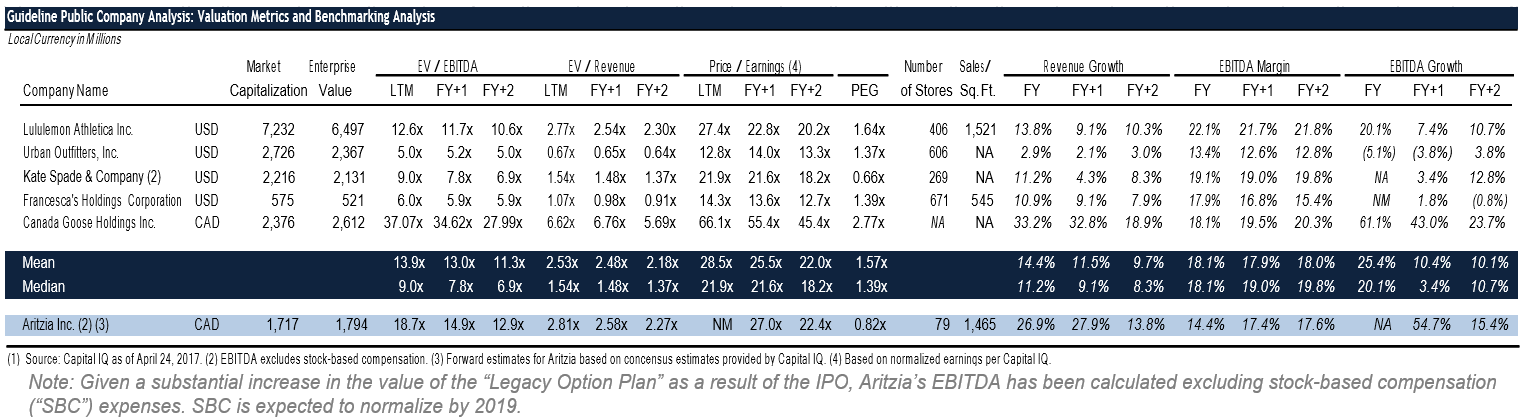
Guideline public company ("GPC") selection criteria: high growth women's apparel retailers in North America with a market capitalization less than $10 billion. Based on the aforementioned criteria, the following guideline public companies were selected: Lululemon Athletica Inc., Urban Outfitters, Inc., Kate Spade & Company, Francesca's Holdings Corporation, and Canada Goose Holdings Inc. Despite relatively low growth projections, URBN was included, given Anthropologie's competitive positioning against Aritzia.
US Expansion
Catalyst : Disciplined and sustainable growth plan into an under-penetrated U.S. market.
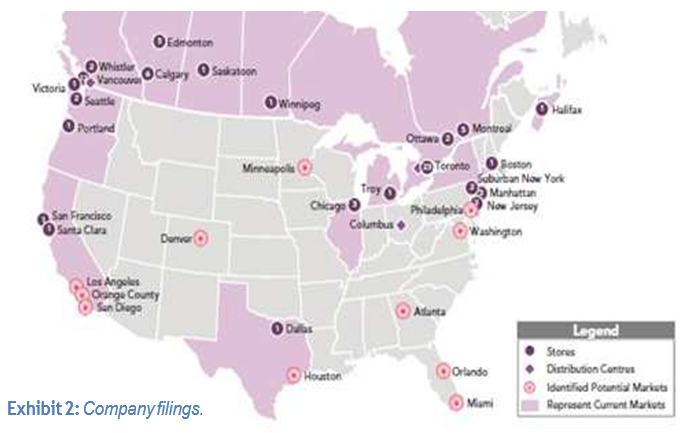
New store openings will introduce economies of scale and allow further leveraging in infrastructure, support office functions, and other fixed costs. Management is targeting 20 to 30 new stores in addition to repositioning and expanding 20 to 25 existing stores. Exhibit 2 identifies current stores and identified potential markets. Additionally, Aritzia has a strong track record, having never closed a store due to poor performance in its 32 years of operations.
Online Apparel Growth
Catalyst: As an increasing proportion of women's retail apparel sales are completed online, e-commerce will become a substantial portion of the overall women's apparel market.
The North American women's apparel industry is forecasted to grow at a compound annual growth rate ("CAGR") of 3.1% between 2016 and 2020 (Exhibit 4). Over the same time frame, women's apparel e-commerce sales are expected to outpace the overall industry at a CAGR of 12.6% (Exhibit 3).
E-commerce sales targets are an important aspect in Aritzia's growth strategy. Aritzia has offered its product lines online since FY2013 and currently generates approximately 12% of its revenue from e-commerce. Aritzia management recognizes the growing online purchasing power of customers and estimates that e-commerce sales will account for 25% of sales by 2021. However, e-commerce sales will not grow solely through online presence. A cohesive omni-channel approach will be integral to capitalizing on the growing proportion of online purchases.
Understanding Millennials
Catalyst: The millennial generation was born between 1980 and 2000, representing those ages 17 to 37 today. According to research by McKinsey, millennials are expected to account for one-third of U.S. retail sales by 2020. Given that today's millennials fall squarely within Aritzia's target age demographic, understanding female millennial purchasing habits will be a key component of future growth.
Female millennials can be highly influenced by the ambiance of their retail environment. As seen in Exhibit 5, over 50% of female millennials define a "fun" and "energizing" environment as an important factor of their apparel shopping experience. Many of the qualities Aritzia envisions in its stores reflect the important criteria identified by female millennials regarding their in-store apparel shopping habits. Per Aritzia's company filings, it offers customers "a multi- layered retail environment that blends artistic touches, music, and high quality materials to create an exceptional customer experience. All [Aritzia's] stores are meticulously and uniquely designed by an in-house team of architects and interior designers to be both aspirational and comfortable." As customer preferences shift to "experience" oriented stores, attracting millennials to physical retail locations will be a key component to increasing brand awareness, establishing a brand identity, and converting in-store visitors to online retail customers. Given Aritzia's unique understanding of millennial habits, it is well-positioned to exploit the growing purchasing power of female millennials in the near future.
Faster Fashion Cycles
Catalyst
Fashion trends are changing faster than ever, with customers demanding transparency, quality, and immediacy in their purchasing decisions. In order to adapt and compete with fast fashion retailers, designers are beginning to abandon the traditional fashion cycle and are adopting "see now, buy now" collections available for immediate purchase. In 2016, Burberry, Tommy Hilfiger, and Tom Ford disrupted the traditional fashion cycle by offering collections immediately after their runway events. Aritzia's competitive advantage lies in its exclusive brand portfolio. Each brand has its own identity, vision, and targeted customer base. Additionally, Aritzia is afforded the flexibility to add additional exclusive brands in order to pursue the latest fads and trends without diluting or straying from the brand identities of its existing brands. As a result, Aritzia can quickly integrate the latest trends into its product offerings. Most recently, Aritzia has introduced The Constant line in order to expand into the athleisure market. Additionally, given Aritzia's variety of brand offerings, its customer base can evolve with the Company. As customers move from their teens to their 20s and beyond, customers can "graduate" to the more mature brand offerings within Aritzia's brand. Unlike fast fashion competitors, Aritzia offers quality apparel at a reasonable price.
Secondary Offering
Catalyst : In January 2017, a secondary offering of $382 million occurred, resulting in an additional 21.9 million shares added to the float, almost doubling the float outstanding. As a result of the offering, excess demand was reduced, pushing share prices near their IPO level of $16. The secondary offering has provided an opportune entry point into the investment.
Target Price
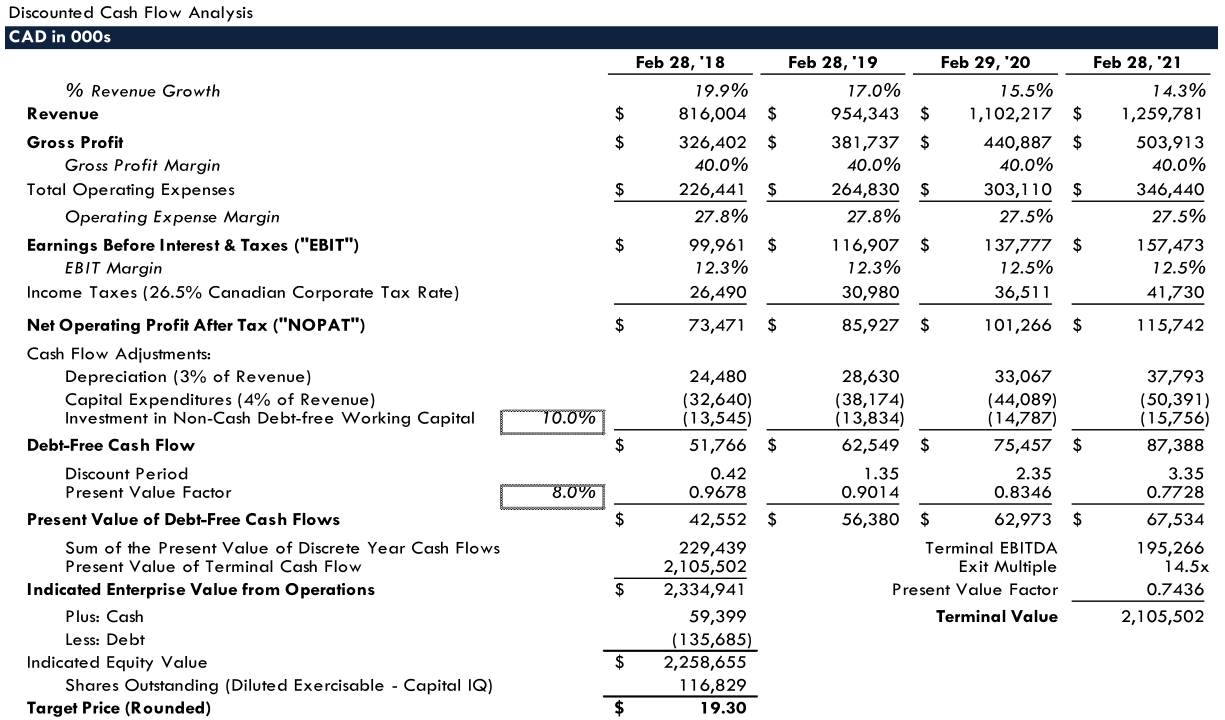
In order to arrive at the 12-month target price of $19.55, I employed both the income and market approaches, specifically utilizing the discounted cash flow ("DCF") method and earnings multiple method. The DCF approach yielded an enterprise value of approximately $2.3 billion. Adjusting for net debt and total diluted exercisable shares outstanding, the total estimated price per share is $19.30. Additionally, the income approach was supplemented with a guideline public company market approach based on P/E multiples. Based on the estimated 2021 EPS of $0.99 and a 20.0x P/E multiple, a target price of $19.80 was concluded on. Giving equal consideration to both the income and the market approach, the concluded target price of $19.55 represents a 33% upside over the current share price of $14.70 as of April 24, 2017. Based on Aritzia's growth prospects, historical performance, and competitive positioning, multiples were selected near the high-end of the range of the GPC multiples.

Fashion Risk : A fashion misstep in one season could cause significant revenue reduction in addition to brand impairment. Accordingly, significant markdowns to remove old inventory could lead to lower margins. However, given Aritzia's diversified product and style mix, it is able to mitigate some of this fashion risk across its brand portfolio.
Retail Malaise: An unexpected reduction in U.S. consumer spending could result in profitability below expectations as Aritzia expands throughout the U.S. Of particular concern is the risk of reduction in spending by millennials given that they are the generation most encumbered by debt, primarily due to student loans.
Discount Culture: In McKinsey's Report, "The State of Fashion 2017", one of the 10 trends of 2016 was the rise of discount culture. Retailers have become increasingly reliant on frequent and significant discounting practices in order to offload excess inventory. As a result, customers have come to accept such discounting practices as the new normal. To date, Aritzia has not had to resort to frequent discounting as a strategy to offload excess inventory. Therefore, its customers have not become conditioned to the recent discounting trend. However, there is the risk that discount expectations could overflow.
Subordinate Voting Share Structure: Aritzia has a multi-voting share structure: publicly traded shares are entitled to one vote per share whereas multi-voting shares held by Berkshire (BRK.A) and Brian Hill are entitled to 10 votes per share. Insiders Berkshire and Brian Hill together hold over 90% of shareholder voting rights. Brian Hill has indicated interest in maintaining a long-term stake of 20- 25% in the Company.
Conclusion
Aritzia has a compelling and sustainable future growth strategy. I believe that the market has unfairly discounted Aritzia based on the overall performance of the retail sector in general. Additionally, the secondary offering has helped contribute to the decline below the IPO price of $16. Given a target price of $19.55, investing in Aritzia today would imply a return of 33%.

See also Titan Pharmaceuticals: Just Be Patient on seekingalpha.com
The views and opinions expressed herein are the views and opinions of the author and do not necessarily reflect those of Nasdaq, Inc.