
Lockheed vs. Anduril: Who Will Build the Army's Next Great Command and Control System?
Key Points
The U.S. Army has awarded contracts to Anduril and Lockheed Martin to develop prototype command and control systems.
Anduril's award is nearly four times the size of Lockheed's.
- 10 stocks we like better than Lockheed Martin ›
When it comes to acronyms, the U.S. Army's Next Generation Command and Control program got the short end of the stick.
Named "NGC2," the Army's attempt to build a new command and control system lacks the flag-waving appeal of the "Phased Array Tracking Radar to Intercept on Target" (PATRIOT) missile defense system or the easy pronounceability of the new Low-cost Unmanned Combat Attack System (LUCAS), whose drones are currently making headlines in the Iran conflict.
Will AI create the world's first trillionaire? Our team just released a report on the one little-known company, called an "Indispensable Monopoly" providing the critical technology Nvidia and Intel both need. Continue »
Investors should pay attention to NGC2 anyway.
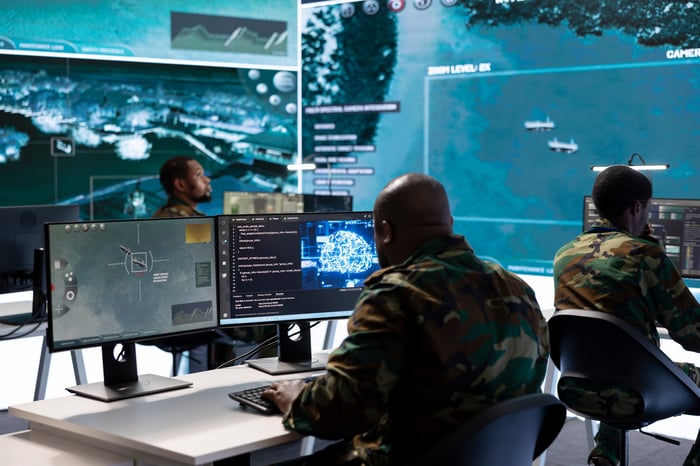
Image source: Getty Images.
Who's who in NGC2?
The Army describes NGC2 as "not a single program or technology, but an ecosystem [comprising] transport, infrastructure, data, and applications." Using artificial intelligence (AI) and machine learning, NGC2 will "rapidly organize and analyze data" for commanders, helping them to make "more, better, and faster decisions than the enemy."
Currently, two defense industry teams are in the lead to build NGC2 for the Army.
In July 2025, the Army announced it would pay a team led by private defense contractor Anduril $99.6 million over 11 months to develop a "prototype architecture" including hardware, software, and applications for the Army's 4th Infantry Division. Anduril's team includes partners Palantir (NASDAQ: PLTR), Microsoft (NASDAQ: MSFT), Govini, and two recent additions, transportation start-up Shift5 and logistics company Rune.
Separately, defense contracting giant Lockheed Martin (NYSE: LMT) and AI partners Raft and Hypergiant were awarded $26 million (over 16 months) in September 2025 to build an NGC2 prototype for the 25th Infantry Division.
Defense industry analysis firm Tectonic Defense notes that NGC2 is itself just part of a larger Pentagon software effort called Joint All-Domain Command and Control (JADC2), which aims to "weave information, data, and decision-making across all domains (land, air, sea, space, and cyber) and services (Army, Navy, Air Force, Marine Corps, and Space Force)" and "basically keep tabs on and control everything that the DoD does -- or wants to do."
What it means for investors
That sounds like a tall order. Tectonic also notes that it's curious that a Pentagon-wide effort to unify command and control throughout the services has spawned competing solutions from the Army (NGC2), the Navy ("Project Overmatch"), and the Air Force ("Advanced Battle Management System").
If the Pentagon continues to fund all three programs, it's likely to run into budget problems, even as it defeats the purpose of creating just one program to be used across all services. Nevertheless, for the time being, this appears to be the approach the services are taking.
To me, what's most curious about the NGC2 aspect of JADC2 is that the bulk of the funds being spent are going not to the biggest name in defense participating -- Lockheed Martin -- but rather to up-and-comer Anduril and its team. For investors, this may create an opportunity.
We already know that Anduril is on an IPO path and seeking to eventually become a publicly traded company (as its partner on NGC2, Palantir, has already done). With Anduril apparently the Army's favorite on this software-centric project, winning nearly four times the funds allotted to Lockheed, it would appear Anduril is "winning" in the defense space as well.
If you're looking for the next great defense stock to invest in, Anduril might be it.
Should you buy stock in Lockheed Martin right now?
Before you buy stock in Lockheed Martin, consider this:
The Motley Fool Stock Advisor analyst team just identified what they believe are the 10 best stocks for investors to buy now… and Lockheed Martin wasn’t one of them. The 10 stocks that made the cut could produce monster returns in the coming years.
Consider when Netflix made this list on December 17, 2004... if you invested $1,000 at the time of our recommendation, you’d have $534,817!* Or when Nvidia made this list on April 15, 2005... if you invested $1,000 at the time of our recommendation, you’d have $1,123,912!*
Now, it’s worth noting Stock Advisor’s total average return is 964% — a market-crushing outperformance compared to 192% for the S&P 500. Don't miss the latest top 10 list, available with Stock Advisor, and join an investing community built by individual investors for individual investors.
*Stock Advisor returns as of March 7, 2026.
Rich Smith has no position in any of the stocks mentioned. The Motley Fool has positions in and recommends Microsoft and Palantir Technologies. The Motley Fool recommends Lockheed Martin. The Motley Fool has a disclosure policy.
