
The external fund manager backed by Berkshire Hathaway's Charlie Munger, Li Lu, makes no bones about it when he says 'The biggest investment risk is not the volatility of prices, but whether you will suffer a permanent loss of capital.' So it seems the smart money knows that debt - which is usually involved in bankruptcies - is a very important factor, when you assess how risky a company is. Importantly, NewAge, Inc. (NASDAQ:NBEV) does carry debt. But should shareholders be worried about its use of debt?
When Is Debt Dangerous?
Debt is a tool to help businesses grow, but if a business is incapable of paying off its lenders, then it exists at their mercy. Part and parcel of capitalism is the process of 'creative destruction' where failed businesses are mercilessly liquidated by their bankers. However, a more common (but still painful) scenario is that it has to raise new equity capital at a low price, thus permanently diluting shareholders. By replacing dilution, though, debt can be an extremely good tool for businesses that need capital to invest in growth at high rates of return. When we think about a company's use of debt, we first look at cash and debt together.
What Is NewAge's Net Debt?
As you can see below, NewAge had US$17.6m of debt at September 2021, down from US$20.0m a year prior. However, it does have US$46.8m in cash offsetting this, leading to net cash of US$29.2m.
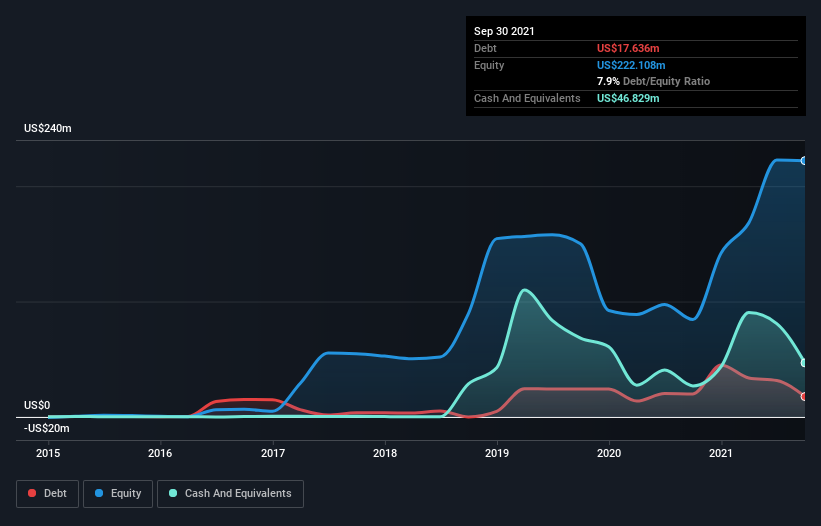
A Look At NewAge's Liabilities
According to the last reported balance sheet, NewAge had liabilities of US$97.8m due within 12 months, and liabilities of US$85.7m due beyond 12 months. On the other hand, it had cash of US$46.8m and US$8.87m worth of receivables due within a year. So its liabilities total US$127.8m more than the combination of its cash and short-term receivables.
This is a mountain of leverage relative to its market capitalization of US$161.5m. Should its lenders demand that it shore up the balance sheet, shareholders would likely face severe dilution. Despite its noteworthy liabilities, NewAge boasts net cash, so it's fair to say it does not have a heavy debt load! The balance sheet is clearly the area to focus on when you are analysing debt. But ultimately the future profitability of the business will decide if NewAge can strengthen its balance sheet over time. So if you're focused on the future you can check out this free report showing analyst profit forecasts.
In the last year NewAge wasn't profitable at an EBIT level, but managed to grow its revenue by 77%, to US$440m. Shareholders probably have their fingers crossed that it can grow its way to profits.
So How Risky Is NewAge?
By their very nature companies that are losing money are more risky than those with a long history of profitability. And in the last year NewAge had an earnings before interest and tax (EBIT) loss, truth be told. And over the same period it saw negative free cash outflow of US$32m and booked a US$7.1m accounting loss. With only US$29.2m on the balance sheet, it would appear that its going to need to raise capital again soon. NewAge's revenue growth shone bright over the last year, so it may well be in a position to turn a profit in due course. By investing before those profits, shareholders take on more risk in the hope of bigger rewards. The balance sheet is clearly the area to focus on when you are analysing debt. However, not all investment risk resides within the balance sheet - far from it. Be aware that NewAge is showing 2 warning signs in our investment analysis , you should know about...
When all is said and done, sometimes its easier to focus on companies that don't even need debt. Readers can access a list of growth stocks with zero net debt 100% free, right now.
Have feedback on this article? Concerned about the content? Get in touch with us directly. Alternatively, email editorial-team (at) simplywallst.com.
This article by Simply Wall St is general in nature. We provide commentary based on historical data and analyst forecasts only using an unbiased methodology and our articles are not intended to be financial advice. It does not constitute a recommendation to buy or sell any stock, and does not take account of your objectives, or your financial situation. We aim to bring you long-term focused analysis driven by fundamental data. Note that our analysis may not factor in the latest price-sensitive company announcements or qualitative material. Simply Wall St has no position in any stocks mentioned.
The views and opinions expressed herein are the views and opinions of the author and do not necessarily reflect those of Nasdaq, Inc.

