
Some say volatility, rather than debt, is the best way to think about risk as an investor, but Warren Buffett famously said that 'Volatility is far from synonymous with risk.' It's only natural to consider a company's balance sheet when you examine how risky it is, since debt is often involved when a business collapses. We can see that BIOLASE, Inc. (NASDAQ:BIOL) does use debt in its business. But should shareholders be worried about its use of debt?
When Is Debt A Problem?
Debt assists a business until the business has trouble paying it off, either with new capital or with free cash flow. Part and parcel of capitalism is the process of 'creative destruction' where failed businesses are mercilessly liquidated by their bankers. However, a more common (but still painful) scenario is that it has to raise new equity capital at a low price, thus permanently diluting shareholders. Of course, plenty of companies use debt to fund growth, without any negative consequences. When we think about a company's use of debt, we first look at cash and debt together.
What Is BIOLASE's Debt?
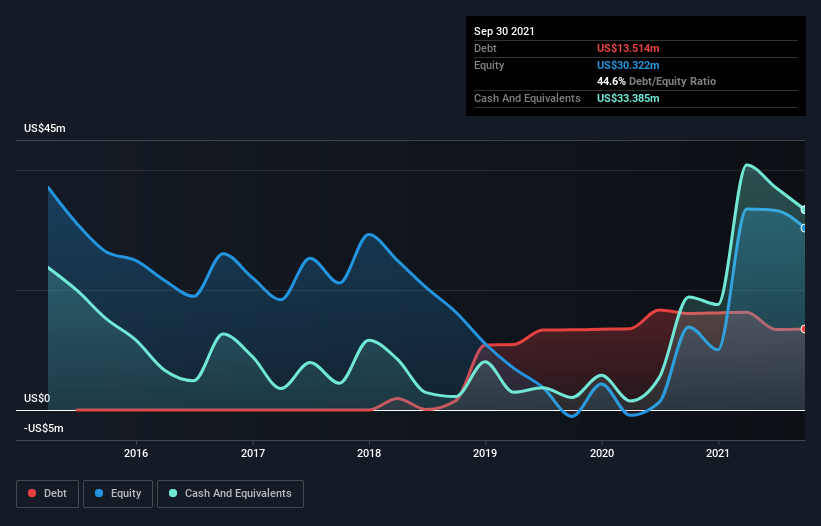
The image below, which you can click on for greater detail, shows that BIOLASE had debt of US$13.5m at the end of September 2021, a reduction from US$16.1m over a year. But it also has US$33.4m in cash to offset that, meaning it has US$19.9m net cash.
A Look At BIOLASE's Liabilities
Zooming in on the latest balance sheet data, we can see that BIOLASE had liabilities of US$13.5m due within 12 months and liabilities of US$14.7m due beyond that. On the other hand, it had cash of US$33.4m and US$3.64m worth of receivables due within a year. So it can boast US$8.83m more liquid assets than total liabilities.
This surplus suggests that BIOLASE has a conservative balance sheet, and could probably eliminate its debt without much difficulty. Succinctly put, BIOLASE boasts net cash, so it's fair to say it does not have a heavy debt load! The balance sheet is clearly the area to focus on when you are analysing debt. But it is future earnings, more than anything, that will determine BIOLASE's ability to maintain a healthy balance sheet going forward. So if you're focused on the future you can check out this free report showing analyst profit forecasts.
In the last year BIOLASE wasn't profitable at an EBIT level, but managed to grow its revenue by 44%, to US$35m. Shareholders probably have their fingers crossed that it can grow its way to profits.
So How Risky Is BIOLASE?
We have no doubt that loss making companies are, in general, riskier than profitable ones. And in the last year BIOLASE had an earnings before interest and tax (EBIT) loss, truth be told. Indeed, in that time it burnt through US$15m of cash and made a loss of US$18m. Given it only has net cash of US$19.9m, the company may need to raise more capital if it doesn't reach break-even soon. With very solid revenue growth in the last year, BIOLASE may be on a path to profitability. Pre-profit companies are often risky, but they can also offer great rewards. The balance sheet is clearly the area to focus on when you are analysing debt. But ultimately, every company can contain risks that exist outside of the balance sheet. For example - BIOLASE has 4 warning signs we think you should be aware of.
Of course, if you're the type of investor who prefers buying stocks without the burden of debt, then don't hesitate to discover our exclusive list of net cash growth stocks, today.
Have feedback on this article? Concerned about the content? Get in touch with us directly. Alternatively, email editorial-team (at) simplywallst.com.
This article by Simply Wall St is general in nature. We provide commentary based on historical data and analyst forecasts only using an unbiased methodology and our articles are not intended to be financial advice. It does not constitute a recommendation to buy or sell any stock, and does not take account of your objectives, or your financial situation. We aim to bring you long-term focused analysis driven by fundamental data. Note that our analysis may not factor in the latest price-sensitive company announcements or qualitative material. Simply Wall St has no position in any stocks mentioned.
The views and opinions expressed herein are the views and opinions of the author and do not necessarily reflect those of Nasdaq, Inc.

