
 Credit: Shutterstock photo
Short of Google ( GOOG ), IPOs don't get any sexier than A123 Systems ( AONE ). No one disputes the potential of battery powered cars, massive storage of green energy from solar and wind, and having virtually every appliance from lawnmowers and vacuum cleaners to computers and entertainment cordless. 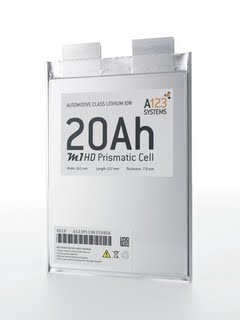 But in the words of the internet, A123 is more eyeballs than monetization.
To be sure they have actual revenue, but they are running a negative gross margin on product sales. In essence the more they sell, the more they lose. And they predict the revenue from their largest customer Black and Decker ( BDK ) is expected to shrink considerably. No more revenue is expected from Mercedes-Benz ( DAI ) HighPerformanceEngines (Vodafone McLaren Mercedes Team). That leaves only BAE Systems (BAESY.PK) for growth.
The truth is in the prospectus . The only real-life applications besides power packs for hand tools have been: BAE Systems' Hybridrive propulsion system for busses and a few Hybrid Ancillary Power Units for the AES Energy Storage unit of AES Corporation.
Here's where it gets interesting. A123 is designing and developing batteries and battery systems for BMW, Chrysler, GM, Shanghai Automotive (( SAIC )), Delphi and Better Place. While A123 invests in custom automotive research and development, they expect most of their revenue for the "foreseeable future" from very few customers. And none of the potential automotive customers have committed to long-term contracts or minimum production volumes. So far A123 is much more hype than substance.
I cannot judge whether A123's technology is superior to its competition. But it has some fierce competitors: Bosch, Dow Chemical ( DOW ), NEC, Panasonic, Sanyo and Samsung. Nissan ( NSANY ), Toyota ( TM ) and Volkswagen have entered into joint ventures to produce batteries that don't include A123.
A123's major manufacturing facilities are located in China and Korea. Their key strategy is to reduce cost by starting to manufacture in Michigan. Makes sense to me; lower costs by moving production from low cost countries to a high cost state in a high cost country. It only makes sense when the government gets involved in this Ponzi scheme.
The US DOE Battery Initiative granted A123 $249.1M to build manufacturing facilities in Michigan. The company also believes that it will be able to borrow up to $235M from the Advanced Technology Vehicles Manufacturing Loan Program. The company expects to be required to invest 25¢ for each DOE Battery Initiative dollar. In addition, the Michigan Economic Growth Authority ( MEGA ) granted $10M and offered up to $4M in loans. MEGA is topping their deal with a 15 year tax credit. Even the government can't resist something this sexy.
Product revenues were $53.5M in 2008 and $36.6M in the first 6 months of 2009. But cost of product sold was $70.4M and 39.2M respectively. Throw on operating expenses of $79.6M and $40.3M, and you get losses of $80.5M for 2008 and $40.7M for H1 2009. With no definitive volume automotive contract in the near future, it looks like A123 is a pipe dream.
It might be helpful to view a speculation on A123 like a small biotech. Though, I take A123 more seriously than the ethanol debacle. No doubt green energy needs smoothing and electric cars will be a reality. But will A123 survive long enough to benefit? While automotive is the highest profile application, it is too much like what General Electric ( GE ) calls "long cycle businesses." A123 will need to concentrate on less sexy applications to keep the company going until the brass ring comes in.
I might speculate on A123 when they break even on a gross margin basis and the hype in the stock is deflated. The trick is to enter when the fundamentals start to look like a viable business, but before the first major automotive and power grid deal is announced.
Disclosures: Author is long GE; GE has made an investment in AONE .
See also What Are Georgia Gulf Shareholders Thinking? on seekingalpha.com
The views and opinions expressed herein are the views and opinions of the author and do not necessarily reflect those of Nasdaq, Inc.
The views and opinions expressed herein are the views and opinions of the author and do not necessarily reflect those of Nasdaq, Inc.

