If You Ain't First, Yer Last
Running Oak's Efficient Growth portfolio outperformed EVERY SINGLE benchmark and peer (that we follow), ytd, as of the end of April.

Why Invest in Efficient Growth:
- Top 3 percentile: Running Oak’s Efficient Growth separate account has performed in the top 3% of all Mid Cap Core funds - despite being out of favor - in Morningstar's database over the last 10 years, net of fees.1
- Opportune: A little known - yet very large - hole exists in the typical equity portfolio, precisely where the most attractive risk/reward asymmetry currently lies. Efficient Growth fills that hole - and opportunity - like few portfolios do.
- 5 Stars: Efficient Growth has a 5-Star Morningstar rating.
- Since inception, Efficient Growth has provided 24% more return than the S&P 500 Equal Weight Index and 6% more return than the S&P 500 Total Return Index, given the same level of downside risk, gross of fees. (Ulcer Performance Index)*
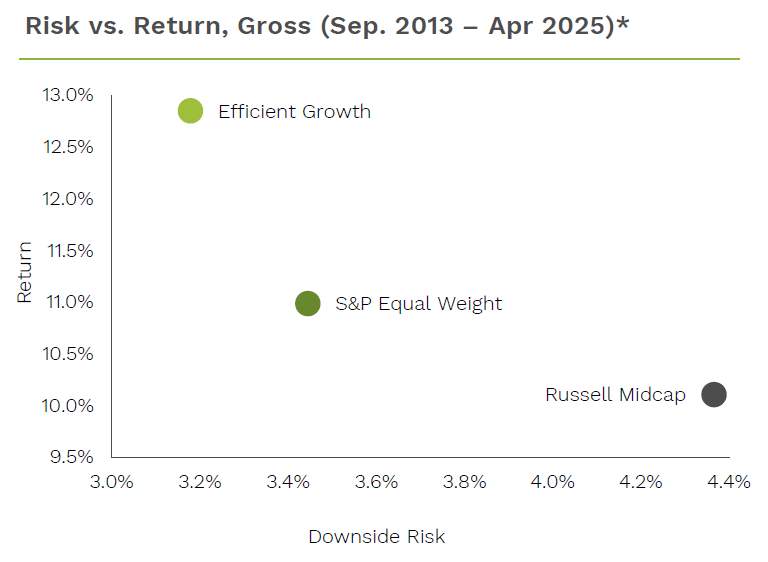
Differentiated Approach and Construction
- Mid Cap stocks are at their cheapest in 25 years relative to Large. Efficient Growth provides significant Mid Cap exposure.
- Efficient Growth is built upon 3 longstanding, common sense principles: maximize earnings growth, strictly avoid inflated valuations, protect to the downside.
- Running Oak utilizes a highly disciplined, rules-based process, resulting in a portfolio that is reliable, repeatable, and unemotional.
How to Invest
- Efficient Growth is currently available as an SMA and ETF. (ETF specifics and SMA historical performance can't be shared in the same letter - sorry, it's annoying, I know. Please inquire for the ticker or more information.)
- In just 22 months, The ETF Which Shall Not Be Named has grown over 17,500% since launch - from 2 to 352mm - despite the recent market decline.
“If you ain’t first, yer last.” – Ricky Bobby, “Talladega Nights: The Ballad of Ricky Bobby”
Okay, that isn’t entirely accurate, but the direction is right.
Invest where others haven’t. Invest in MARGE (upper Mid/lower Large Cap). There's a hole in the center of the typical equity portfolio. That's the sweet spot, offering the most attractive risk/return asymmetry.
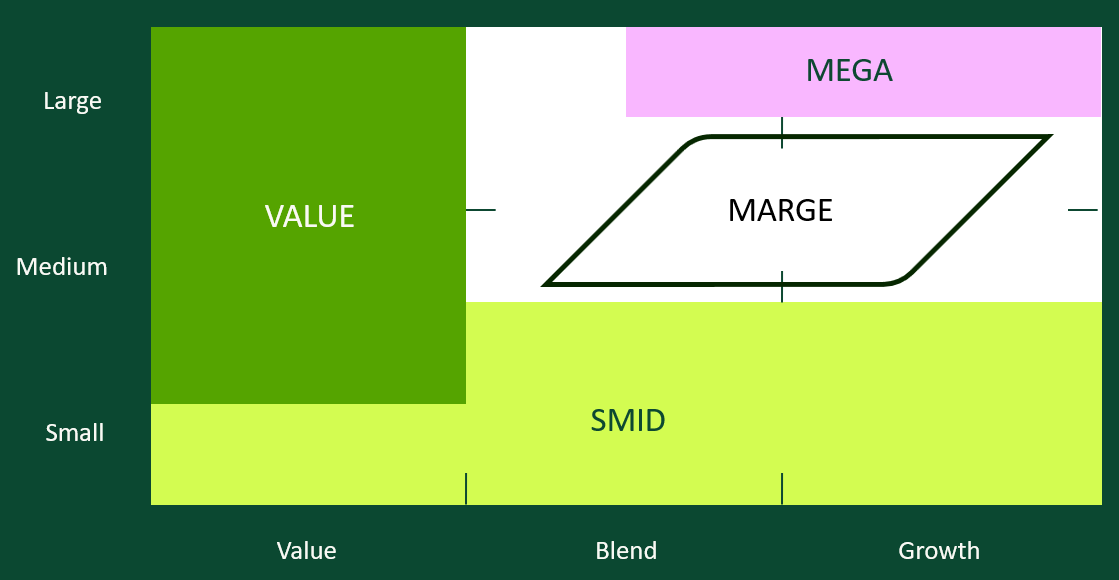
“That doesn't make any sense at all, you can be second, third, fourth... he[ck] you can even be fifth.” - Reese Bobby
In investing, it is far better to be early than late for a number of significant reasons. You don’t have to be 1st, but don’t bring up the rear.
Valuations
Blatantly Obvious Rule of Investing #1: Invest at lower prices, not higher.
Demand for an asset drives the price upward. It’s better to invest in a lower price than a higher price. If you’re late, you’re investing after many have already bought and, therefore, at a less attractive price. If you’re early, you invest before the price has been driven higher, getting a more attractive price.
Return – Lower prices/valuations imply higher potential returns. As far as I know, more money is why everyone invests. Please correct me if I’m mistaken.
Risk – Higher prices/valuations imply higher risk and greater potential downside. Clients work all day, every day, every week, every year, for decades to provide a desired lifestyle and level of comfort for their families. Losing money is counterproductive to their production… to say the least. Everyone owns the same tiny number of companies, a historically high amount of that tiny number of companies, and owns them at historically unintelligent valuations. That puts clients’ futures at significant risk, and they may have many years ahead of them.
"No one lives forever, no one. But with advances in modern science and my high level of income, it's not crazy to think I could live to be 245, maybe 300." - Ricky Bobby
Low valuations provide a margin of error and safety. It’s difficult to predict the future in an uncertain world. A buffer that protects your clients in the event things don’t go according to plan is good.
"The function of the margin of safety is, in essence, that of rendering unnecessary an accurate estimate of the future." — Benjamin Graham
"Help me, Jesus! Help me, Jewish God! Help me, Tom Cruise!" – Ricky Bobby
The CEO of a massive planning firm recently posted that none of the top-performing managers in 2020 were top-performing managers by 2023. Soooo, chasing the hottest short-term returns (investing where everyone else has) isn’t a successful strategy, long-term? It turns out piling into that which performed best through a once-in-a-century pandemic didn’t continue to perform best through the greatest fiscal spending and monetary binge in history. Shocking. He’s quoting Standard and Poor's research, SPIVA scorecard and their Persistence "report", two oft-quoted marketing efforts that intentionally manipulate data to pump indexing (because that’s how Standard and Poor's makes money). While I disagree with their motives, methods, and misdirection, we are in agreement that chasing returns and investing where everyone else already has is a poor practice.
Don’t follow (despite the religious and Tom Cruise reference above). Invest where others haven't.
"You can't have two number ones. That makes eleven!" — Cal Naughton Jr.
Would you prefer a return tailwind or headwind?
Other investors can help you or hurt you. Investing in what others haven’t will provide a tailwind to your returns, if others follow. Demand drives prices higher.
On the other hand, following and buying the same tiny number of companies that everyone else has at historically unintelligent valuations will result in a significant headwind, if they sell. Supply drives prices down.
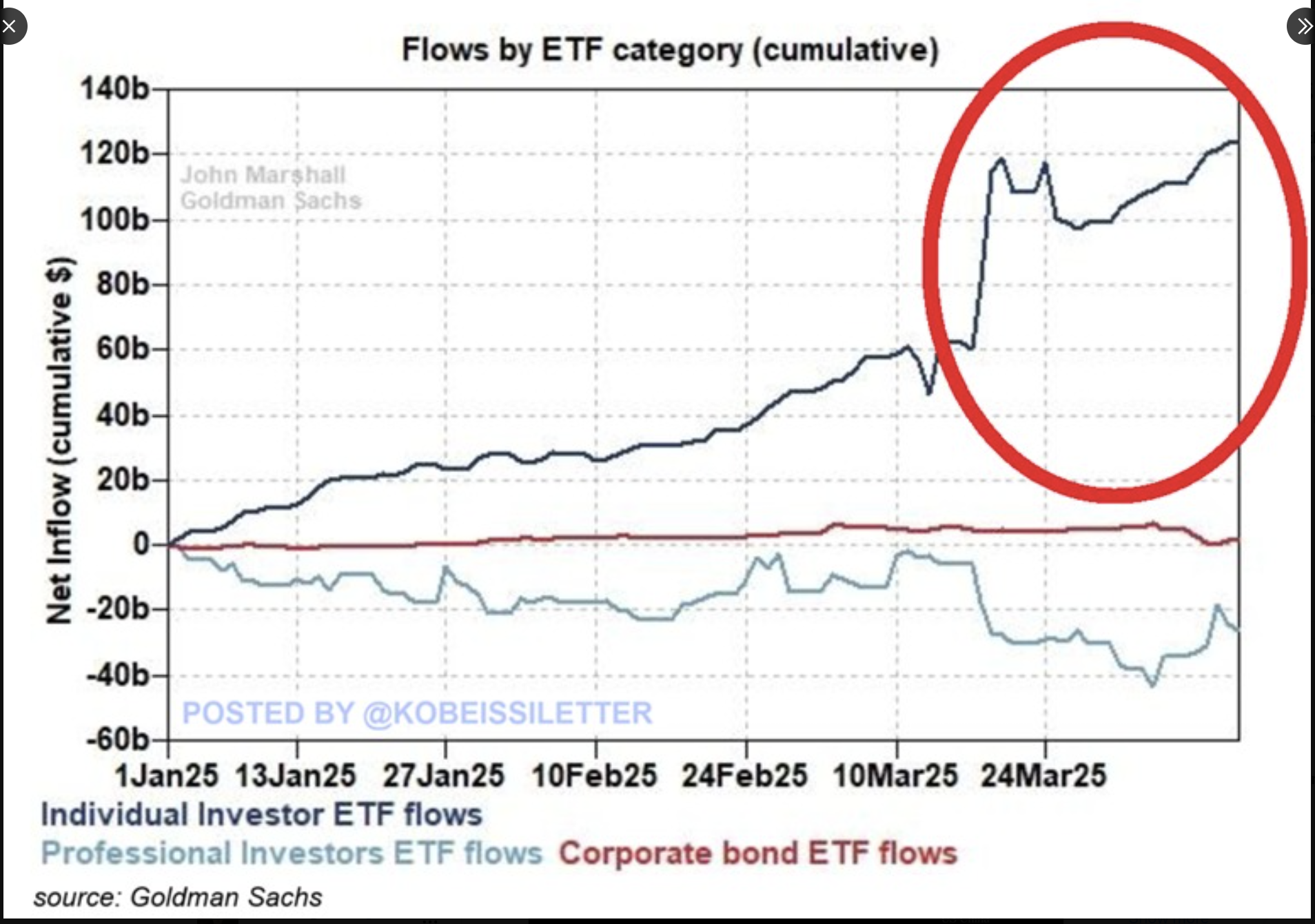
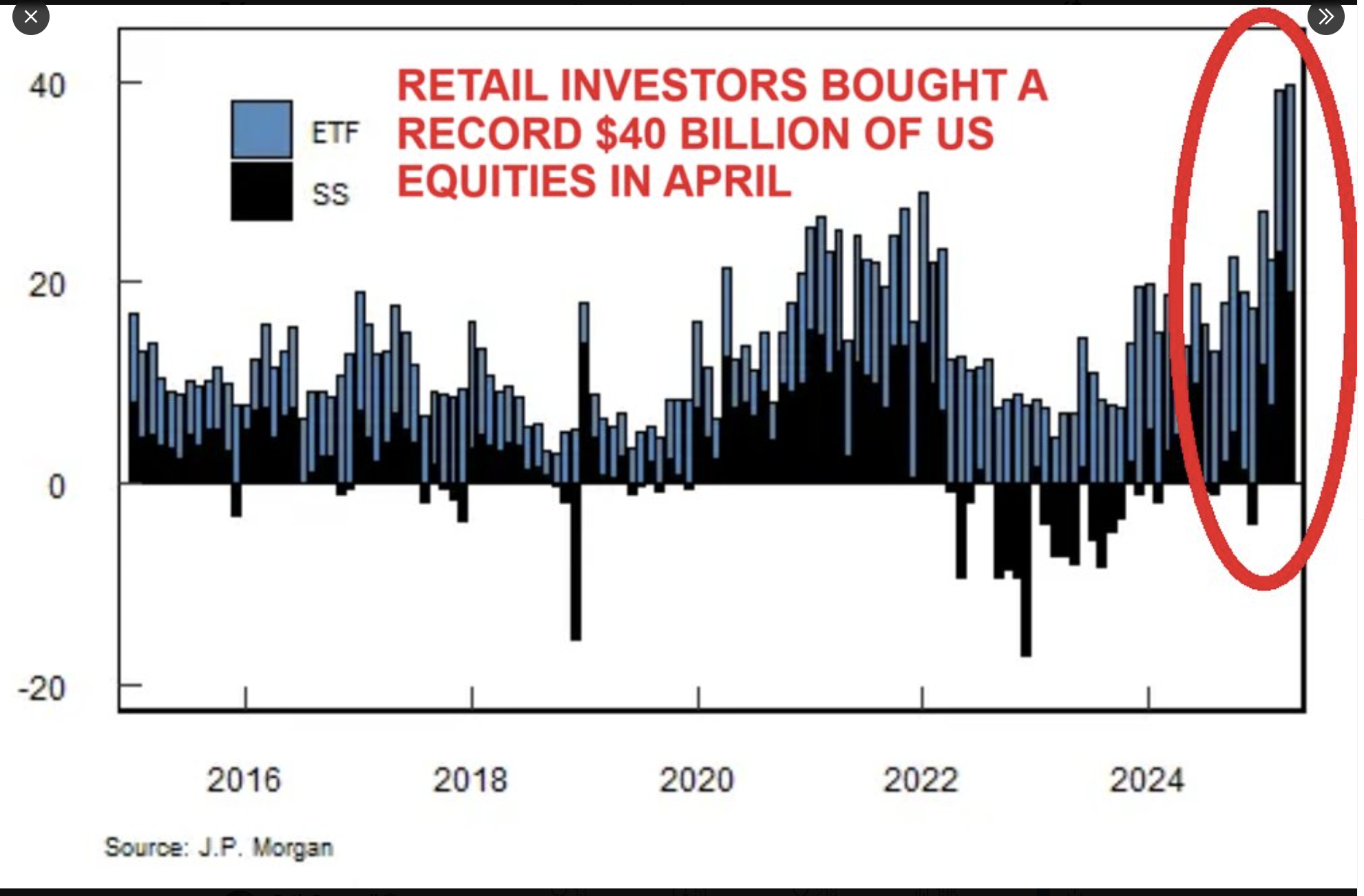
Retail investors have piled in like never before, driving prices and valuations higher.
Thoughtfully investing in that which others don’t own is a win/win – more likely upside, less likely downside.
"Most people get interested in stocks when everyone else is. The time to get interested is when no one else is." — Warren Buffett
Blatantly Obvious Rule of Investing #2: Invest in the asset class that provides the highest long-term return.
Mid Cap stocks have outperformed Lage by 60bps over the last 33 years. In aggregate, Mid Cap stocks have provided 20% more return than Large; that’s A LOT of money.

Blatantly Obvious Rule of Investing #3: See Blatantly Obvious Rule of Investing #1: Invest at lower prices, not higher.
Large Cap stocks, as of a few months ago, were 100% overvalued relative to their long term mean, per Ned Davis. Mid Cap stocks are undervalued.

Invest Where Others Aren't (MARGE - Upper Mid/Lower Large Cap)
- Investing where everyone else is investing means higher prices, higher valuations, lower implied returns, higher implied downside.
- Investing where others aren't means lower prices, lower valuations, higher implied returns, lower implied downside and a margin of error.
- Investing where others aren't also provides valuable diversification.
- If the market goes up, others are likely to follow, propelling prices.
- If the market goes down, others can't sell what they don't own, meaning less selling and downside pressure.
It's win/win.
Running Oak's goal is to maximize the exponential growth of clients' portfolios, while subjecting them to far less risk of loss. In other words, we aim to help your clients realize their dreams and avoid their nightmares.
If you appreciate critical thinking, math, common sense, and occasional sarcasm, we would love to speak with you. Please feel free to set up a time here: Schedule a call.
Best,
Seth L. Cogswell
Founder and Managing Partner
Edina, MN 55424
P +1 919.656.3712
For additional data and context regarding the claims made within this letter, please refer to the Disclosures and Additional Data document located here.
“All opinions expressed in this newsletter are those of Running Oak Capital’s and do not constitute investment advice.”
Investment Advisory Services are offered through Running Oak Capital, a registered investment adviser.
*Past performance is no guarantee of future results. Performance expectations are no guarantee of future results; they reflect educated guesses that may or may not come to fruition. All indices are unmanaged and may not be invested into directly.
*Statements reflect the opinion of Running Oak Capital on the average investor’s equity portfolio allocation. This is based on informal feedback and experience from interactions with investors and other financial professionals.
The Standard & Poor’s 500 Index is a capitalization weighted index of 500 stocks designed to measure performance of the broad domestic economy through changes in the aggregate market value of 500 stocks representing all major industries.
The opinions voiced in this material are for general information only and are not intended to provide specific advice or recommendations for any individual. To determine which investments and strategies may be appropriate for you, consult with us at Running Oak Capital or another trusted investment adviser.
Stock prices and index returns provided by Standard & Poor’s.