

Uranium is an essential metal producing for nuclear power, a clean energy source that is growing in importance in an era of unstable energy markets and the energy transition.
The uranium market offers investors an excellent entry point into the global energy economy as governments and corporations around the world are looking for more stable, secure energy sources.
So how does one invest in uranium? There are plenty of options to consider, including uranium stocks, exchange-traded funds, physical trusts and futures.
As part of their due diligence, it's important for investors interested in uranium to understand the market's fundamentals and the potential risks, and how they are all shaping the investment case for the energy metal.
We break down what you need to know about the uranium market and how to invest in uranium below.
In this article
- What is uranium and what is it used for?
- What is the future outlook for uranium prices?
- Uranium demand outlook: Nuclear energy and AI
- Uranium supply outlook: Mining shortfalls ahead
- What are the risks of investing in uranium?
- How to invest in uranium
- Uranium stocks
- Uranium ETFs
- Uranium physical trusts
- Uranium futures
What is uranium and what is it used for?
Uranium (U) is a naturally occurring metal primarily valued as an energy metal due to its fissionable properties. Uranium is produced with both conventional mining and in-situ recovery. Both methods ultimately produce a uranium oxide concentrate commonly referred to as U3O8, and sometimes as yellowcake.
Uranium's primary use is in nuclear reactors, which are fueled with the isotope uranium-235. Through the fission process, uranium produces many times more energy than an equivalent amount of fossil fuels do through combustion. For example, the energy recoverable from 1 kilogram of uranium is 45,000 kilowatt hours of electricity, equivalent to that of 14,000 kilograms of coal.
As U3O8 has a low concentration of uranium-235, it must be enriched before it can be used as feedstock for reactors. The enrichment process produces a by-product known as depleted uranium, which is used for military applications including armor-piercing munitions.
What is the long-term outlook for uranium prices?
The uranium market’s future outlook is strong given the growing demand for reliable, non-fossil fuel sources of energy, and this has been represented in the strength of both spot uranium prices and prices for long-term contracts.
The uranium spot price, which represents the cost of on-market purchases for immediate delivery, has been on the rise and briefly broke US$100 per pound of U3O8 in January.
One of the key trends for uranium prices in 2025 was the strength of long-term uranium contract prices, which are typically negotiated between suppliers and utilities for a set amount of uranium product to be delivered over a determined number of years. Hence, prices set for long-term uranium contracts are a more reliable bellwether for the future outlook of the uranium market.
As for the 2026 forecast for uranium long-term contracts, Justin Huhn of Uranium Insider told the Investing News Network he sees prices rising from US$86 at the end of 2025 to potentially US$100 per pound of U3O8. By the end of Q1 2026, the long-term contract price for uranium was sitting at US$90 per pound of U308, its highest level since 2008.
These contracts have floor and ceiling prices built in to protect both the mining company and the utility company from large swings in uranium prices, and recent data shows that utilities are already budgeting for significantly higher prices.
In January, Cameco President Grant Isaac CEO reported, “We’ve had market-related contracts with floors, escalated floors in the mid-70s. We’ve had ceilings as high as US$150 escalated. The midpoint between those floors and the ceilings are already US$100 uranium, US$115 uranium.”
For a better understanding of the uranium market outlook and whether uranium is a good investment now, let’s look at what’s driving demand and influencing supply for the energy metal.
Uranium demand outlook: Nuclear energy and AI data centers
Uranium demand is primarily driven by growth in nuclear power generation, meaning this sector of the global energy market has a major influence on the price of uranium.
One of the biggest factors supporting the nuclear energy narrative in 2026 is its role as a supplier of clean energy for AI data centers. As the AI sector continues growing, so too will its already substantial electricity consumption.
Nuclear reactors are already a significant supplier of electricity, accounting for 9 percent of the world's electricity generation in 2024, according to the World Nuclear Association. As of April 2026, there are 438 operable reactors around the world today, with the US, France and China taking top three for total operable net capacity.
On top of this, there are a further 78 reactors under construction. China leads the pack with 38 nuclear reactors in the works, most of which are large reactors with capacities over 1,000 megawatts electric, followed by India with eight and Russia with seven.
Looking forward, in its demand and supply report published in September 2025, the WNA projected that installed nuclear capacity could nearly double from the 398 gigawatts electric (GWe) estimated in June 2025 to 746 GWe by 2040. As a result, uranium demand from reactors could grow from an estimated 68,900 metric tons (MT) of uranium in 2025 to just over 150,000 MT by 2040.
In its World Nuclear Outlook Report, released in January 2026, the WNA notes “strong international support for nuclear energy as a core component of climate and energy security strategies.” By 2050, the association estimates that total global capacity could reach 1446 GWe by 2050 if nations around the world meet their ambitious nuclear energy goals and all under construction, planned and potential reactors are operating. China, France, India, Russia and the US represent nearly 980 GWe of this estimate.
Some of the trends the WNA sees driving this potential growth are the energy needs of a growing global population, the rapid electrification across all sectors of the economy due to the shift away from fossil fuels, and the aforementioned growth of AI technology.
Additionally, physical uranium investment trusts, which are discussed later on, have scooped up significant amounts of supply.
Uranium supply outlook: Shortfalls expected despite new mines
There are many factors shaping the supply side of the global uranium market, namely the geopolitics and environmental regulations in the jurisdictions in which uranium deposits occur.
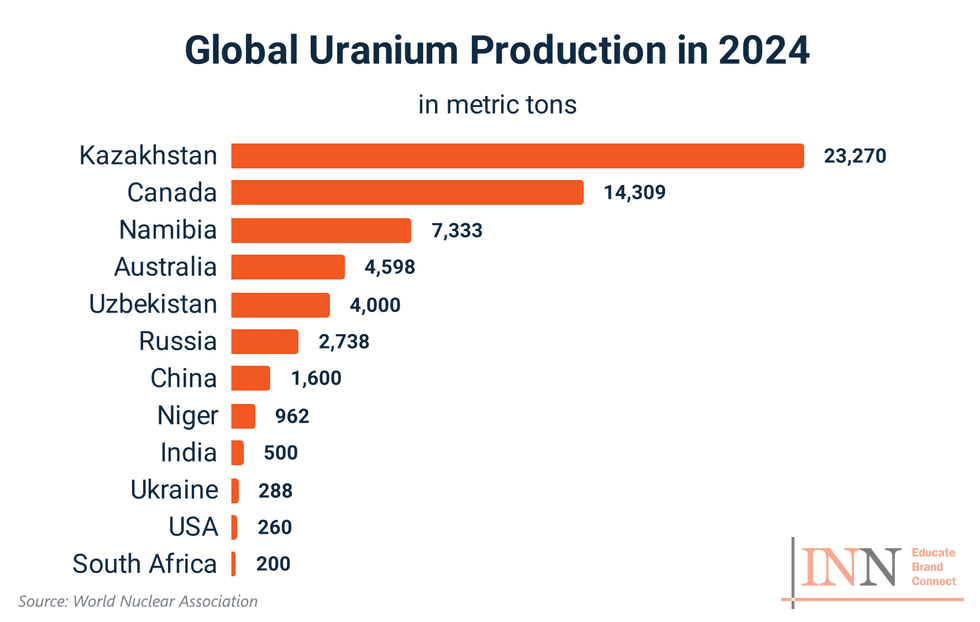
According to WNA data, 60,213 metric tons of uranium were mined in 2024, which was equivalent to about 90 percent of total uranium demand for that year, leaving a notable 10 percent supply gap.
The top uranium producing nations of Kazakhstan, Canada, Namibia and Australia were responsible for more than 82 percent of the total. Kazakhstan is by far the largest uranium producer with an output of 23,270 MT of uranium compared to Canada at 14,309 MT, Namibia at 7,333 MT and Australia at 4,598 MT.
Although it ranks fourth in terms of uranium production, Australia is home to the world’s largest confirmed uranium resource base, representing about 28 percent of total global uranium resources.
Canada's uranium mining industry is centered in Northern Saskatchewan's prolific Athabasca Basin, home to the world’s two largest uranium mines by production, the Cigar Lake and McArthur River/Key Lake uranium mines, both owned by joint ventures between Cameco (TSX:CCO,NYSE:CCJ) and Orano Canada.
One of the biggest factors influencing uranium supply is the continued supply shortages as a result of the lack of investment in exploration and development that pervaded the market after the March 2011 Fukushima nuclear accident triggered significant anti-nuclear sentiment that led to permanent shutdowns and delayed nuclear startups for years.
Nuclear power demand is on the rise again thanks to a push toward non-fossil-fuel power generation and supportive policies from governments and investment in uranium projects has rebounded. In 2026, multiple uranium companies are bringing production online in Canada, the US and around the world.
Still, more production is needed to meet growing demand, and the decades-long lead times required to bring new uranium projects into production means these supply deficits are expected to last well into the 2030s despite a much improved uranium price landscape.
In March 2026, Justin Huhn of Uranium Insider told the Investing News Network (INN) that two of the world’s key uranium mining companies, the aforementioned Cameco and Kazakhstan’s Kazatomprom, are on track to see some of their most productive projects run out of steam in the next five years.
“Both (major miners) have pipeline problems into the 2030s. Without new development, the market will struggle to balance supply with the surging demand ahead,” he said. In order to incentivize uranium mining miners to lay out the capital required to spur supply side growth, uranium prices need to move higher and stay there.
“Looking at what the world will need to supply 250 million to 300 million pounds a year in about 10 years, we’re probably going to need prices in the US$125 to US$150 range, and they’ll need to stay there for a while,” Huhn said.
What are the risks of investing in uranium?
The uranium market currently has many tailwinds supporting it as part of the push towards clean energy. However, as with any commodity market, there are several risks inherent to uranium investing that investors should know when deciding if it is the right choice for their portfolio, including political instability, long permitting timelines and market volatility.
For one, substantial geopolitical risks exist in some of the top jurisdictions in which uranium is mined. Kazakhstan, Russia, Namibia and Niger are highly prone to political instability, resource nationalism and external pressures such as sanctions and trade disputes. For example, Kazakhstan’s close ties with Russia has led to supply chain disruptions, while coups in Niger have resulted in export restrictions. This should be considered when deciding which jurisdictions to invest in.
Additionally, most countries have placed strict regulations on the mining of uranium and storage of mine tailings, as uranium tailings are highly harmful to human health and the environment. Investors can expect uranium mining companies to face lengthy permitting for new projects and mines to ensure their safety, and stringent international safety standards enforced by agencies such as the International Atomic Energy Agency (IAEA).
Public sentiment around the safety of both uranium mines and nuclear power plants is often in flux, which can result in governments decreeing unforeseen moratoriums or outright bans leading to project delays, cost overruns or project cancellations that can erase any future returns on investment.
Uranium prices are historically volatile, reacting with large price swings in response to nuclear policy shifts, reactor restarts and speculative demand. While long-term supply contracts with utilities at set prices can help uranium miners mitigate some of that risk, they do not fully insulate a mining firm and its investors from market volatility. For example, if a miner is not able to fulfill delivery of the contract due to production setbacks, the company may need to purchase the shortfall on the spot market at unfavorable prices.
How to invest in uranium?
There are four main routes to investing in uranium: uranium stocks, uranium exchange traded funds (ETFs), physical uranium trusts and uranium futures. Each option comes with a variety of pros and cons for investors, which we compare below.
Uranium stocks offer direct exposure to upside during a uranium bull market plus potential dividends. However, this option has the highest risk and research burden for investors, particularly when investing in the junior sector. We offer some due diligence advice to get you started in the next section.
Uranium ETFs, which hold a portfolio of uranium mining stocks, offer a better balance of diversification and ease of liquidity than stocks. This upside can still be dragged down by individual performers, or by market headwinds affecting the sector at large. Additionally, associated fees can dilute returns.
Physical uranium trusts hold physical uranium, meaning they offer direct exposure to the uranium price at the lowest risk profile compared to the other avenues. However, while these lack the operational risks associated with mining stocks, there are complex tax considerations and management fees associated with these investment vehicles.
Uranium futures offer the purest price play and leverage to upside in the uranium market. But they carry more risk than ETFs or trusts with the potential for margin calls, illiquidity for retail investors and the high degree of market knowledge required to manage the complex nature of this investment type. This option is best suited for advanced traders not interested in long-term investments.
Uranium stock investing guide
Shares in uranium mining stocks are traded on major exchanges like the New York Stock Exchange (NYSE), the Toronto Stock Exchange (TSX), the Australian Stock Exchange (ASX), and the London Stock Exchange (LSE). Investors can purchase shares of stocks several ways, including through a stock broker or an online stock trading platform.
Uranium mining stocks
The world’s largest uranium-mining companies often provide more stability compared to juniors, making them a safer option for beginners compared to junior companies. Here are some options to consider:
Cameco (TSX:CCO,NYSE:CCJ)
Cameco operates the world's largest uranium mines, Cigar Lake and McArthur River/Key Lake, in the Athabasca Basin of Saskatchewan, Canada. Cameco holds a 54.55 percent interest in Cigar Lake, 70 percent of the McArthur River mine and 83 percent of the Key Lake mill, alongside partner Orano Canada.
Paladin Energy (ASX:PDN,OTCQX:PALAF)
Paladin Energy has a 75 percent stake in the Langer Heinrich uranium mine in Namibia. The company also has a portfolio of exploration projects that spans Canada and Australia, including the Patterson Lake South (PLS) uranium project in the Athabasca Basin which it picked up when it acquired Fission Uranium in 2024.
Boss Energy (ASX:BOE,OTCQX:BQSSF)
Boss Energy has two producing uranium assets, the Honeymoon mine in South Australia and the Alta Mesa in-situ recovery (ISR) operation in South Texas, US.
Energy Fuels (TSX:EFR,NYSEAMERICAN:UUUU)
Energy Fuels is the leading US producer of natural uranium concentrate, with several conventional and ISR uranium projects in the western United States. It also owns the White Mesa Mill in Utah, the country's only fully licensed and operating conventional uranium processing facility.
Kazatomprom (LSE:KAP)
Kazatomprom is the world's largest producer and seller of natural uranium, accounting for roughly 20 percent of global primary production. It was formerly a Kazakhstan state-owned entity, but 25 percent of its shares are now publicly listed.
For more uranium majors, we profile the largest Australian uranium stocks on the market. You can also learn about Canadian uranium companies here.
Uranium junior stocks
Junior uranium explorers and developers are an option that can offer a much higher upside than established miners, as a big discovery or deal can cause their share price to rise steeply. However, these carry a much higher risk, as a lack of funds or discoveries can weigh heavily on the price.
Because of this, junior stocks are a better option for experienced investors in the resources market, and require significant due diligence before making a big investment. We offer tips below.
For interested investors, there are quite a few mid-tier and junior uranium exploration companies that investors may want to take a closer look at. As a starting point, check out our lists of the top-performing Canadian uranium stocks, the top-performing Australian uranium stocks and uranium companies exploring the Athabasca Basin of Saskatchewan, Canada.
Due diligence tips
Investors are advised to practice due diligence before investing in uranium mining stocks, meaning carefully researching the company and its projects. Industry experts recommend focusing on the following points, which you can usually find on companies' websites and reports:
- the management team’s track record
- the company’s financials
- jurisdictional risks such as political instability or uranium mining moratoriums
- what de-risking milestones have been reached, such as permitting, feasibility studies, community engagement and offtake agreements
- the project's access to markets, such as proximity to consumers, ports and railway
Uranium ETFs
For investors who want exposure to the uranium market, but appreciate the diversity of a basket of equities instead of single stocks, exchange-traded funds (ETFs) are generally the way to go.
Selecting the best uranium ETF depends on your investment goals. Luckily for investors, the selection of uranium-focused ETFs has grown in recent years. The list below includes pureplay uranium ETFs and ones that also offer exposure to nuclear energy industry.
Horizons Global Uranium Index ETF (TSX:HURA)
The Global X Uranium Index ETF holds a range of global uranium stocks, with Cameco and Kazatomprom weighted around 20 and 15 percent respectively. It also offers exposure to physical uranium through the Sprott Physical Uranium Trust.
Sprott Uranium Miners ETF (ARCA:URNM)
The Sprott Uranium Miners ETF is an international uranium fund composed of companies in Kazakhstan, Canada and the US. Using the North Shore Global Uranium Mining Index, the ETF tracks producers and explorers, as well as holders of physical uranium.
Global X Uranium ETF (ARCA:URA)
The Global X Uranium ETF tracks a basket of uranium miners and nuclear component producers. The ETF has significant exposure to Canadian major Cameco, which makes up just under a quarter of its holdings by weight.
VanEck Uranium and Nuclear ETF (ARCA:NLR)
This uranium ETF tracks a market-cap-weighted index of companies in the uranium and nuclear industries, including miners and nuclear electricity and technology companies.
Physical uranium investment vehicles
Investors can't personally hold physical uranium metal, unlike commodities such as gold and silver.
Investors looking for more direct exposure to upside in uranium prices might want to consider physical uranium trusts and other vehicles that provide exposure to the price of U3O8. The difference between uranium trusts and uranium ETFs is that, as the name implies, the trusts invest solely in physical uranium without exposure to the risks inherent in mining operations.
Trusts aren't the only option for access to the uranium price. We've collected several ways to get direct exposure to its movements below.
Sprott Physical Uranium Trust (TSX:U.U,OTCQX:SRUUF)
The most popular and the world’s largest uranium trust, the Sprott Physical Uranium Trust has holdings of over 80 million pounds of uranium through partnerships with several miners. It has been credited with helping to boost investment demand and uranium prices in recent years.
Zuri-Invest Physical Uranium AMC
One of the newest physical uranium products is Zuri-Invest's actively managed certificate (AMC), purchasable through a stock broker. The custodian of the product is Cameco, which holds the physical uranium in a secure storage facility in Canada.
Yellow Cake (LSE:YCA,OTCQX:YLLXF)
Setting itself apart from the trusts and funds on this list, Yellow Cake is a company that purchases and holds physical uranium via a partnership with Kazatomprom.
Roundhill Uranium ETF (CBOE:UX)
The Roundhill Uranium ETF offers investors exposure to the uranium price through swap agreements with financial institutions instead of holding physical uranium itself.
xU3O8
Using the power of the Tezos blockchain and real-world asset tokenization, the xU3O8 token from uranium.io gives investors the ability to directly own and trade fractions of physical uranium digitally, backed by holdings stored by Cameco. Investors can access xU3O8 using cryptocurrency exchanges.
Uranium futures
As a fourth option, investors can look to the futures market while awaiting a further rise in the uranium price. Futures are financial contracts that obligate the buyer to purchase (or the seller to sell) an asset like a physical commodity or financial instrument at a predetermined future date and price.
In terms of uranium futures, investors have a few options. CME Group (NASDAQ:CME) offers UxC uranium U3O8 futures. These contracts track U3O8, and each one represents 250 pounds of the nuclear fuel. The NYMEX also provides investors with a U3O8 futures trading option.
As noted earlier, futures investing carries higher risks, making uranium futures something only advanced traders familiar with this method should consider.
This is an updated version of an article originally published by the Investing News Network in 2016.
Don’t forget to follow us @INN_Resource for real-time news updates!
Securities Disclosure: I, Melissa Pistilli, hold no investment interest in any of the companies mentioned in this article.
Editorial Disclosure: The Investing News Network does not guarantee the accuracy or thoroughness of the information reported in the interviews it conducts. The opinions expressed in these interviews do not reflect the opinions of the Investing News Network and do not constituteinvestment advice All readers are encouraged to perform their own due diligence.
The views and opinions expressed herein are the views and opinions of the author and do not necessarily reflect those of Nasdaq, Inc.

