How Cycles and Position Sizing are Connected
We talked a lot about cycles towards the end of 2019. Today, we'll explain how cycles and position sizing are connected with the help of a legendary billionaire, Howard Marks.
Marks is a distressed-debt investor worth $2.2 billion. He is famous for his "memos" — multi-page client letters on various investing topics.
The insights in these memos are always clear, simple, and practical. Here is what Warren Buffett says: "When I see memos from Howard Marks in my mail, they're the first thing I open and read. I always learn something." That is one heck of an endorsement.
Marks has also written a few books, the most recent of which is "Mastering the Market Cycle: Getting the Odds on Your Side." As you may guess from the title, he is a devoted student of market cycles. Here are some direct quotes from the book — the third one being the most important:
"I can't say an understanding of cycles is everything in investing, or the only thing, but for me it's certainly right near the top of the list."
"Most of the great investors I’ve known over the years have had an exceptional sense for how cycles work in general and where we stand in the current one. That sense permits them to do a superior job of positioning portfolios for what lies ahead."
"If we apply some insight regarding cycles, we can increase our bets and place them on more aggressive investments when the odds are in our favor, and we can take money off the table and increase our defensiveness when the odds are against us."
Marks likes to adjust his portfolio exposure based on cycle inputs. As a general rule, it makes sense to have larger position sizing (or more positions) when the cycle is in your favor, and smaller position sizing (or fewer positions) when it’s not.
For investors, cycle awareness is like counting cards in blackjack. To count cards, the idea is to track the cards that come out of the casino dealer’s shoe (a device that holds multiple decks) to observe whether the number of aces and face cards left to be dealt out is high, average, or low. When the shoe is determined to be "rich in aces and faces," the card counter will signal to bet aggressively, because a concentration of aces and faces tilts the odds in favor of the player.
If we adopt blackjack as an investing metaphor, a favorable investing environment would be one that is "rich in aces and faces" in terms of the market deck, with various factors increasing the odds of victory. The following bell curve graphs, from Marks’ book titled "Mastering the Market Cycle," help illustrate this concept.
The first bell curve shows a "normal" market, where cycle conditions are decent. There is a reasonable probability of gain (everything to the right of the zero line), but also a non-trivial chance of loss (everything to the left of the zero line).

The second bell curve shows what excellent cycle conditions look like. The probability of loss is now extremely low and cycle dynamics are heavily in the investor's favor — "rich in aces and faces."

The third bell curve below shows conditions where the odds of winning are reduced and the probability of a loss is high. These are conditions where the best move is caution, or not taking positions at all.
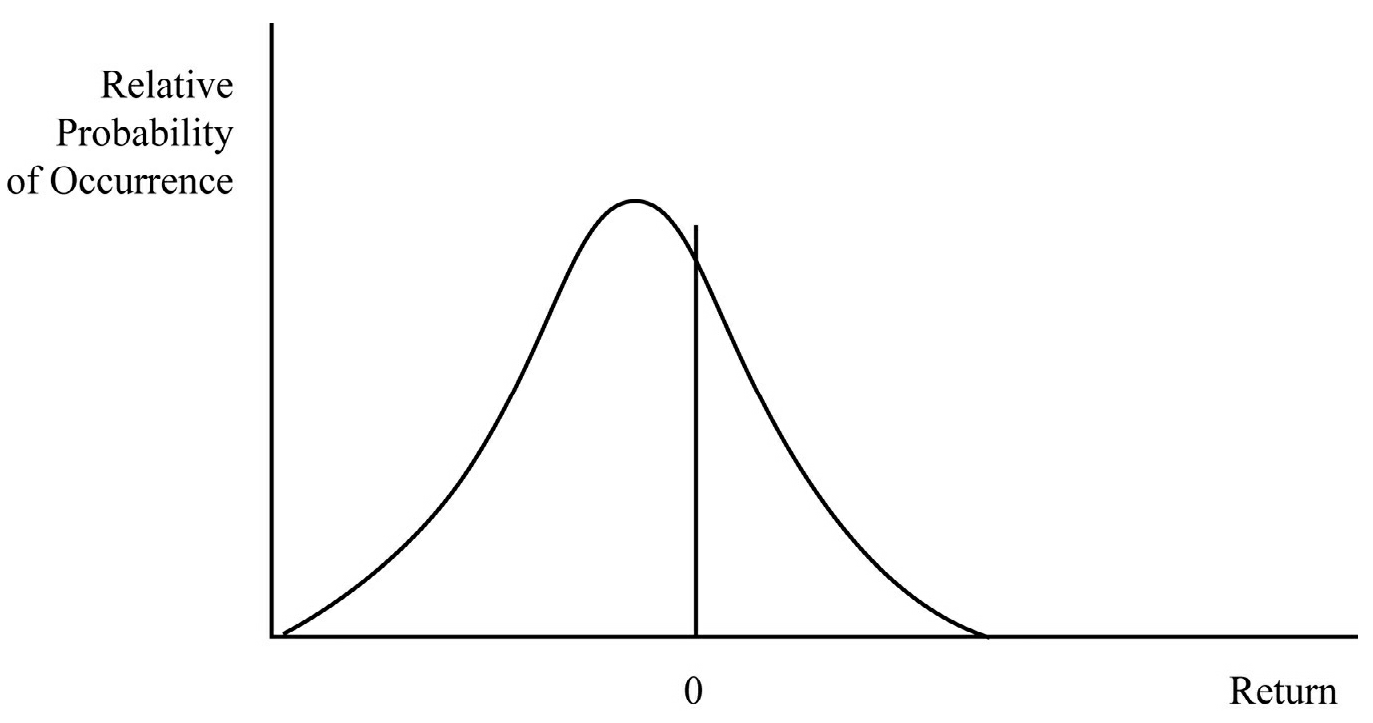
To summarize, cycles and position sizing are connected because cycle dynamics have an impact on the odds of success, which in turn impacts the size and frequency of investments (or at least it should).
These concepts are basic, but powerful. Cycles are not a form of crystal ball — they don't offer certainty or tell you what the future holds. But they can help put the odds in your favor, which is a very big part of successful investing.