
Key Points
Amazon is a great example of how a business can expand beyond its original scope.
Investors had to endure a huge downdraft in the stock, but those who stayed the course were duly rewarded.
Even becoming the undisputed leader of a key industry didn't stop Amazon from broadening its horizons.
- 10 stocks we like better than Amazon ›
It's hard for many people to envision what the world looked like before Amazon (NASDAQ: AMZN). Anyone under the age of 40 takes it largely for granted that getting just about anything they would ever want requires little more than a click of a mouse. And what's particularly interesting is how it came to be that Amazon emerged as the biggest winner of the e-commerce revolution, particularly since its initial aspirations were much more modest.
Amazon has a number of lessons to teach investors about what makes a successful business. That's why I'm taking a look at Amazon as part of my research for potential stocks to include in the Voyager Portfolio. There's no better place to start than at the beginning, so in this first article of a three-part series on Amazon, you'll have a chance to turn back the clock and see how Amazon became the giant it is today.
Will AI create the world's first trillionaire? Our team just released a report on the one little-known company, called an "Indispensable Monopoly" providing the critical technology Nvidia and Intel both need. Continue »
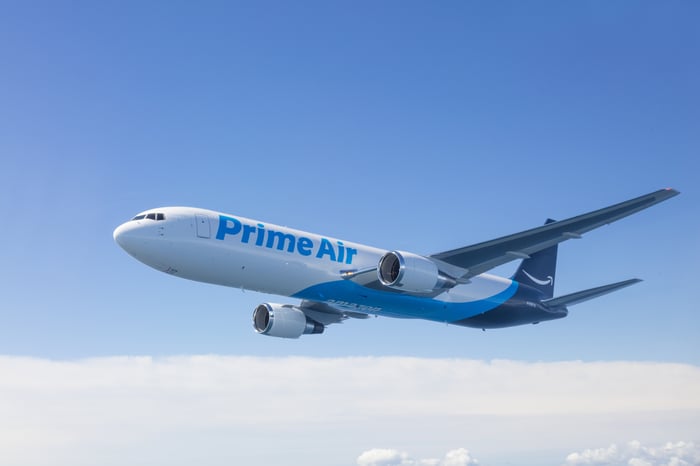
Image source: Amazon.
Writing the book on e-commerce
Amazon founder Jeff Bezos created what is today known as Amazon in 1994. After about a year of preparation, Bezos launched the Amazon.com website, selling books and handling deliveries across the U.S. and abroad from a garage in the Seattle-area city of Bellevue.
What Bezos quickly realized, though, was that there wasn't anything special about books as a good to sell via e-commerce. Indeed, Amazon's interface was largely agnostic to the type of inventory that a seller wanted to offer. That helped Amazon expand its product offerings over time, adding music on physical media in 1998. And in a key move, Amazon opened its platform up to third-party sellers in 2000, dramatically expanding the website's reach and allowing it to make money on the infrastructure it had set up. That would prove to be a repeating theme in other areas of its business.
Surviving the tech bust
The early 2000s weaned out the over-hyped internet sector, infamously crushing silly dot-com concepts that never realistically stood a chance of long-term survival. But Amazon navigated its way through the tough times, and it made strategic plans that it has executed well ever since.
Some key events for Amazon's overall business included:
- The 2005 launch of Amazon Prime, the subscription-based service that initially was limited to unlimited delivery on a two-day schedule. Over time, Amazon used Prime to introduce new features, including the Prime Video streaming service.
- The creation of the Amazon Web Services cloud computing business in 2006, which offered to outside clients the same resources that Amazon had developed internally for its own purposes.
- The 2007 release of the Kindle mobile device, which was the first of many consumer electronic products that Amazon would come out with over the course of its history.
- Amazon's efforts to incorporate some brick-and-mortar elements to its e-commerce business culminated in the acquisition of grocery chain Whole Foods Market in 2017, which offered a novel way for the e-commerce company to handle some of its distribution challenges.
Today, Amazon dominates e-commerce, but its cloud computing business has taken on a life of its own. The e-commerce portion of the company is responsible for the vast majority of Amazon's revenue. However, despite having much lower sales, Amazon Web Services is much more profitable. That has made Amazon as much a technology company as it is a consumer goods company.
The long path to prosperity for Amazon
Perhaps the most interesting part of Amazon's journey is how Amazon stock elicited heated debate among investors. As you'll see in the second article of this three-part series on Amazon, the company went a long time without posting profits, but once it did, its growth potential became quite clear.
Should you buy stock in Amazon right now?
Before you buy stock in Amazon, consider this:
The Motley Fool Stock Advisor analyst team just identified what they believe are the 10 best stocks for investors to buy now… and Amazon wasn’t one of them. The 10 stocks that made the cut could produce monster returns in the coming years.
Consider when Netflix made this list on December 17, 2004... if you invested $1,000 at the time of our recommendation, you’d have $445,995!* Or when Nvidia made this list on April 15, 2005... if you invested $1,000 at the time of our recommendation, you’d have $1,198,823!*
Now, it’s worth noting Stock Advisor’s total average return is 927% — a market-crushing outperformance compared to 194% for the S&P 500. Don't miss the latest top 10 list, available with Stock Advisor, and join an investing community built by individual investors for individual investors.
*Stock Advisor returns as of February 26, 2026.
Dan Caplinger has positions in Amazon. The Motley Fool has positions in and recommends Amazon. The Motley Fool has a disclosure policy.
The views and opinions expressed herein are the views and opinions of the author and do not necessarily reflect those of Nasdaq, Inc.

