
David Iben put it well when he said, 'Volatility is not a risk we care about. What we care about is avoiding the permanent loss of capital.' So it seems the smart money knows that debt - which is usually involved in bankruptcies - is a very important factor, when you assess how risky a company is. We can see that Beasley Broadcast Group, Inc. (NASDAQ:BBGI) does use debt in its business. But the real question is whether this debt is making the company risky.
What Risk Does Debt Bring?
Debt assists a business until the business has trouble paying it off, either with new capital or with free cash flow. Ultimately, if the company can't fulfill its legal obligations to repay debt, shareholders could walk away with nothing. However, a more usual (but still expensive) situation is where a company must dilute shareholders at a cheap share price simply to get debt under control. Of course, the upside of debt is that it often represents cheap capital, especially when it replaces dilution in a company with the ability to reinvest at high rates of return. When we think about a company's use of debt, we first look at cash and debt together.
What Is Beasley Broadcast Group's Debt?
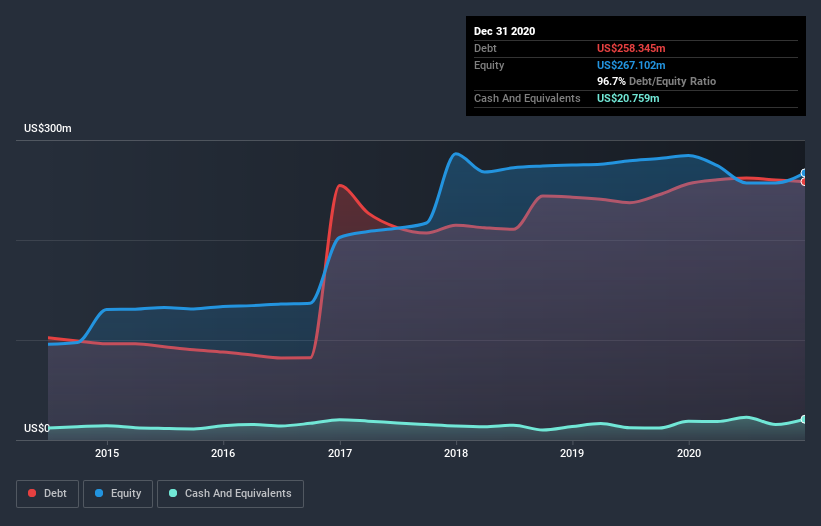
As you can see below, Beasley Broadcast Group had US$258.3m of debt, at December 2020, which is about the same as the year before. You can click the chart for greater detail. However, because it has a cash reserve of US$20.8m, its net debt is less, at about US$237.6m.
How Healthy Is Beasley Broadcast Group's Balance Sheet?
Zooming in on the latest balance sheet data, we can see that Beasley Broadcast Group had liabilities of US$40.5m due within 12 months and liabilities of US$431.1m due beyond that. On the other hand, it had cash of US$20.8m and US$47.4m worth of receivables due within a year. So its liabilities outweigh the sum of its cash and (near-term) receivables by US$403.4m.
This deficit casts a shadow over the US$83.7m company, like a colossus towering over mere mortals. So we definitely think shareholders need to watch this one closely. After all, Beasley Broadcast Group would likely require a major re-capitalisation if it had to pay its creditors today.
We use two main ratios to inform us about debt levels relative to earnings. The first is net debt divided by earnings before interest, tax, depreciation, and amortization (EBITDA), while the second is how many times its earnings before interest and tax (EBIT) covers its interest expense (or its interest cover, for short). This way, we consider both the absolute quantum of the debt, as well as the interest rates paid on it.
Weak interest cover of 0.014 times and a disturbingly high net debt to EBITDA ratio of 21.0 hit our confidence in Beasley Broadcast Group like a one-two punch to the gut. The debt burden here is substantial. Worse, Beasley Broadcast Group's EBIT was down 99% over the last year. If earnings keep going like that over the long term, it has a snowball's chance in hell of paying off that debt. When analysing debt levels, the balance sheet is the obvious place to start. But it is future earnings, more than anything, that will determine Beasley Broadcast Group's ability to maintain a healthy balance sheet going forward. So if you're focused on the future you can check out this free report showing analyst profit forecasts.
Finally, a business needs free cash flow to pay off debt; accounting profits just don't cut it. So we always check how much of that EBIT is translated into free cash flow. Looking at the most recent three years, Beasley Broadcast Group recorded free cash flow of 40% of its EBIT, which is weaker than we'd expect. That's not great, when it comes to paying down debt.
Our View
To be frank both Beasley Broadcast Group's EBIT growth rate and its track record of staying on top of its total liabilities make us rather uncomfortable with its debt levels. But at least its conversion of EBIT to free cash flow is not so bad. Considering all the factors previously mentioned, we think that Beasley Broadcast Group really is carrying too much debt. To our minds, that means the stock is rather high risk, and probably one to avoid; but to each their own (investing) style. There's no doubt that we learn most about debt from the balance sheet. However, not all investment risk resides within the balance sheet - far from it. Case in point: We've spotted 4 warning signs for Beasley Broadcast Group you should be aware of, and 1 of them doesn't sit too well with us.
When all is said and done, sometimes its easier to focus on companies that don't even need debt. Readers can access a list of growth stocks with zero net debt 100% free, right now.
This article by Simply Wall St is general in nature. It does not constitute a recommendation to buy or sell any stock, and does not take account of your objectives, or your financial situation. We aim to bring you long-term focused analysis driven by fundamental data. Note that our analysis may not factor in the latest price-sensitive company announcements or qualitative material. Simply Wall St has no position in any stocks mentioned.
Have feedback on this article? Concerned about the content? Get in touch with us directly. Alternatively, email editorial-team (at) simplywallst.com.
The views and opinions expressed herein are the views and opinions of the author and do not necessarily reflect those of Nasdaq, Inc.

