

Grab Holdings’ (NASDAQ: GRAB) major hurdle this year is investor perception. On the one hand, its empire in Indonesia is threatened by regulatory changes. On the other hand, the on-again, off-again negotiation with GoTo has the market on edge. In the first case, a cap on commissions in its largest market is forcing a business reset, while in the second, Grab comes out a winner either way. The merger would create a ride-hailing behemoth, but it would face significant hurdles, including the threat of divestitures.
The combined company would command approximately 90% of Indonesia’s ride-sharing market, which seems unlikely given Indonesia’s position. It's concerned about the impact on drivers, which would be immense.
Assuming no deal is made, Grab will be left to focus on what it does best: expanding its ecosystem of drivers, cars, merchants, and services. In this scenario, there is value to be unlocked, and valuation metrics suggest the upside potential runs in the high triple-digit range.
The impact of Indonesia’s regulatory change will be felt, but executives say it will be minimal, affecting only a small portion of its overall business, if at all. As it stands, two-wheel transportation, including motorbikes, is the primary target of the regulation, with them accounting for less than 6% of Grab's total volume. The caveat is that capping commissions effectively increases driver pay and may undercut the need for incentives. In this scenario, not only will the impact be minimal, but also be short-lived.
Grab Trades at Rock Bottom Pricing
Grab stock is not cheap today, trading at nearly 40X its current-year earnings forecast, but it is deeply undervalued relative to forward estimates. Reliable forecasts put this stock at only 18X its earnings by 2028, with the potential for that metric to fall into the low single digits by mid-2035. The major barrier is time, but the recent Q1 2026 results indicate the company is on track to meet goals. Assuming Grab grows in line with its outlook and reaches a 22X valuation in 2035, aligning with the broad market average, this stock is worth more than $30 per share relative to forward earnings, representing about 1000% upside from where it trades today.
Analysts' trends reflect optimism for Grab Holdings’ long-term potential. MarketBeat tracks eight who rate it as a consensus Moderate Buy, with an 87.5% Buy-side bias and steady coverage over the past year. The sole outlier is Weiss Ratings, which pegs the stock at Sell.
That aside, price targets are also robust, indicating more than 70% upside at the consensus, including the first post-earnings revision tracked by MarketBeat. It's a $6 target forecasting a 60% upside, which would be sufficient to put this market near long-term highs. Institutional activity is noteworthy.
The group owns more than 55% of the stock, has accumulated quarterly earnings for more than two years, and ramped activity sequentially in 2025 and again in Q1.
The early Q2 institutional activity reveals slowing, but still bullish behavior, underscoring the value presented. The likely outcome is that institutions will continue to acquire this stock, limiting downside risk in 2026.
The chart price action reflects a bottom. Support is evident near $3.50, aligning with lows set in 2025, and echoed by the indicators. MACD momentum and stochastic oscillators indicate the market is in the midst of a shift; the question is whether it is from a downtrend to a range-bound phase or to a rebound.
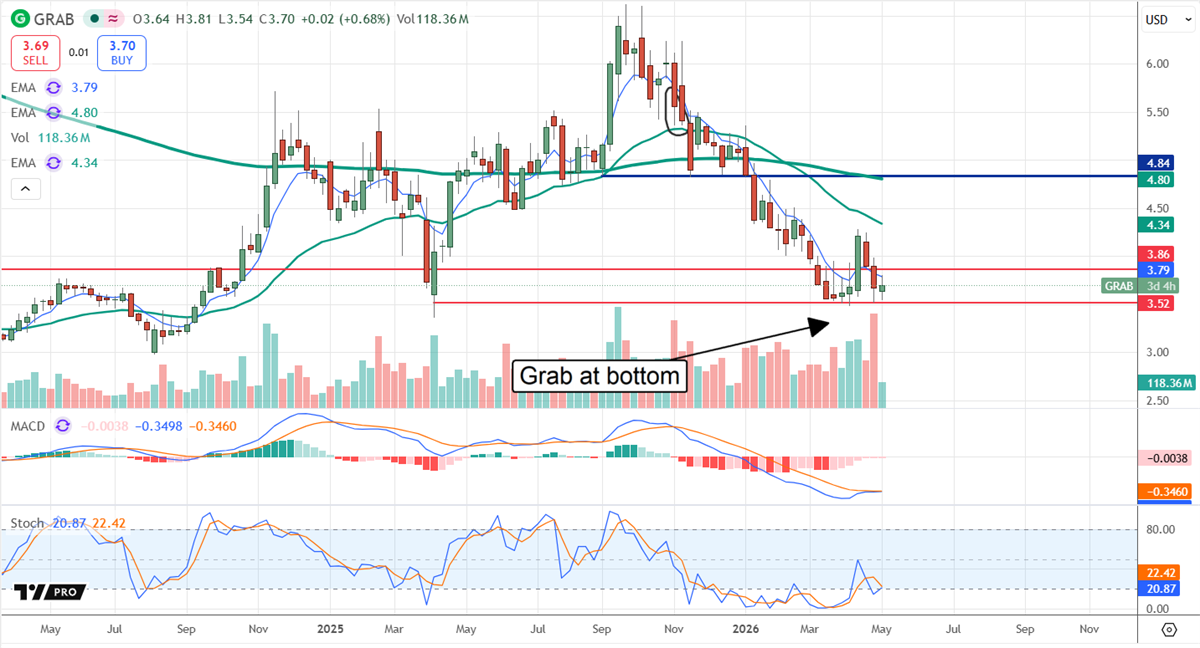
Grab Holdings’ Business Is Booming, Hurdles or Not
Grab Holding’s business is thriving. Q1 revenue grew 24% to $955 million, outpacing the consensus by nearly 400 basis points, driven by strength in on-demand and financial services. Deliveries revenue grew by 22% on a 24% increase in gross merchandise volume, underpinned by a 7% increase in volume per user. Mobility was also strong, up by 19%, as was the Financial segment, which increased by more than 100%.
Margin was a standout detail. Adjusted EBITDA increased by 46%, providing evidence of improving profitability at scale. Improving profitability was also reflected in free cash flow, which grew to $489 million on a trailing 12-month basis, up 68% from the prior quarter, and is expected to remain strong through year’s end. The guidance was left unchanged, with revenue expected to grow in the low-20% range and adjusted EBITDA to increase by approximately 42%.
Evidence of management’s confidence in the outlook lies in the capital return program. The company initiated an accelerated share repurchase earlier this year and is on track to return as much as $400 million to investors by year’s end. Grab’s biggest risk is competition, but it is handling it well.
Where Should You Invest $1,000 Right Now?
Before you make your next trade, you'll want to hear this.
MarketBeat keeps track of Wall Street's top-rated and best performing research analysts and the stocks they recommend to their clients on a daily basis.
Our team has identified the five stocks that top analysts are quietly whispering to their clients to buy now before the broader market catches on... and none of the big name stocks were on the list.
They believe these five stocks are the five best companies for investors to buy now...
The views and opinions expressed herein are the views and opinions of the author and do not necessarily reflect those of Nasdaq, Inc.

