
It's been a disappointing year for Estée Lauder (NYSE: EL) investors, as the cosmetics maker's stock is down almost 50% in 2024. Any time a market leader's stock drops significantly, it's worth investigating to see whether it's a possible bounce-back candidate.
With this in mind, let's analyze what led to Estée Lauder's struggles and assess whether the stock is a buy, hold, or sell for 2025.
Start Your Mornings Smarter! Wake up with Breakfast news in your inbox every market day. Sign Up For Free »
Here's why Estée Lauder stock is down
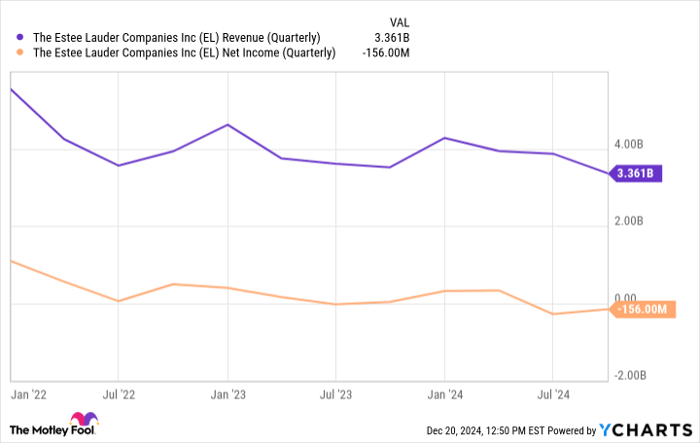
Estée Lauder's blemishes were evident during fiscal Q1 2025, starting with a decline in its top and bottom lines. Specifically, the company reported $3.36 billion in net revenue, representing a 4% year-over-year decline. Management blamed lackluster sales in China and travel retail.
As for the bottom line, the company reported a net loss of $156 million, partly due to settlement agreements of $159 million relating to legal settlements. If you were to exclude that expense, the company still would've generated a 90.3% decline compared to its net income of $31 million for its fiscal Q1 2024. Notably, the settlement represents 70% of pending cases against Estée Lauder related to contaminants in talcum powder, meaning there could very well be future settlements weighing on earnings.
EL Revenue (Quarterly) data by YCharts
Here's where things went from bad to worse. As a result of the disappointing quarter, management withdrew its initial earnings-per-share guidance for fiscal 2025, which it had previously set between $2.52 and $2.76. On top of that, it slashed the quarterly dividend from $0.66 to $0.35, its first cut since the pandemic.
Here's the case for how Estée Lauder turns its stock around
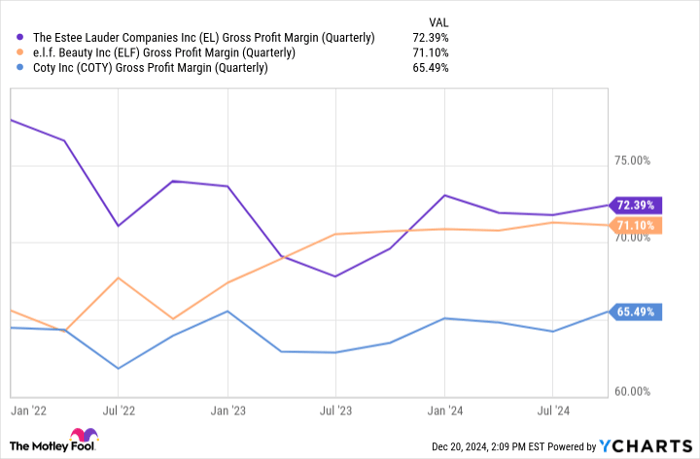
There was some good news in the company's most recent quarterly report. Namely, it expanded its gross margin by 3.1% year over year to 72.4%. The metric, which measures sales minus cost of goods sold, is an important one for consumer goods companies because it demonstrates how profitable their products are -- and Estée Lauder is best in class in the makeup sector. For comparison, Coty and e.l.f. Beauty reported a gross margin of 65.5% and 71.1%, respectively, during their most recently reported quarters.
EL Gross Profit Margin (Quarterly) data by YCharts
Additionally, the dividend cut frees management to allocate capital in other areas. That's because the company's payout ratio, which measures the percentage of profits distributed as dividends, became unsustainable. Even when adjusting for the $159 million settlement agreements and $106 million of restructuring charges, the company only made $0.14 in adjusted earnings per share yet paid out $0.66 per share in dividends during its fiscal Q1 2025, equating to an adjusted payout ratio of 471.4% for the quarter. Now, with the dividend cut, management has the option to do any combination of paying down its rising debt, reducing its growing share count, or funding future growth.
On the topic of management, Estée Lauder is set to welcome a new CEO in the new year, as current President and CEO Fabrizio Freda plans to retire. Stéphane de La Faverie, a member of the executive leadership team since 2014, will step into the role. While it remains to be seen if this leadership shift will drive results, a fresh perspective could be a positive step given the company's current struggles.
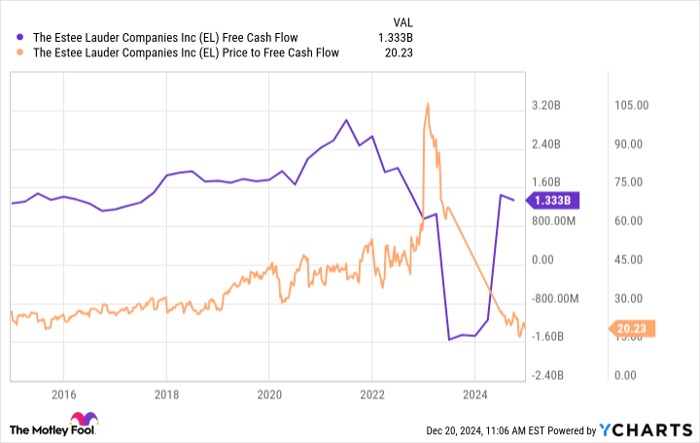
But arguably the best thing going for Estée Lauder's stock is its valuation, with shares currently trading at 20.2 times trailing-12-month free cash flow. That's the lowest valuation in a decade for a company that is a market leader in its industry, suggesting the stock is trading at a significant discount.
Overall, several of Estée Lauder's problems are short term, like its talcum settlement and restructuring costs. If it can grow revenue again, its profitability will likely follow, especially given its high gross margin and new capital allocation flexibility.
EL Free Cash Flow data by YCharts
Here's the bottom line on Estée Lauder's stock
An investment thesis for a stock, especially for a company as established as Estée Lauder, should never start with the word "if." A company struggling to grow revenue organically is often forced to grow by acquisition, which can be costly and without a guarantee of success.
Notably, Estée Lauder's most recent acquisition in 2023 of the Tom Ford brand for a total enterprise value of $2.8 billion is already facing challenges. The brand reported net sales in fragrance declining by "high single digits" in fiscal Q1 2025 compared to fiscal Q1 2024.
And while the dividend cut may alleviate some balance sheet concerns, it's historically a sign of a bad stock. Recent research from Hartford Funds backs this up, showing that companies cutting or eliminating dividends typically underperform those with consistent growth.
For Estée Lauder investors, selling now appears to be the most prudent move to take advantage of tax-loss harvesting at year-end as a way to help offset some losses.
Should you invest $1,000 in Estée Lauder Companies right now?
Before you buy stock in Estée Lauder Companies, consider this:
The Motley Fool Stock Advisor analyst team just identified what they believe are the 10 best stocks for investors to buy now… and Estée Lauder Companies wasn’t one of them. The 10 stocks that made the cut could produce monster returns in the coming years.
Consider when Nvidia made this list on April 15, 2005... if you invested $1,000 at the time of our recommendation, you’d have $825,513!*
Stock Advisor provides investors with an easy-to-follow blueprint for success, including guidance on building a portfolio, regular updates from analysts, and two new stock picks each month. The Stock Advisor service has more than quadrupled the return of S&P 500 since 2002*.
*Stock Advisor returns as of December 16, 2024
Collin Brantmeyer has no position in any of the stocks mentioned. The Motley Fool has positions in and recommends e.l.f. Beauty. The Motley Fool has a disclosure policy.
The views and opinions expressed herein are the views and opinions of the author and do not necessarily reflect those of Nasdaq, Inc.

