

Equity Beat: Sloppy Conditions
May 2025
The 151st running of the Kentucky Derby took place on the first Saturday of May, at the famed Churchill Downs Racetrack in Louisville. The event – one of the longest continually held sporting events in America and considered one of the nation’s most prestigious horse races – carries the long-standing traditions of wearing bright and elegant attire, the serving of sweet and syrupy Mint Juleps, and the devouring of gooey and chocolatey Derby Pies. The 1.25 mile, twenty-horse derby has been labeled “the fastest two minutes in sport”, although the winning Thoroughbred this year, Sovereignty crossed the finish line slightly beyond the two-minute mark. A rain-soaked day transformed the fast, dirt track into a surface perhaps best described as “peanut butter”.
The official term for the track’s condition is “sloppy” – saturated from rain, with standing water visible. The track and field equivalent would be attempting to run a lap on deep, soft sand. In the case of the derby, a sloppy track changes the complexion of the race; stamina/endurance likely plays a more significant role in determining success, as does the ability to cope (for both jockey and horse) with the adversity of slipping and having mud sprayed everywhere.
Following a two-year stretch where the S&P 500® Index’s cumulative total return was nearly 60%, the US equity market has encountered what could easily be described as “sloppy” conditions in 2025. With a furious rally since entering bear market territory in early April, the S&P 500 Index is slightly positive for the year as of May 16. Yet, capital allocators have debated an “appropriate” exposure level to US equities due to uncertainty surrounding policy and the potential economic impact over both the near and medium-term. The US credit downgrade by Moody’s on May 16 further complicates the backdrop.
While March-quarter earnings season has been reasonably well received by investors as a function of the resilient, affluent US consumer and a seemingly manageable net tariff impact on earnings per share (EPS), most companies are challenged to provide a precise outlook for the coming quarters. Later on, we’ll provide quotes directly from the “horses’ mouths” regarding broad themes from quarterly earnings calls. Yet investors and corporations alike are in “wait and see” mode – whether it be related to trade negotiations or the impact of higher prices on consumer demand. For these reasons it’s likely wise to take consensus earnings estimates for the remainder of this year with a grain of salt.
Regardless of the track conditions the goal for active equity managers remains consistent – generate alpha over multi-year periods and through economic cycles. For the past few years, it’s been challenging for large-cap core and growth managers to keep up with the pace of the benchmark (S&P 500 Index and Russell 1000® Growth Index, respectively). A small group of companies generated the majority of market returns, and index concentration reached levels we simply had not experienced previously. During 2023 and 2024, only a fraction of S&P 500 Index constituents outperformed the Index. As such, most active equity managers in these style boxes underperformed on a relative basis. However, thus far in 2025 track conditions have changed, providing the opportunity for many active managers to “launch a rally”. As of May 16, 55% of constituents in the S&P 500 Index have outperformed year-to-date – a considerably higher level than for most of the past decade. In addition, for the first time in at least ten years, the majority of large-cap growth managers are outperforming their respective benchmark thus far in 2025, per public Morningstar data.

Note: 2025 YTD data as of May 16.
Source: Morningstar, Bloomberg and FactSet.
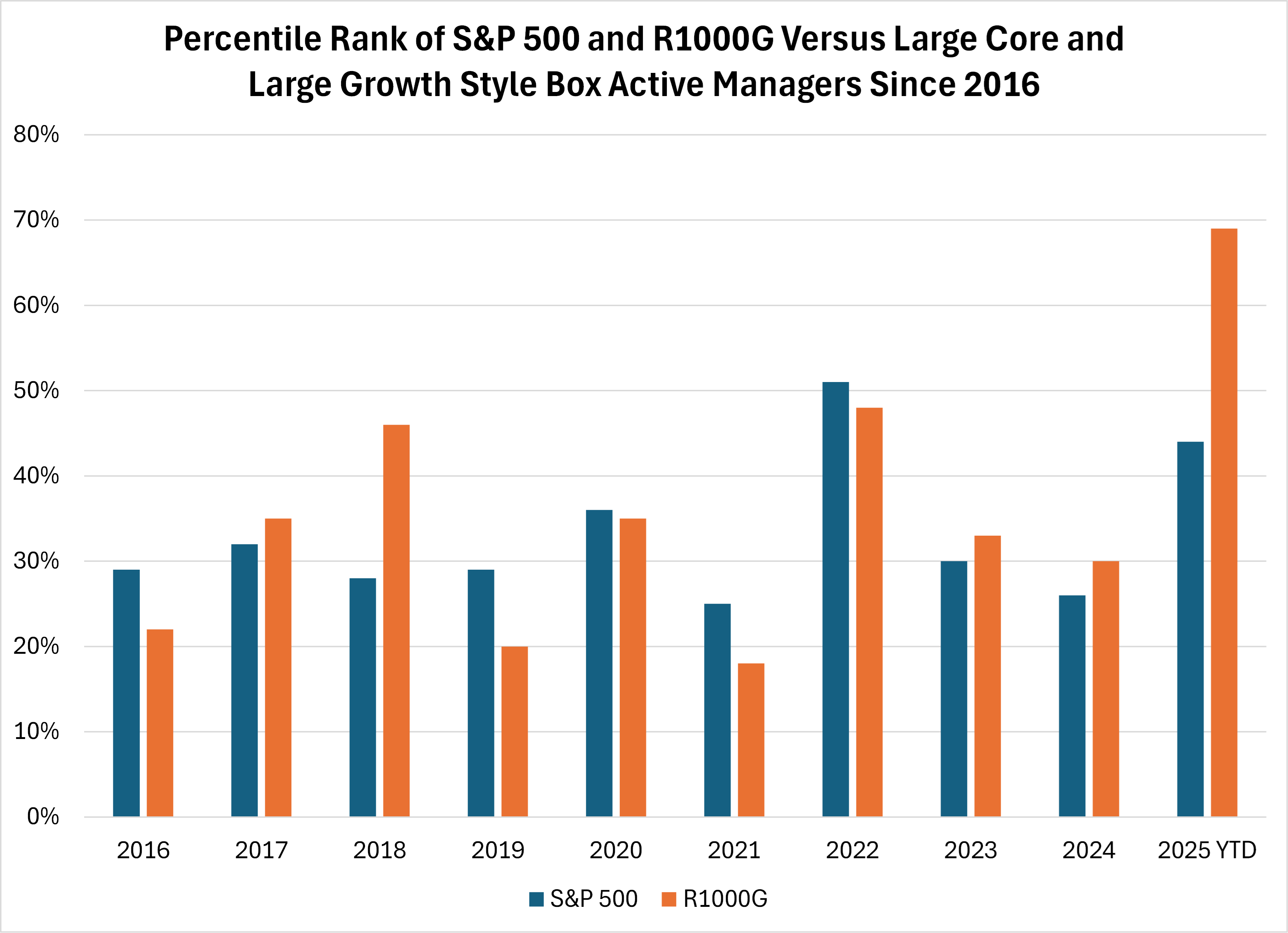
Note: Analysis uses “IWF” and “SPY” tickers for Russell 1000 Growth and S&P 500 performance and percentile ranking. The percentage is equivalent to the percentage of active managers beating their benchmark. Data as of May 16, 2025.
Source: Morningstar.
A combination of factors has led to particularly sloppy conditions for many of the Magnificent Seven1 this year. As of May 16, only Microsoft (MSFT) and Meta Platforms (META) have outperformed the S&P 500 Index. The most menacing Thoroughbreds of recent years are being treated like also-rans driven by their geographic exposures as well as the outcome of, and concerns around, government anti-trust hearings.
It remains to be seen whether sloppy conditions continue to keep the broader market, along with the Magnificent Seven, stuck in the mud over the near and medium-term. Regardless, our portfolio managers will remain consistent in the application of their investment philosophies – with a focus on endurance and a healthy dose of humility for what cannot be predicted.
Earnings Takeaways
With hundreds of companies having now reported March-quarter results, there are a handful of common themes that are worth sharing directly through earnings call quotes. Overall, the high-end US consumer remains resilient while many companies believe they can effectively tackle the impact of tariffs through a combination of supply chain adjustments, cost reductions and price increases/surcharges. The primary question to these near-term conclusions is if cost reductions include layoffs, while price increases and surcharges eventually flow to the consumer, how much longer can the US economy remain resilient? Many companies and their customers are taking a “wait and see” approach, which is completely understandable. With retail-company earnings season quickly approaching the starting gate, we won’t need to wait too long for the next update.
March Quarter Earnings Season Themes
Theme #1: “Wait and See” Company/Customer Approach

Theme #2: Travel and Entertainment Spend Weakness

Theme #3: High-End Consumer Still Spending

Theme #4: Tariff Costs Are Seemingly Manageable

Theme #5: Price Increases/Surcharges to Help Offset Tariff Costs

Note: Comments are from company March quarter earnings call transcripts.
Source: FactSet.
Thanks for reading, and remember to never skip a Beat - Eric
Disclosures:
1Magnificent Seven stocks: Alphabet (GOOG), Amazon (AMZN), Apple (AAPL), Meta (META), Microsoft (MSFT), NVIDIA (NVDA), and Tesla (TSLA).
Source: FactSet®. FactSet is a registered trademark of FactSet Research Systems, Inc.
The views expressed are those of the author and Brown Advisory as of the date referenced and are subject to change at any time based on market or other conditions. These views are not intended to be and should not be relied upon as investment advice and are not intended to be a forecast of future events or a guarantee of future results. Past performance is not a guarantee of future performance and you may not get back the amount invested. The information provided in this material is not intended to be and should not be considered to be a recommendation or suggestion to engage in or refrain from a particular course of action or to make or hold a particular investment or pursue a particular investment strategy, including whether or not to buy, sell, or hold any of the securities mentioned. It should not be assumed that investments in such securities have been or will be profitable. To the extent specific securities are mentioned, they have been selected by the author on an objective basis to illustrate views expressed in the commentary and do not represent all of the securities purchased, sold or recommended for advisory clients. The information contained herein has been prepared from sources believed reliable but is not guaranteed by us as to its timeliness or accuracy, and is not a complete summary or statement of all available data. This piece is intended solely for our clients and prospective clients, is for informational purposes only, and is not individually tailored for or directed to any particular client or prospective client.
The S&P 500® Index represents the large-cap segment of the U.S. equity markets and consists of approximately 500 leading companies in leading industries of the U.S. economy. Criteria evaluated include market capitalization, financial viability, liquidity, public float, sector representation and corporate structure. An index constituent must also be considered a U.S. company. These trademarks have been licensed to S&P Dow Jones Indices LLC. S&P, Dow Jones Indices LLC, Dow Jones, S&P and their respective affiliates (collectively "S&P Dow Jones Indices") do not sponsor, endorse, sell, or promote any investment fund or other investment vehicle that is offered by third parties and that seeks to provide an investment return based on the performance of any index. This document does not constitute an offer of services in jurisdictions where S&P Dow Jones Indices does not have the necessary licenses. S&P Dow Jones Indices receives compensation in connection with licensing its indices to third parties.
The Russell 1000® Growth Index measures the performance of the large-cap growth segment of the U.S. equity universe. It includes those Russell 1000® Index companies with higher price-to-book ratios and higher forecasted growth values. The Russell 1000® Growth Index is constructed to provide a comprehensive and unbiased barometer for the large-cap growth segment. The Index is completely reconstituted annually to ensure that new and growing equities are included and that the represented companies continue to reflect growth characteristics. Russell® and other service marks and trademarks related to the Russell indexes are trademarks of the London Stock Exchange Group Companies. An investor cannot invest directly into an index.
An investor cannot invest directly into an index.
Earnings per share (EPS) is calculated as a company's profit divided by the outstanding shares of its common stock.

Latest articles

This data feed is not available at this time.
Data is currently not available