

Please find Running Oak's most recent performance and letter below. This letter and those of the past can be found on Nasdaq.
Why Invest in Efficient Growth:
- Top 5 percentile: Running Oak’s Efficient Growth separate account has performed in the top 5% of all Mid Cap Core funds - despite being historically out of favor - in Morningstar's database over the last 10 years, net of fees.1
- Opportune: A little known - yet very large - hole exists in the typical equity portfolio, precisely where the most attractive risk/reward asymmetry currently lies. Efficient Growth fills that hole - and opportunity - like few portfolios do.
- 5 Stars: Efficient Growth has a 5-Star Morningstar rating.
- Since inception, Efficient Growth has provided 25% more return than the S&P 500 Equal Weight Index and 3% more return than the S&P 500 Total Return Index, given the same level of downside risk, gross of fees. (Ulcer Performance Index)*

Differentiated Approach and Construction
- Mid Cap stocks are at their cheapest in 25 years relative to Large. Efficient Growth provides significant Mid Cap exposure.
- Efficient Growth is built upon 3 longstanding, common sense principles: maximize earnings growth, strictly avoid inflated valuations, protect to the downside.
- Running Oak utilizes a highly disciplined, rules-based process, resulting in a portfolio that is reliable, repeatable, and unemotional.
How to Invest
- Efficient Growth is currently available as an SMA and ETF. (ETF specifics and SMA historical performance can't be shared in the same letter - sorry, it's annoying, I know. Please inquire for the ticker or more information.)
- In just 23 months, The ETF Which Shall Not Be Named has grown over 18,000% since launch - from 2 to 361mm.
"You need a job. A J-O-B, job!" - Mr. Jones, Friday
An advisor recently told me “A strategy needs to just do the job it was assigned to do.” I love that. Efficient Growth stands out in a number of ways, top 5% performance and less than half of the downside risk of the S&P 500 over the last 35 years, to name two.* It also fills a specific role in a larger portfolio that very few do.
"I ain’t the one who got fired on his day off!" - Smokey, Friday
Job description: The first step is defining the role. Efficient Growth is constructed to maximize earnings growth within the constraints of avoiding overvaluation, overleverage, unprofitability, and other qualities that portend greater downside. It’s Growth-y but disciplined, resulting in a Core portfolio. It sits in the dead center of a diversified portfolio, a role many completely overlook. Efficient Growth is an excellent foundation to build upon – going back to that whole “top 5% performance and less than half of the downside risk of the S&P 500” thing.
Building a diversified portfolio is much like building a company. A successful company requires people with differing skillsets, performing numerous critical tasks. If built properly, a company can handle anything the competition or economy throws its way. A diversified portfolio is the same. Ideally, a portfolio consists of multiple, best-in-class, complementary strategies. If each strategy does the job assigned, the portfolio will mitigate risk – weathering inevitable challenges better than a strategy would on its own – and provide higher compound returns OVER THE LONG RUN. (Single strategies are prone to short-lived days in the sun. Note: the only strategy I own is ours.)
Diversification – The Free Lunch
"Every time I come in the kitchen, you in the kitchen... in the... refrigerator. Eatin' up all the food. All the chicken... all the pig’s feet... all the collard greens... all the hog maws!" – Mr. Jones, Friday
Harry Markowitz, the father of Modern Portfolio Theory, demonstrated that it’s possible to reduce risk without sacrificing return through effective diversification. Today, diversification is, unfortunately, a dirty word, just as Warren Buffett - whom many would argue is the greatest investor to ever live - is ridiculed for sitting on too much cash. When the market goes straight up for 15 years and Momentum hits the 99.8% in history due to stimulus like nothing ever imagined, math, Nobel Prize winners, and decades of excellence are mocked. Regardless, once upon a time, diversification was considered a requisite.
The "free lunch" of effective diversification is only achieved if each strategy does its job, which is yet another way in which Efficient Growth stands out.
Rules-Based – Disciplined, Repeatable, and Reliable
Running Oak’s investment process is rules-based. The rules guiding Efficient Growth promote discipline and objectivity, eliminating emotion from the investment management process. The application of those rules results in a portfolio that is dependable. We do the same thing over and over and have done so for 4 decades. Our clients know what we’re doing at all times, meaning Efficient Growth can be relied upon – just like a great employee – to do the job we were hired to do.
It’s essential that strategies DO THEIR JOB within a portfolio. In 2023, following the challenging year of 2022, a CIO of a significant, sophisticated firm shared that she and her team were shocked by how poor their performance was. As they took a critical look at their strategies and managers, they realized that many were hired to perform a specific role but didn’t do their job.
"Man, I thought she was Janet Jackson. She came out the house lookin' more like Freddie Jackson!"— Smokey, Friday
As Big Tech and Large Cap Growth got frothier and frothier, many managers – somewhat understandably – threw in the towel and joined the herd. What was built to be a diversified portfolio ended up being heavily concentrated in the most overvalued, most overcrowded companies. Strategies didn’t do their job, and clients paid the price.
Running Oak’s rules-based process is designed to ensure we stay in our lane. Efficient Growth does the job it’s hired to do.
"Y'all ain't never got two things that match. Either y'all got Kool-aid, no sugar. Peanut butter, no jelly. Ham, no burger." - Smokey
It’s an incredibly uncertain time. Most own little more than the Magnificent 7 and S&P 500 (which is largely the Magnificent 7). Whether intentionally or not, concentration implies certainty - certainty that Big Tech will continue its historic run and maintain historically high valuations and certainty that there is a 0% chance of a recession.
Personally, I’m uncertain. The risks seem to rise by the day, while stocks do the same. It’s rare risk and equity prices are highly correlated. The free lunch of diversification pays off in uncertain times. Here are a few reasons to reconsider the jobs within your portfolio:
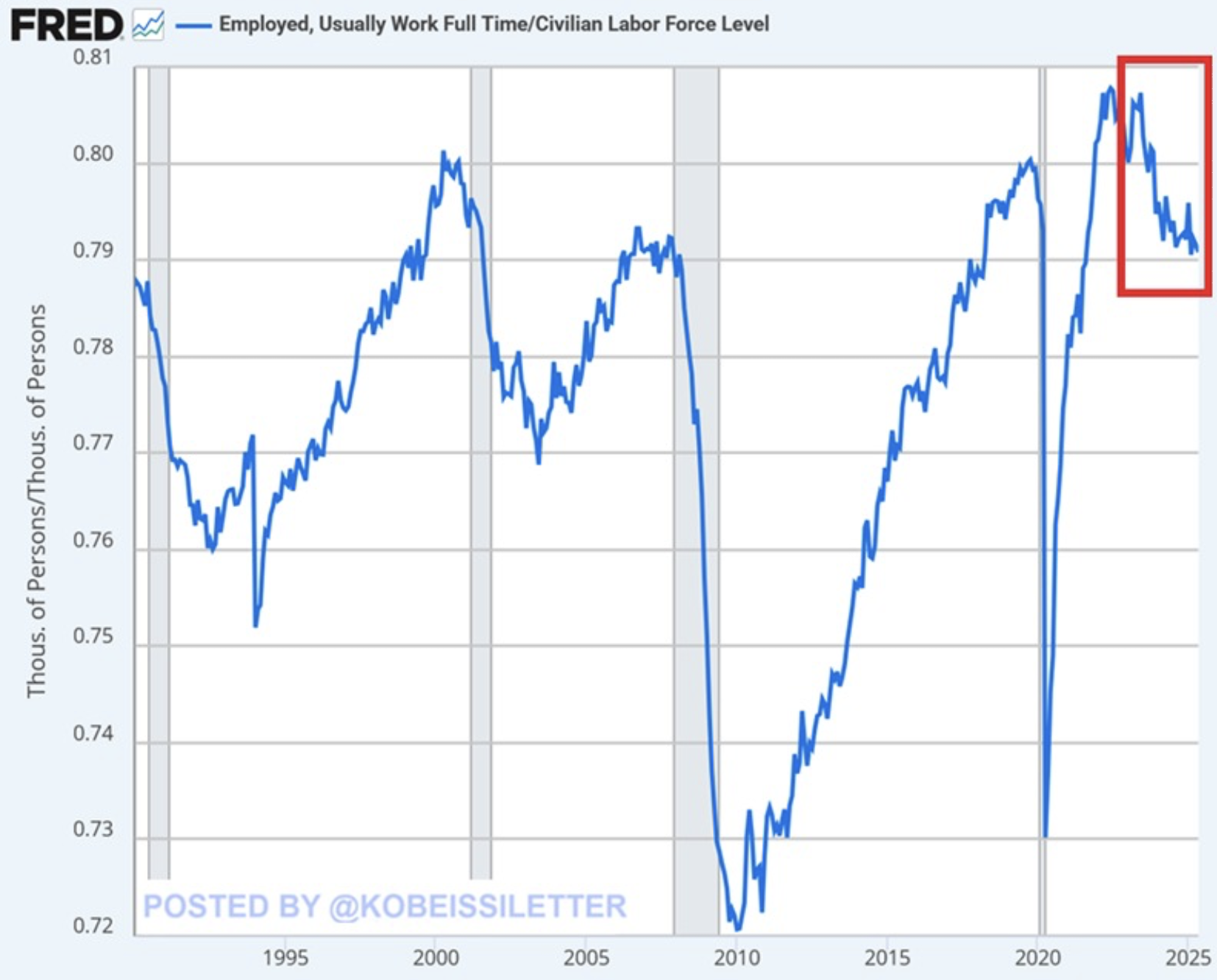
The labor market is weakening. Labor is synonymous with jobs. People make money at jobs. If fewer people have jobs, more people have less money. Less money being spent is recessionary. The stock market, on average, declines 35% in a recession. Overvalued, overcrowded investments decline more than average. The Magnificent 7 and passive portfolios are arguably the most overcrowded trades in history. Lunch time.

Equity represents ownership in a company. The economy is comprised of companies. The economy and the stock market are related… usually. The stock market is more dislocated from the US economy than any time in history, other than 2021.

Investors own a historically high percentage of that which can go to $0 first, equities.

The US can’t pay its bills. I’m sure it’ll be fine… until it isn’t.

"Ohhh! My neck! My back! My neck and my back! I want $150,000... but we can settle out of court right now for twenty bucks." – Ezell, Friday
More money is pouring into penny stocks, the most risky of equities, than ANY TIME IN HISTORY. On Thursday, June 19th, penny stocks accounted for over 47% of total market volume.

The least sophisticated of investors are buying… A LOT, while the most sophisticated of investors are selling.
Invest Where Others Aren't (MARGE - Upper Mid/Lower Large Cap)
- Investing where everyone else is investing means higher prices, higher valuations, lower implied returns, higher implied downside.
- Investing where others aren't means lower prices, lower valuations, higher implied returns, lower implied downside and a margin of error.
- Investing where others aren't also provides valuable diversification.
- If the market goes up, others are likely to follow, propelling prices.
- If the market goes down, others can't sell what they don't own, meaning less selling and downside pressure.
It's win/win.
Running Oak's goal is to maximize the exponential growth of clients' portfolios, while subjecting them to far less risk of loss. In other words, we aim to help your clients realize their dreams and avoid their nightmares.
If you appreciate critical thinking, math, common sense, and occasional sarcasm, we would love to speak with you. Please feel free to set up a time here: Schedule a call.
"Bye, Felicia." - Craig, Friday
Seth L. Cogswell
Founder and Managing Partner
Edina, MN 55424
P +1 919.656.3712
For additional data and context regarding the claims made within this letter, please refer to the Disclosures and Additional Data document located here.
Investment Advisory Services are offered through Running Oak Capital, a registered investment adviser.
The opinions voiced in this material are those of Running Oak Capital’s, do not constitute investment advice, and are not intended as recommendations for any individual. To determine which investments and strategies may be appropriate for you, consult with us at Running Oak Capital or another trusted investment adviser.
*Past performance is no guarantee of future results. Performance expectations are no guarantee of future results; they reflect educated guesses that may or may not come to fruition. All indices are unmanaged and may not be invested into directly.
*Statements regarding the large gap in the middle of the typical equity allocation reflect the opinion of Running Oak Capital This is based on informal feedback and experience from interactions with investors and other financial professionals. Further, statements on where the most attractive risk/reward asymmetry lie, although based on observable data, reflect the opinion of Running Oak Capital.
*Statement regarding Mid Cap stocks outperforming Large is reflective of historical performance of the Russel Midcap Index vs Russell 1000 Index.
*Statement regarding “less than half of the downside risk of the S&P 500” refers to the extended history of the investment strategy, which includes unaudited performance predating the inception of Running Oak Capital in 2013, which was documented and generated on a real time (not back-tested) basis. Such results are from accounts managed at other entities prior to the formation of Running Oak Capital. Downside risk refers to the average downside capture ratio over the time period.
*Source of Mid Cap undervaluation & Large Cap overvaluation: Bloomberg
This email transmission and any documents, files or previous email messages attached to it may contain information that is confidential or legally privileged. If you are not the intended recipient, you are hereby notified that you must not read this transmission and that any disclosure, copying, printing, distribution, or any action or omission of this transmission is strictly prohibited. If you have received this transmission in error, please immediately notify the sender by telephone at (919) 656-3712 or return and delete the original transmission and its attachments without reading or saving in any manner.

Latest articles

This data feed is not available at this time.
Data is currently not available